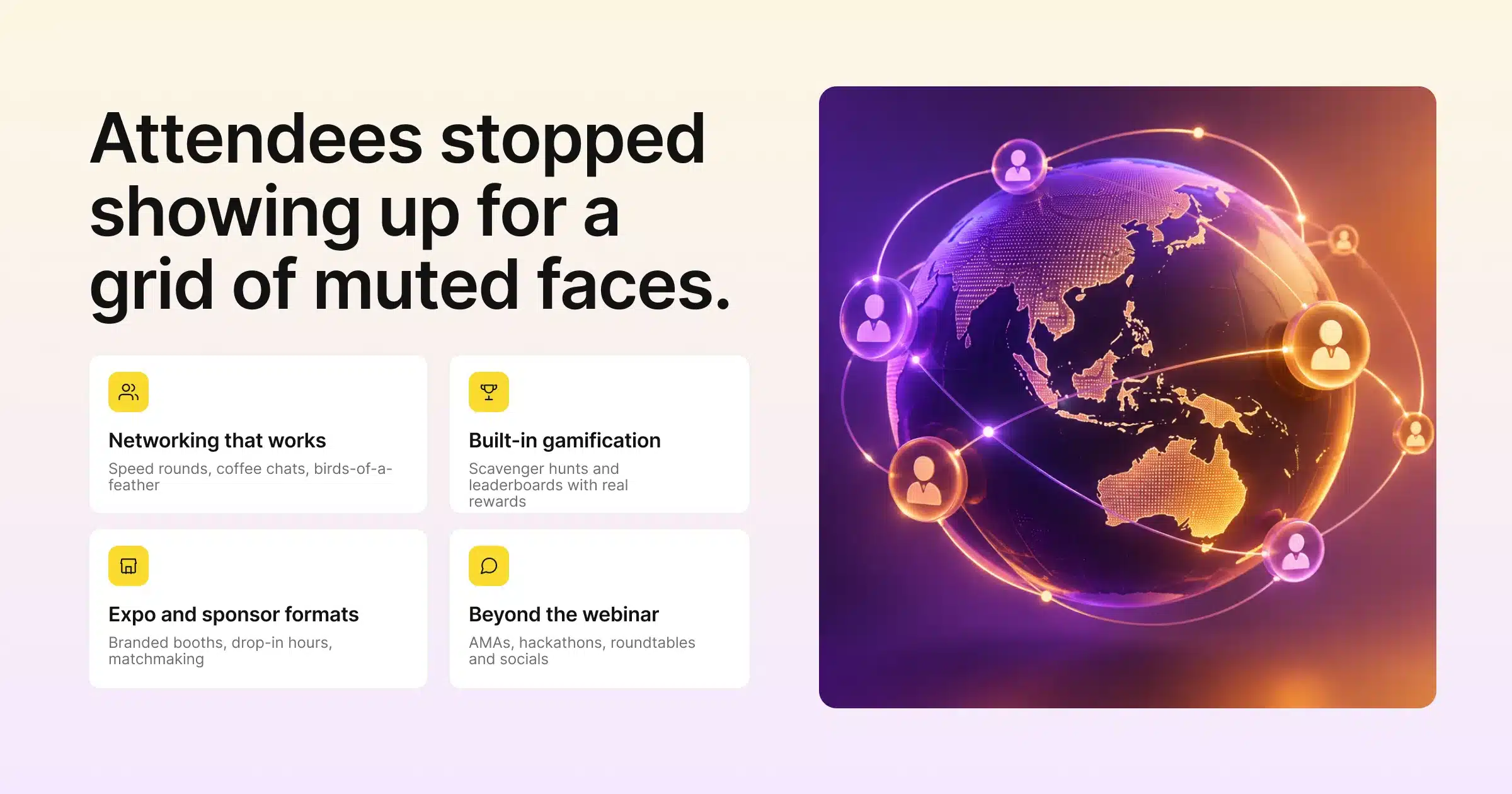
Is your idea of a virtual event still a single speaker talking to a grid of muted faces for an hour? You’re not alone. That’s also exactly the format most attendees have quietly stopped showing up for. The platforms and the formats have both moved on a long way from the early webinar era. There’s now a genuinely wide menu of formats built specifically to keep people present, instead of leaving a tab open in the background.
This isn’t a list of speculative, someday ideas. Every format here is something organizers and platforms already run, credited to where that’s documented. Alongside each one sits an honest look at which platforms actually support the technology it needs. This guide covers networking formats that go beyond a chat sidebar, and ways to turn passive viewers into active participants. It also covers expo and sponsor formats, content formats beyond the standard webinar, and a few purely social formats worth trying. Finally, it compares Gevme with vFairs, Swapcard, EventsAIR, BigMarker, Zoom, ON24 and Webex on the technology behind all of it.
Key Takeaways
- Networking remains the hardest part of virtual events to get right. Formats built around small groups, such as speed networking, coffee chats and birds-of-a-feather tables, tend to outperform an open chat room most attendees never use.
- Gamification is one of the most consistently recommended tools across event platforms, from scavenger hunts to leaderboards. It works best tied to a real reward or recognition rather than points for their own sake.
- Gevme’s virtual venue supports more than 50 event themes and RTMP streaming, alongside business matchmaking on its higher tiers. That makes it a genuine option for both a branded expo-style format and a more intimate networking-focused one.
- vFairs remains the platform most associated with fully immersive 3D environments. It’s useful if a format specifically calls for attendees navigating a virtual space rather than clicking between static pages.
- EventsAIR’s AIRCast Studio is built specifically for broadcast-quality hybrid production. That’s worth knowing if your format depends on a genuinely professional live-switching setup rather than a single static camera feed.
- Not every format needs new technology. World Café-style rotating discussions, AMAs and roundtables work on almost any platform with basic breakout and video capability. So the format idea should come before the platform search, not after.
- If your organization already uses Zoom, ON24 or Webex for other meetings, check what their event-specific tiers actually include before assuming your everyday plan covers expo booths or advanced networking formats. Those are often separate products from the standard meeting tool.
Formats for Better Networking
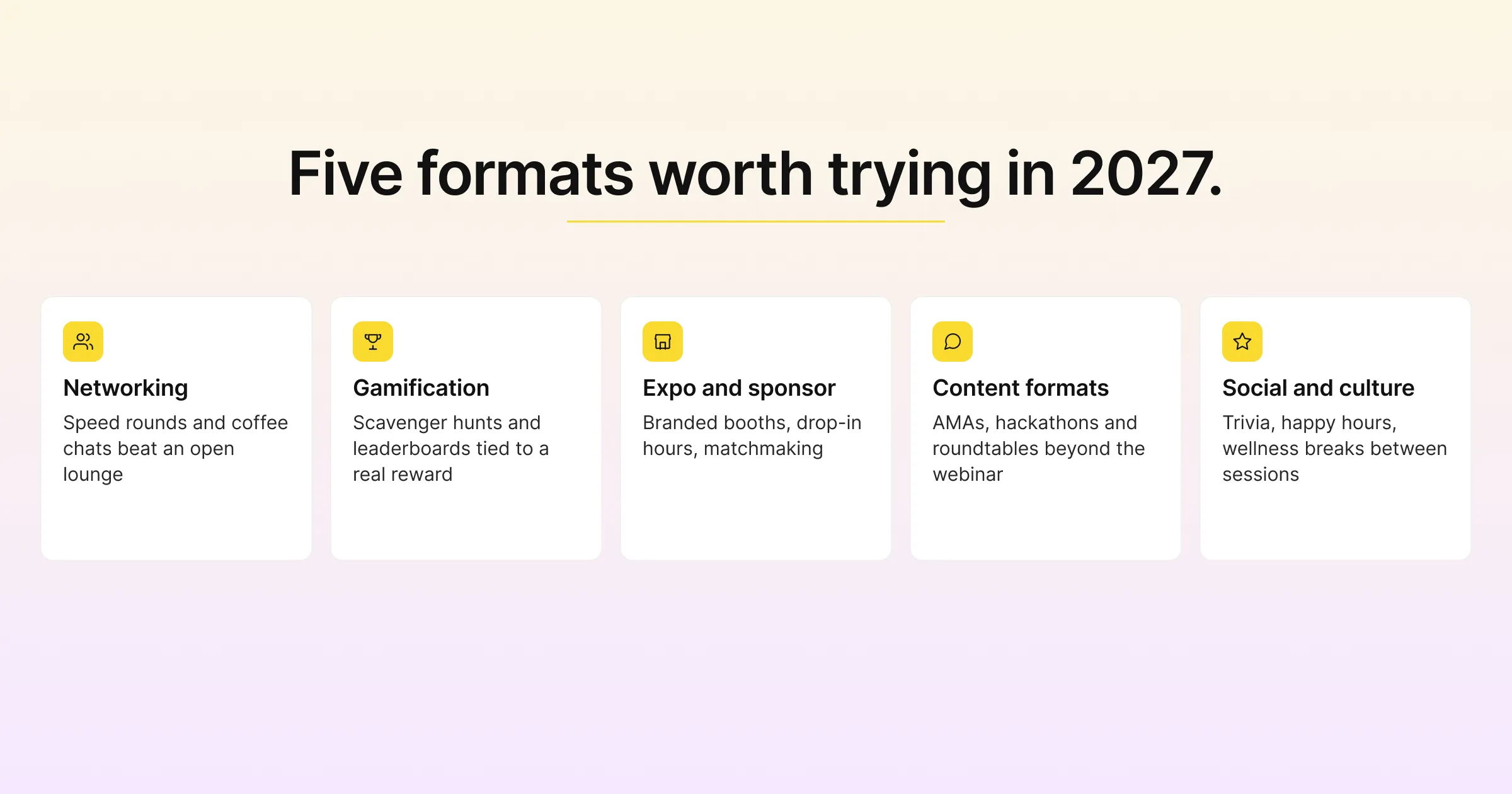
Networking is consistently the part of virtual events attendees say falls flat. It’s worth leading with, because a stronger content format won’t fix a weak networking experience on its own. Per Bizzabo’s own blog on virtual networking, checked in late August 2026, two formats outperform an open networking lounge. Lightning round networking uses fast-paced video meetups built around icebreaker prompts. Coffee chats are one-on-one video calls with conversation starters built in. Both beat a lounge that relies on attendees to strike up conversation themselves.
Bizzabo also highlights a virtual scavenger hunt format specifically for networking. Attendees have to connect with people fitting certain professional descriptions to complete a list. It pairs this with automated “missed connections” follow-up emails after the event, to recover conversations that didn’t happen live.
Per Skift Meetings’ roundup of virtual event ideas, checked in late August 2026, two more formats give attendees a lower-pressure way to connect than a scheduled one-on-one. Birds-of-a-feather breakout sessions are informal small groups organized around a shared interest or role rather than a formal agenda. Always-open audio rooms allow spontaneous conversation. EventsAIR’s own blog on interactive event ideas, checked in late August 2026, describes a related format it calls World Café. Small groups rotate between topic tables every ten to fifteen minutes, giving attendees several short conversations rather than one long one.
Formats That Turn Passive Viewers Into Active Participants
Gamification shows up across nearly every source checked for this guide, and for good reason. Per Cvent’s own roundup of virtual event ideas, checked in late August 2026, gamification challenges, social media scavenger hunts and industry-term bingo boards all give attendees a reason to stay engaged beyond just watching. That matters particularly across a multi-day event, where attention naturally drops after the first session or two. EventsAIR adds leaderboards and prize-based rewards tied to session attendance and virtual booth visits, as a way to make gamification measurable rather than purely decorative.
Live polling and moderated Q&A both convert a one-way presentation into something closer to a conversation. Moderated Q&A means a moderator filters and queues audience questions rather than taking them unfiltered. Cvent’s roundup names both directly as reliable options. EventsAIR describes a more unusual format worth considering for a workshop-style session: a human spectrogram. Attendees physically or virtually position themselves along a spectrum to visualize agreement or disagreement on a topic, turning an abstract opinion into something visible to the whole group.
Expo Halls, Career Fairs and Sponsor-Focused Formats
If sponsor and exhibitor revenue matters to your event, the format needs to give exhibitors something better than a static logo on a slide. Per Cvent’s own roundup, checked in late August 2026, two options give exhibitors a real chance at attendee attention. Virtual trade shows and exhibitions offer interactive booth environments. Scheduled drop-in hours confirm a booth rep will be available at set times. Both beat a passive listing.
Zoom’s own Events Expo feature, per Zoom’s blog, checked in late August 2026, supports more than 100 configurable sponsor and non-sponsor booths. Booth-rep chat and direct networking work across the expo floor. BigMarker’s own site describes a similar customizable Expo Hall, alongside AI-driven attendee matching for its networking center.
Virtual career fairs are a specific, well-developed version of this format. Per vFairs’ own guide to virtual career fairs, checked in late August 2026, the format typically includes a branded lobby, an exhibit hall of employer booths, and a centralized job board. Chat, audio or video connections link candidates and recruiters. Gamification like scavenger hunts encourages candidates to visit more booths than they otherwise would.
Content Formats Beyond the Standard Webinar
AMAs are Ask Me Anything sessions built around audience-submitted questions rather than a prepared talk. Both PheedLoop and EventsAIR name them as a reliable way to get more candid, less rehearsed content from a speaker than a standard keynote produces. Per PheedLoop’s own blog, checked in late August 2026, roundtable discussions and virtual facility or lab tours both work well as a change of pace from a straight presentation. That’s particularly true for content that benefits from showing rather than telling.
Virtual hackathons are worth considering for a technical or product-focused audience specifically. Per AngelHack’s own guide, checked in late August 2026, a professional virtual hackathon typically runs two to four weeks, longer than an in-person version, with structured judging and mentorship built in. The format’s main advantage is reaching global talent without the cost of flying anyone in. For multi-day or global-audience events generally, Cvent’s roundup also recommends building in multi-timezone and multi-language scheduling from the start, rather than defaulting to a single time zone.
Social and Culture Formats Worth Trying
Not every session needs to be about the core content. Per PheedLoop’s own blog, checked in late August 2026, virtual happy hours give a conference the kind of informal social time that’s otherwise hard to replicate online. These are casual networking sessions with coordinated food or drink delivery to attendees beforehand. Cvent’s roundup lists a wider set of purely social add-ons worth considering for a multi-day event: trivia, a mixology or cooking class, a wine tasting, karaoke, a talent show, a fitness challenge, and even a pet show-and-tell. All aim at giving attendees a reason to stay logged in between the sessions they came for.
Where the Format Meets the Platform
Some of these formats work on almost any platform with basic video and breakout functionality. Others genuinely depend on what the platform behind them can do. It’s worth matching the format to the right technology before you commit to an idea.
Gevme’s virtual venue is built around a template-driven approach: more than 50 themes and RTMP streaming, per its own pricing page, checked in late August 2026. Business matchmaking is available on its higher tiers. That suits a branded expo-style format or a structured networking event without requiring a custom production build. vFairs takes a more heavily immersive approach. Per vFairs’ virtual environment page, checked in late August 2026, it offers customizable 2D or 3D environments with avatars. That’s useful for a format where attendees navigate a virtual space, like an expo hall or a career fair, rather than clicking between static pages.
EventsAIR’s AIRCast Studio, per its own blog post, checked in late August 2026, is built for broadcast-quality hybrid production specifically. It offers live camera switching, lower-third graphics and mid-session layout changes. That matters if your format depends on a genuinely professional live broadcast rather than a single static camera feed. Swapcard’s Sherlock AI, per its own platform pages, checked in late August 2026, handles personalized session and connection recommendations. That’s relevant to any networking format where matching the right people together matters more than the format itself.
BigMarker, Zoom, ON24 and Webex
BigMarker positions itself across webinars, virtual, hybrid and in-person events rather than purely webinar-first, per its own solutions page, checked in late August 2026. A customizable Expo Hall and AI-powered speed networking and roundtables are built in.
Does your organization already rely on Zoom, ON24 or Webex for everyday meetings? Check their dedicated event products specifically, rather than assuming your standard meeting plan covers this. Zoom Events supports breakout rooms, an Expo feature and event-wide analytics, per Zoom’s own product pages, checked in late August 2026. ON24’s own site, checked in late August 2026, states more than 20 engagement tools including live polls and one-on-one video networking. It doesn’t claim immersive 3D environments, which is worth knowing if that specific format is what you’re after. Webex Webinars, the current name for what was previously called Webex Events, supports breakout rooms per Webex’s own help documentation, checked in late August 2026. It also has a notable feature called Immersive Share, which overlays a presenter’s video directly over their shared content.
A Few Terms Worth Knowing
- RTMP streaming: A common protocol for delivering live video from a broadcast source into a virtual event platform, used for higher-quality or externally produced video feeds.
- Simulive: Pre-recorded content played back on a live schedule, often with the speaker available in a live chat during the airing to answer questions in real time.
- Breakout room: A smaller, separate video session split off from a main event session, used for small-group discussion or networking.
- Gamification: Adding game-like elements to a non-game activity like a conference session, such as points, badges, leaderboards and challenges, to encourage participation.
How Gevme and Its Alternatives Support These Formats
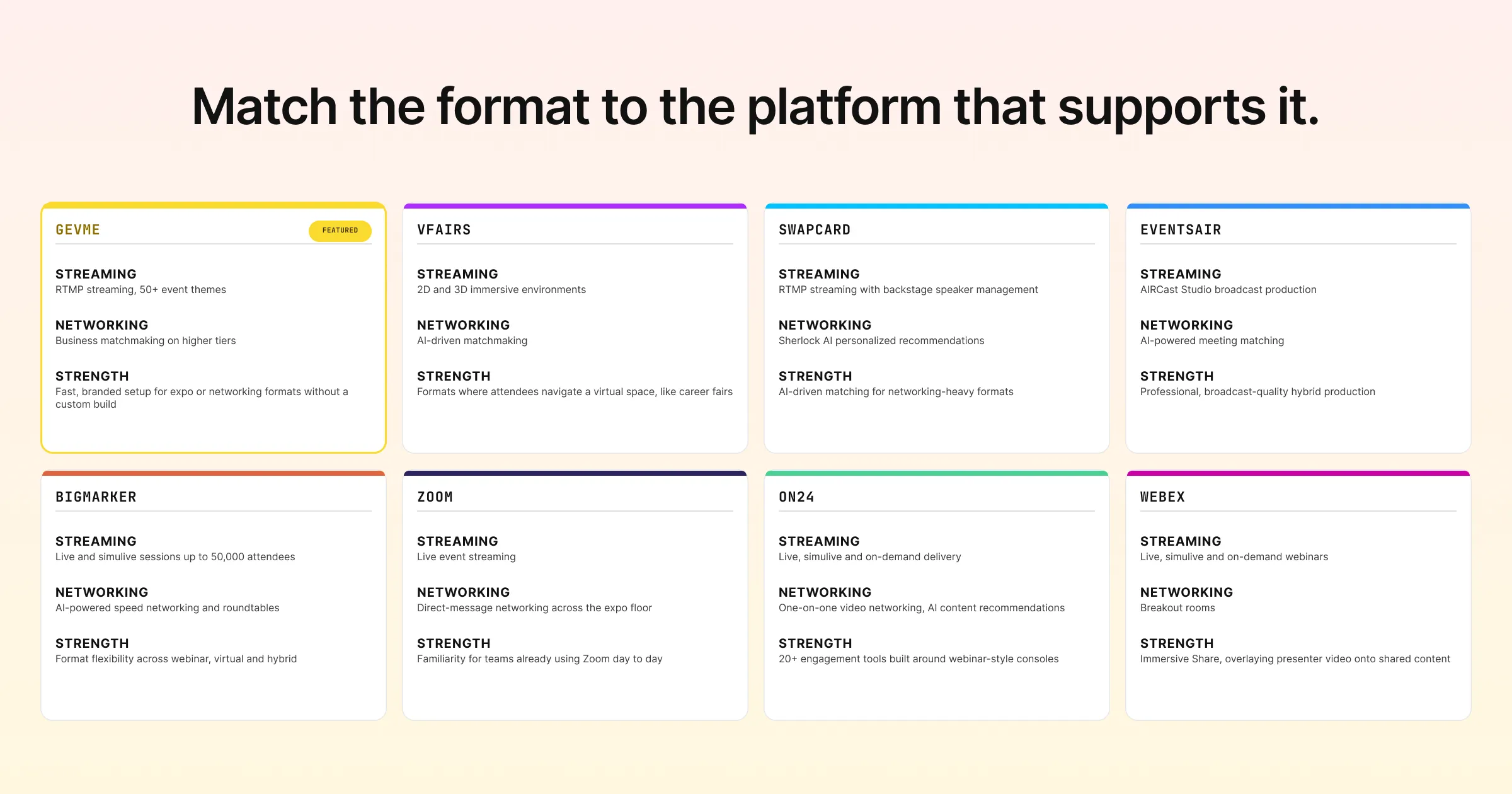
| Platform | Streaming & Broadcast | Networking & Matchmaking | Expo & Booth Support | Notable Format Strength |
|---|---|---|---|---|
| Gevme | RTMP streaming, 50+ event themes | Business matchmaking on higher tiers | Included as part of the virtual venue | Fast, branded setup for expo or networking formats without a custom build |
| vFairs | 2D and 3D immersive environments | AI-driven matchmaking | Branded exhibit halls with avatars | Formats where attendees navigate a virtual space, like career fairs |
| Swapcard | RTMP streaming with backstage speaker management | Sherlock AI personalized recommendations | Sponsor meeting tools | AI-driven matching for networking-heavy formats |
| EventsAIR | AIRCast Studio broadcast production | AI-powered meeting matching | Virtual exhibition halls | Professional, broadcast-quality hybrid production |
| BigMarker | Live and simulive sessions up to 50,000 attendees | AI-powered speed networking and roundtables | Customizable Expo Hall | Format flexibility across webinar, virtual and hybrid |
| Zoom | Live event streaming | Direct-message networking across the expo floor | Zoom Events Expo, 100+ configurable booths | Familiarity for teams already using Zoom day to day |
| ON24 | Live, simulive and on-demand delivery | One-on-one video networking, AI content recommendations | Not a primary focus | 20+ engagement tools built around webinar-style consoles |
| Webex | Live, simulive and on-demand webinars | Breakout rooms | Not a primary focus | Immersive Share, overlaying presenter video onto shared content |
Sources, checked in late August 2026, are each platform’s own product pages: Gevme, vFairs, Swapcard, EventsAIR, BigMarker, Zoom, ON24, Webex. Vendor product pages change often. Confirm directly before you plan a format around any specific feature listed here.
Choosing a Format and Platform Together
Start with the problem you’re trying to solve, not the platform you already have a login for. This applies just as much to a conference-style format as it does to a purely internal gathering. Do your attendees consistently skip networking sessions? A structured format like speed networking, or a scavenger hunt with a real prize, is a bigger lever than switching platforms. Where your event depends on sponsor revenue, prioritize a platform with genuine expo or booth tools over one built primarily around a single-track webinar. Gevme’s virtual venue, vFairs, EventsAIR, BigMarker and Zoom all support some version of this.
Perhaps you want a format that feels like a destination rather than a series of pages. vFairs’ immersive 3D approach fits that goal directly. Where broadcast quality matters more than immersion, meaning a keynote that needs to look and feel like a professional production, EventsAIR’s dedicated studio tooling is built for exactly that. Finally, you may want registration, on-site check-in and a themed virtual venue with matchmaking working together on one connected platform rather than assembled from separate tools. Gevme covers that ground without requiring a custom build for a first attempt at any of the formats above.
Pro Tip
Before you commit to a new format for your next event, run it internally first, with your own team standing in as attendees. Don’t debut it live with real registrants. A scavenger hunt with confusing rules, or a networking format nobody understands how to join, is a lot cheaper to fix in a dry run than in front of the audience you spent months trying to attract.
Frequently Asked Questions
Improving networking tends to have the biggest impact, because it is the part attendees most consistently say falls short. Structured formats like speed networking, coffee chats or birds-of-a-feather groups outperform an open chat room that most attendees never use on their own.
Gevme virtual venue is template-driven, built around more than 50 ready-made themes and RTMP streaming for a fast, branded setup. vFairs takes a more heavily immersive 3D approach. Both are legitimate ways to run a strong virtual event. The right choice depends on whether your format calls for a navigable space or a fast, polished branded page.
It is one of the most consistently recommended tactics across the sources checked for this guide. However, it works best when tied to something real: a genuine prize, recognition, or a meaningful leaderboard, rather than points that do not lead anywhere. A half-built gamification layer tends to underperform no format at all.
Check first whether your Zoom plan includes Zoom Events specifically. The Expo feature with configurable booths is part of that dedicated event product, rather than the standard meeting plan most teams already have. The same applies to ON24 and Webex, where event-specific tiers include features the everyday meeting product does not.
A mix tends to work better than one format repeated across every day. Pair core content sessions with a lighter social format, such as a happy hour, trivia or a wellness break, plus a structured networking activity. That gives attendees a reason to stay logged in across the full event rather than just the opening keynote.
They work well for a technical or product-focused audience specifically, and the main advantage is reaching contributors globally without travel costs. Professional virtual hackathons typically run longer than an in-person version, two to four weeks rather than a single weekend, to account for the different pace of remote collaboration.
It depends on what you want attendees to feel. A broadcast-style format, produced with real camera switching and graphics, works best when the goal is a polished, professional keynote experience. An immersive 3D format works better when the goal is exploration, like a career fair or expo hall attendees are meant to wander through rather than watch.
Conclusion: Picking Formats That Earn Attention, Not Just Fill Time
vFairs, Swapcard, EventsAIR, BigMarker, Zoom, ON24 and Webex each bring real strength to specific formats. vFairs and BigMarker lead on immersive and expo-style experiences. EventsAIR leads on broadcast-quality production, and Swapcard on AI-driven networking. Zoom, ON24 and Webex bring the familiar webinar and meeting infrastructure many teams already trust.
Maybe you want a platform that can support a themed expo format, structured networking, and a professional-feeling virtual venue without a custom production build. If it should run on the same system that handles your registration and on-site check-in, Gevme is worth including in your shortlist for 2027 planning. Its virtual venue starts with more than 50 themes to build from, and business matchmaking is available if a networking-focused format is what your event actually needs. If you’re ready to try one of these formats on your next event, request a demo and talk through which one fits.