You’ve done the hard part. You built the event, set the price, wrote the description, and got someone to actually click through to register. Then they leave the page before finishing, often for reasons that have nothing to do with how interested they are. Multiply that by every event you run and it adds up to real revenue sitting on the table. People wanted to come. The checkout process got in the way.
This is a genuinely well-studied problem outside the events industry, and the research holds up inside it too. This guide covers why registration checkout gets abandoned in the first place, and what’s actually proven to reduce it. It also looks at how fast different platforms get your money into your bank account once someone does pay. Finally, it compares Gevme with Cvent, Bizzabo, Swapcard, EventMobi, Accelevents and Whova on fees, payment gateways and checkout features.
Key Takeaways
- The average online checkout abandonment rate sits around 70 percent across studied purchases. The leading cause by far is unexpected costs revealed late in the process, not lack of interest in what’s being bought.
- Roughly one in ten buyers drops off for every extra field added to a registration form. So a shorter form isn’t a nice-to-have, it’s a direct lever on completed registrations.
- Dynamic, adaptive registration forms converted at close to double the rate of static ones in recent industry data. They do it largely by pre-filling known information and skipping irrelevant questions.
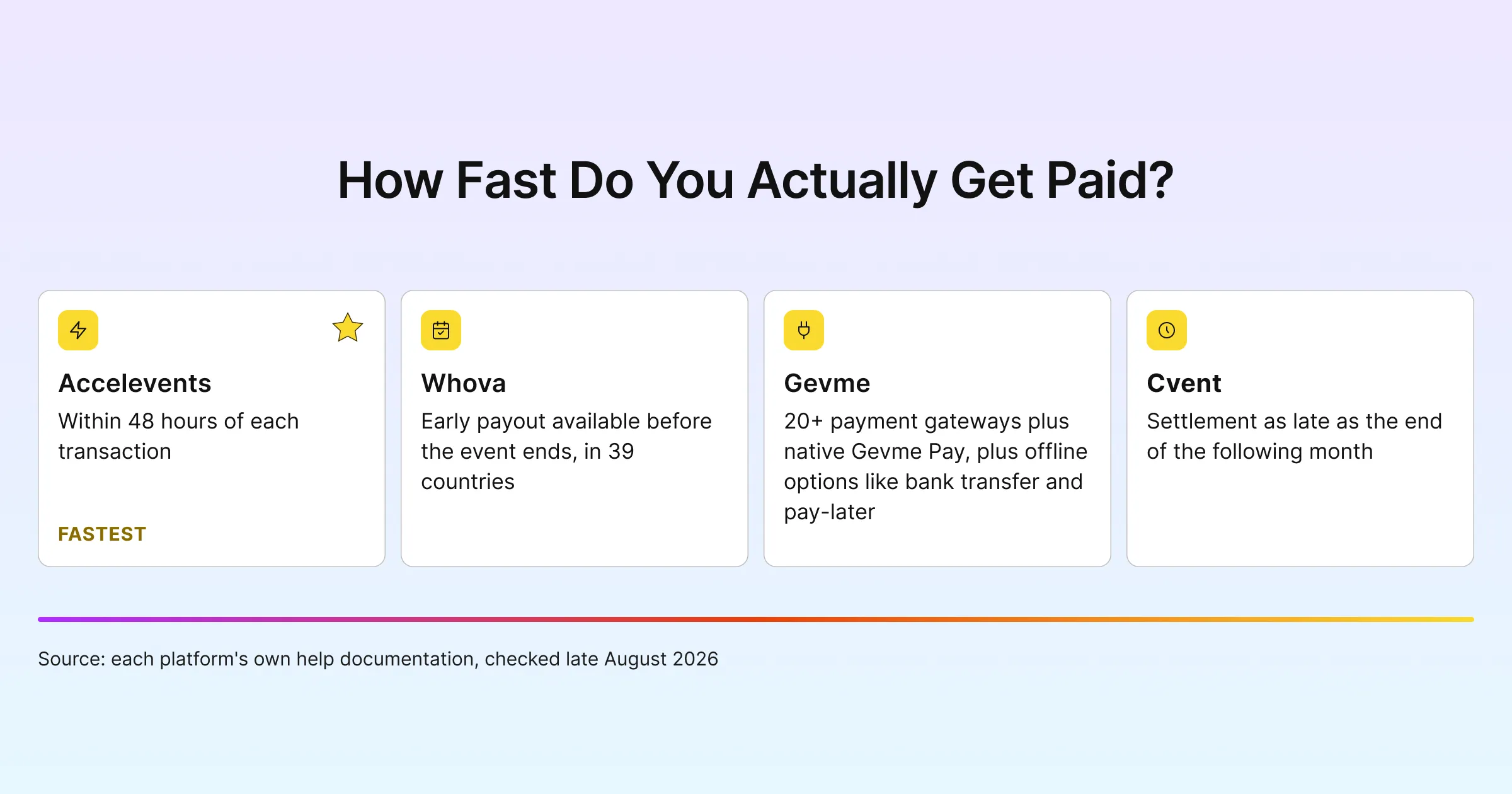
- Payout speed varies dramatically by platform. Accelevents pays out within 48 hours of each transaction, and Whova offers an early-payout option before the event ends. Cvent’s own documentation describes settlement as late as the end of the following month.
- Gevme’s Registration Platform connects to more than 20 third-party payment gateways alongside its own native Gevme Pay option, plus offline methods like bank transfer and pay-later. That gives organizers flexibility instead of locking them into one processor.
- Whova is the only platform in this guide with an explicitly named abandoned-registration recovery feature on its own site. It’s worth a look if reclaiming lost sign-ups matters to your bottom line.
- Fee transparency varies sharply by platform. Accelevents and Whova publish a clear percentage-based fee on their own sites. Others fold processing costs into pricing you only see once you’ve connected a gateway.
Why Attendees Abandon Registration Checkout
The best data on checkout abandonment doesn’t come from the events industry specifically, because nobody has run a large-scale study on event registration alone. General ecommerce checkout research is a solid proxy, though, and event organizers report the same patterns. Per the Baymard Institute’s research, checked in late August 2026, the average documented cart abandonment rate across 50 tracked studies sits at roughly 70 percent.
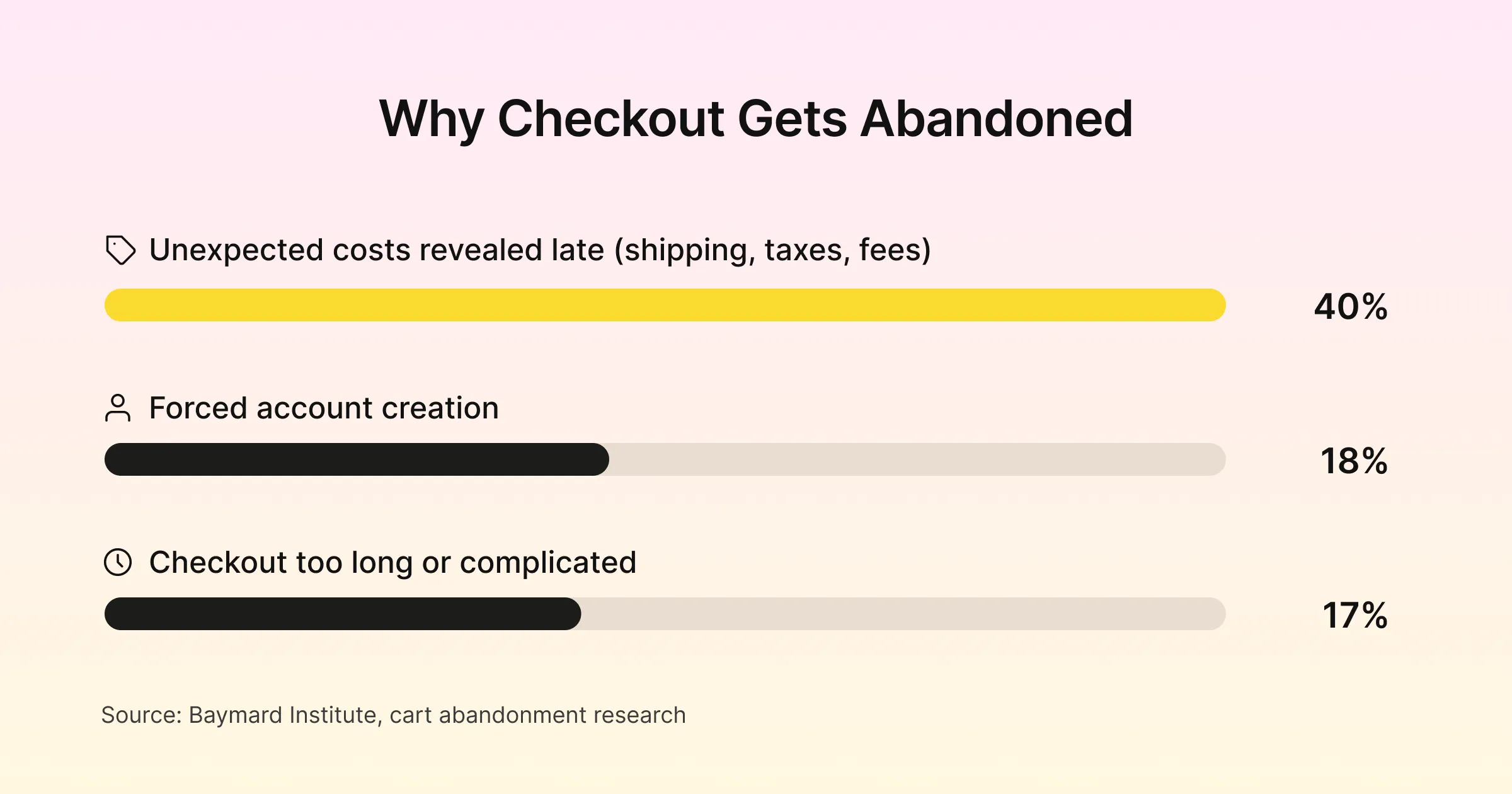
Their quantitative breakdown of causes, excluding people who were just browsing, tells the real story. Late-revealed extra costs, meaning shipping, taxes or hidden fees, topped the list at 40 percent. Forced account creation followed at 18 percent, and a checkout process that’s simply too long or complicated at 17 percent.
Event-specific research backs this up. Per Eventbrite’s own blog on checkout design, checked in late August 2026, roughly one in ten buyers drops off for every additional field added to a registration form. Mobile registrants also convert at a noticeably lower rate than desktop ones, which makes fast load times and a clean mobile layout a real priority rather than a design preference. The same article notes that event creators who kept checkout on their own page, rather than redirecting buyers elsewhere to pay, reported registration completion roughly doubling.
What Actually Reduces Drop-off
Short forms help, but the improvement isn’t just about trimming fields randomly. Per Bizzabo’s own research on registration optimization, checked in late August 2026, dynamic and adaptive registration flows converted at approximately 24.4 percent in recent benchmark data. Those flows pre-fill known attendee information and skip questions that don’t apply to a given registrant type. Static forms that ask every registrant the same fixed set of questions converted at 11.6 percent. That’s roughly double, and it comes from relevance rather than brevity alone.
Transparent pricing matters just as much. Per Stripe’s own guidance on checkout conversion, checked in late August 2026, showing the full, all-in price before the final step is one of the most consistently effective fixes available. Adding fees at the last screen does the damage. Offering more than one payment method helps too, as does making sure the checkout flow works cleanly on a phone.
Guest checkout matters here as well. Both Eventbrite’s and Cvent’s own published guidance, checked in late August 2026, recommend not forcing an account creation step before someone can pay. That friction shows up directly in Baymard’s abandonment data.
Whova takes this a step further with a specific feature most of the other platforms in this guide don’t publish an equivalent for. Per Whova’s own site, checked in late August 2026, it offers abandoned registration recovery. It follows up with people who started checkout but didn’t finish, and Whova credits it with recovering real revenue that would otherwise have been lost entirely.
Getting Paid Faster: Payout Speed and Fees Compared
Once someone actually completes checkout, how quickly that money reaches your account varies more than most organizers expect. It’s rarely the headline feature on a pricing page.
Gevme’s Registration Platform starts at USD $960 a year on its Starter plan, per Gevme’s pricing page, checked in late August 2026. Attendee-level pricing starts at $2.10 per registrant on both the Starter and Pro plans. Its own payment gateway page, checked in late August 2026, confirms integration with more than 20 third-party payment gateways alongside a native Gevme Pay option. Offline methods are covered too: bank transfer, cheque, pay-later arrangements and on-site payment collection. That gives organizers a choice of processor rather than a single fixed payout path.
Accelevents is the clearest and fastest on payout timing among every platform checked for this guide. Per Accelevents’ own help documentation, checked in late August 2026, funds transfer to the organizer within 48 hours of each transaction, instead of sitting until after the event. Its platform fee is published too: $1.50 plus 3.5 percent per ticket on Free and Starter plans. That sits on top of standard card processing rates from whichever gateway is connected, whether Stripe, Square, Braintree, Authorize.net or others, none of which Accelevents marks up.
Whova publishes something similar in spirit. Per Whova’s own blog, checked in late August 2026, it offers an early-payout option that makes ticket revenue available before the event even concludes. That’s useful for covering venue deposits or catering costs ahead of time, and Whova states it’s available in 39 countries. Its platform fee is 2.5 percent plus $0.99 per ticket, on top of Stripe’s own processing fee. Stripe is Whova’s sole payment processor.
Cvent, Bizzabo, Swapcard and EventMobi
Cvent sits at the other end of the spectrum on speed. Per Cvent’s own blog on its payment services, checked in late August 2026, transactions transfer to the organizer’s bank by the last week of the following month. So a registration taken in early October might not settle until the end of November. Cvent’s processing fee is stated at 3.99 percent on the same page, though it notes this can vary by contract.
Bizzabo and Swapcard don’t publish payout timing at all. Bizzabo’s own organizer agreement, checked in late August 2026, confirms that organizers connect their own third-party payment processor rather than using a named Bizzabo-branded one. So payout speed depends on whichever processor you choose. Swapcard’s help documentation, checked in late August 2026, states that Stripe is currently the only payment processor available on its Registration platform, and that Swapcard itself doesn’t add a transaction fee on top of Stripe’s standard rates.
EventMobi publishes the widest range of supported gateways of any platform in this guide. Per EventMobi’s help center, checked in late August 2026, it connects to 24 named gateways including Stripe, PayPal, Adyen and Authorize.net. That lets organizers choose per-region processors. EventMobi doesn’t publish payout timing or its own transaction fee, so both depend on whichever gateway you connect.
Payment Gateways, Currency and Checkout Features
Gateway flexibility matters most if you run events in multiple countries, or already have a preferred processor for other parts of your business. Gevme and EventMobi both stand out here. Gevme offers more than 20 supported gateways alongside its native option, and EventMobi has 24 named integrations giving organizers a specific processor for nearly any region.
Accelevents offers a feature worth a closer look if your attendees sometimes need flexibility on timing rather than payment method. It publishes a pay-later or pay-a-deposit option, letting a registrant confirm their spot and pay the full amount afterward via an emailed link. Alternatively they can pay part of the cost upfront with the remainder collected later. This isn’t the same as a multi-installment plan, but it solves a similar problem for attendees who need more time without losing their spot.
On currency, most platforms in this guide support multiple currencies in some form. Cvent’s own materials state it processes payments in more than 130 currencies. The other platforms generally describe multi-currency support in general terms tied to whichever gateway is connected. That matters if you’re planning an event with international ticket buyers.
Payment Security Is Worth Checking, Even When the Checkout Feels Routine
Every platform in this guide handles card data on your behalf the moment someone pays for a ticket. That makes payment security worth understanding rather than assuming. Per their own security or pricing pages, checked in late August 2026, Swapcard states PCI DSS v4.0 compliance backed by annual independent audits. EventMobi states PCI DSS Level 1 certification through its hosting infrastructure. Accelevents and Whova both state SOC 2 compliance alongside their payment processing setup, and Cvent’s own documentation states PCI Level 1 status directly.
None of this requires you to evaluate the cryptography yourself. It means knowing, before your first paid event goes live, whether card data touches the platform’s own servers directly or passes straight through to a certified processor.
A Few Terms Worth Knowing
- Payment gateway: The service that actually processes a card payment, like Stripe or PayPal, sitting between your registration page and the buyer’s bank.
- Payout: The transfer of collected registration revenue from your payment gateway or event platform into your own bank account.
- PCI DSS: A security standard for handling card payment data. Any platform processing card payments on your behalf should be able to confirm compliance with it.
- Dynamic form: A registration form that changes which questions it asks based on earlier answers, rather than showing every field to every registrant regardless of relevance.
How Gevme and Its Alternatives Compare on Payments
| Platform | Attendee/Platform Fee | Payout Speed | Payment Gateways | Notable Checkout Feature |
|---|---|---|---|---|
| Gevme | Starts at $2.10 per attendee (Starter/Pro) | Not listed on their site | 20+ third-party gateways plus native Gevme Pay | Offline payment options including pay-later and on-site collection |
| Cvent | 3.99% processing fee (per Cvent’s blog) | End of the following month | Cvent Payment Services (built on Stripe Connect) | Embedded checkout, Apple Pay and Google Pay support |
| Bizzabo | Not listed on their site | Depends on organizer’s own processor | Bring-your-own third-party processor | Invoicing option alongside instant transactions |
| Swapcard | Gateway rates only, no added Swapcard fee | Not listed on their site | Stripe (Registration platform) | Real-time payment tracking and automatic access restriction for unpaid balances |
| EventMobi | Not listed on their site | Depends on connected gateway | 24 named gateways including Stripe, PayPal and Adyen | Per-region gateway choice for international events |
| Accelevents | $1.50 + 3.5% per ticket (Free/Starter) | Within 48 hours per transaction | Stripe, Square, Braintree, Authorize.net and others | Pay-later or pay-a-deposit registration option |
| Whova | 2.5% + $0.99 per ticket | Early payout available before event ends | Stripe only | Abandoned registration recovery |
Sources, checked in late August 2026, are each platform’s own pricing, product or help center pages: Gevme, Cvent, Bizzabo, Swapcard, EventMobi, Accelevents, Whova. Vendor pricing and fee pages change often. Confirm directly before you budget against any figure here.
Merchandise, Promo Codes and Other Revenue Details That Affect Checkout
Payment features cover more than how a card gets charged. Many events sell add-ons alongside the base ticket: merchandise, workshop upgrades, VIP passes. How cleanly your platform handles those at checkout affects both conversion and total revenue per attendee. Per its own payment gateway page, checked in late August 2026, Gevme supports merchandise sales with inventory tracking directly inside registration. It also offers customizable taxes. You can set them inclusive or exclusive, and apply them before or after fees depending on the payment method. Promo codes cover early bird, group and partner discounts, each with their own usage limits and date ranges.
Group Registration and Invoicing
Accelevents supports a comparable set of discount and group registration tools. One buyer can register multiple attendees in a single transaction, which reduces the number of separate checkout sessions your attendees have to complete in the first place.
Invoicing and post-sale adjustments matter too, particularly for B2B-style events where a company, not an individual, is paying. Gevme’s own payment gateway page states it generates invoices, receipts, credit notes and refunds directly through order management. That matters if your finance team needs paper trails that don’t require a separate accounting tool. Bizzabo’s own site mentions invoicing as an available option alongside instant transactions, useful for the same reason.
Which Platform Fits Which Kind of Organizer
Does cash flow timing matter to your event, because you cover vendor deposits or venue costs before doors open? Accelevents’ 48-hour payout or Whova’s early-payout option are the two fastest routes to your money among the platforms covered here. If you run events across many countries and want a named processor for each region rather than a single default, EventMobi’s 24-gateway list gives you that flexibility directly.
Perhaps you want payment flexibility bundled with the rest of your event platform rather than managed as a separate concern. Gevme’s registration platform connects to more than 20 gateways alongside its own native option and offline methods like pay-later and on-site collection. That suits organizers who don’t want to negotiate a separate merchant relationship on top of choosing event software. Finally, if reducing abandoned registrations specifically is your priority, Whova’s named recovery feature is a genuine differentiator worth testing against your own numbers.
Pro Tip
Before your next event goes live, register for it yourself on your phone, the way a real attendee would. Time how long it takes from landing on the page to a confirmed ticket in your inbox. If you hit a moment where you’re unsure what happens next, whether that’s unclear pricing, a field that seems unnecessary, or a slow page, your actual attendees are hitting that same moment and quietly leaving.
Frequently Asked Questions
There is no event-specific benchmark at the same rigor as ecommerce research. General checkout abandonment averages around 70 percent, and the same root causes, unexpected costs and overly long forms, show up consistently in event-specific guidance from platforms like Eventbrite and Cvent.
Yes. Event-specific data suggests roughly one in ten buyers drops off for each additional field on the form. Dynamic forms that skip irrelevant questions also convert meaningfully better than static ones that ask everyone the same questions.
It depends heavily on the platform. Accelevents states a 48-hour payout window per transaction, and Whova offers an early-payout option before the event ends. Cvent own documentation describes settlement as late as the end of the following month, so payout speed is worth weighing alongside features.
Gevme attendee-level pricing starts at $2.10 per registrant on its Starter and Pro plans, covering the platform itself. Beyond that, gateway-level processing rates follow whichever of the 20-plus supported payment gateways you connect. So the total cost structure reflects the processor you choose rather than a single fixed markup.
Yes, based on both general checkout research and event-specific guidance. Forced account creation shows up as a documented abandonment cause in Baymard Institute data, and Eventbrite own guidance explicitly recommends against requiring an account before someone can pay.
Accelevents and Whova both publish specific percentage-based fees directly on their own sites. Others, including Bizzabo, Swapcard and EventMobi, either do not publish a platform fee at all, or tie the cost entirely to whichever payment gateway you connect.
Not immediately, but check before you plan an event with international attendees. Most platforms in this guide describe multi-currency support in general terms tied to their connected payment gateway rather than publishing a specific list. Cvent stands out by naming a specific figure at over 130 currencies.
Conclusion: Reducing Drop-off Comes Down to Removing Friction
Cvent, Bizzabo, Swapcard, EventMobi, Accelevents and Whova each solve part of this problem well. Accelevents and Whova lead on payout speed and fee transparency. EventMobi gives international organizers the widest choice of named gateways. Whova’s abandoned-registration recovery is a genuinely useful feature most of the others don’t publish an equivalent for.
Maybe you want payment flexibility built into the same platform that handles your registration, check-in and virtual delivery, rather than treated as a bolt-on decision. Gevme’s registration platform connects to more than 20 gateways plus its own native option and offline methods, giving you room to choose what fits your organization instead of being boxed into one processor. If cutting registration drop-off and simplifying how you get paid is the problem you’re solving for your next event, request a demo and walk through your actual checkout flow together.