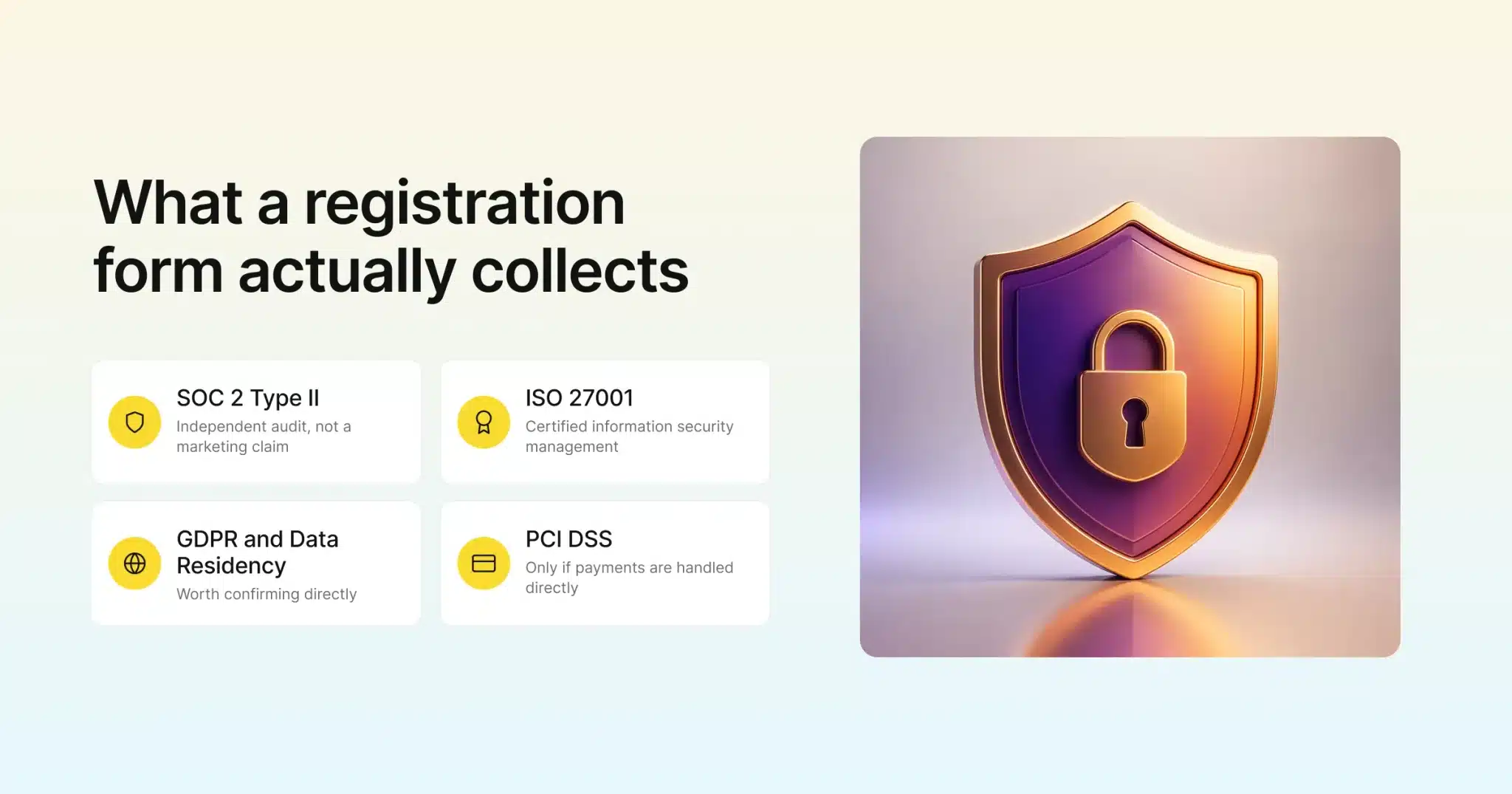
Every event platform’s marketing page says some version of “your data is safe with us.” Almost none of them explain what that actually means until you dig into a trust center or security page. By then, most buyers have already moved on to comparing features. That’s backwards for events specifically. A registration form collects names, emails, sometimes payment details and dietary or accessibility information, all from people who never signed up to have their data mishandled.
This guide isn’t a ranking of “most secure” platforms. That’s not a claim anyone can honestly make from the outside looking in. It’s a straight, sourced look at what five platforms actually publish about their security practices and compliance certifications. That way you know what questions to ask and what to verify yourself before you sign a contract.
This guide covers what to actually look for in event software security, and what Gevme, Cvent, Bizzabo, Swapcard, and EventsAIR publish about their own practices. It also includes a comparison table and a framework for figuring out what level of compliance your organization actually needs.
Key Takeaways
- Event registration data is more sensitive than most people assume: names, emails, payment details, and sometimes dietary or accessibility information. That makes vendor security practices worth checking directly rather than assuming.
- Cvent and Bizzabo both publish the most extensive compliance certifications among the platforms compared here. That list includes SOC 2 Type II, ISO 27001, GDPR, and PCI DSS.
- Gevme publishes ISO 27001, ISO 27017, ISO 27018, PDPA, SOC 2 Type 2, GDPR, and CCPA compliance on its trust center. It also lists AES-256 encryption at rest and TLS encryption in transit.
- Swapcard is EU-based and hosts data in Ireland. It holds SOC 2 Type II and ISO 27001 certifications, with GDPR compliance as a baseline of its structure.
- EventsAIR’s privacy policy states GDPR compliance and describes general encryption and access-control practices. The company doesn’t publish specific third-party certifications like SOC 2 or ISO 27001 on its site, though.
- Where your event data is physically hosted matters for compliance in some industries and regions. That’s not always obvious from a vendor’s marketing pages, so it’s worth asking directly.
- No certification is a substitute for reading a vendor’s actual data processing agreement, especially around what happens to attendee data after your contract ends.
Why Event Data Security Deserves Its Own Line of Questions
Most event platform demos lead with registration flows, branding, and reporting dashboards, and security comes up only if the buyer asks. That ordering makes sense from a sales perspective, but it puts the burden on you to bring it up.
It’s worth bringing up early for a specific reason. It becomes obvious the moment you list out what a registration form actually collects: event registration data touches more categories of personal information than people usually expect. A conference registration form might collect a name and email. It might also collect a company name, job title, payment card details for a paid ticket, dietary restrictions, accessibility needs, and sometimes passport or visa information for international attendees. That’s a wider surface area than a typical marketing signup form, and it’s flowing through a platform your organization is trusting on behalf of every person who registers.
What to Look for in Event Software Security and Compliance
- Recognized third-party certifications. SOC 2 Type II and ISO 27001 are the two most common independent audits in this space. A vendor that’s actually been through these audits will say so specifically. It’ll usually make an audit report available on request, too, rather than using vague language like “bank-level security.”
- Data encryption standards. Look for confirmation that data is encrypted both in transit (typically TLS) and at rest (typically AES-256). That’s close to industry standard among the platforms in this comparison.
- Data residency and hosting location. Where your data is physically stored can matter for regulatory reasons, particularly for government, healthcare, or EU-based organizations. Not every vendor publishes this clearly, so it’s worth asking directly if it matters for your event.
- GDPR and regional privacy law compliance. European attendees, or attendees anywhere with strong regional privacy laws, change what to confirm. Check the vendor’s specific GDPR compliance claims and whether they offer a data processing agreement (DPA).
- Payment data handling (PCI DSS). If the platform processes credit card payments directly, PCI DSS compliance level matters. Some vendors offload payment processing to a certified third party instead of handling card data themselves. That’s a legitimate approach, but worth understanding.
- What happens to data after your contract ends. This gets skipped constantly. Ask directly whether attendee data is deleted, retained, or exportable once you stop using a platform, and get the answer in writing.
What Five Platforms Actually Publish
Gevme
Per Gevme’s trust center, checked mid-August 2026, the platform lists ISO 27001, ISO 27017, ISO 27018, PDPA, GDPR, and CCPA as compliant. It also holds SOC 2 Type 2 certification. Gevme’s privacy policy backs this up on the GDPR side. It cites the regulation directly and confirms Gevme has appointed the European Data Protection Office (EDPO) as its GDPR representative under Article 27, along with data subject rights covering access, rectification, erasure, and portability.
Data in transit is encrypted with TLS, and sensitive data at rest is encrypted with AES-256. Infrastructure runs on AWS, with the trust center noting a 2024 migration of Snapsight’s hosting from the Singapore region to Frankfurt. Gevme doesn’t publish a standalone PCI DSS certification. Instead, it routes card payments through more than 20 third-party payment gateways plus its own Gevme Pay option, per Gevme’s payment gateway page. That’s the same offload-to-a-certified-processor model several other platforms in this comparison use, rather than certifying PCI DSS themselves. These controls sit underneath all three of Gevme’s connected products, registration, on-site check-in, and the virtual venue, rather than varying by product line.
Cvent
Per Cvent’s security page, checked mid-August 2026, Cvent publishes the broadest certification list among the platforms here. That list includes ISO 27001, ISO 27701, SOC 1 and SOC 2 Type II, PCI DSS Level 1, CSA STAR, and TX-RAMP. The company states it complies with GDPR (EU and UK), CCPA, and the EU-U.S. and Swiss-U.S. Data Privacy Frameworks, and states plainly that it “never sells your data or your attendees’ data.” Data is processed through AWS regions specific to customer location: US East and West for North American customers, Frankfurt and Dublin for EU-based customers. Encryption runs via TLS 1.2 in transit and AES-256 at rest.
Bizzabo
Per Bizzabo’s security page, checked mid-August 2026, Bizzabo publishes SOC 2 Type 2, ISO 27001, EU-U.S. Data Privacy Framework compliance, PCI DSS SAQ D V.4 compliance, GDPR compliance, and CCPA compliance. The company describes itself specifically as a data processor rather than a data controller. That means customers retain control of their own data, rather than Bizzabo using it independently. Data is hosted on U.S.-based AWS and Google Cloud infrastructure, encrypted at rest and in transit. Backups are transferred to different regions every three hours for disaster recovery.
Swapcard
Per Swapcard’s security page, checked mid-August 2026, the company holds SOC 2 Type 2 (achieved 2022, renewed annually) and ISO 27001 (certified July 2023, verifiable certificate number provided). It also states it “complies with GDPR as an EU-based company.” Data is hosted primarily in an AWS Ireland data center, with encryption via AES-256 at rest and TLS v1.2 in transit. The company runs a 24/7 security operations center, quarterly vulnerability scans, and a private bug bounty program. Swapcard’s page does not mention PCI DSS specifically.
EventsAIR
EventsAIR’s public-facing content on security is thinner than the other four platforms compared here. Per EventsAIR’s privacy policy, checked mid-August 2026, the company states its policy “complies with applicable privacy laws, including but not limited to GDPR.” It describes general protections too, including encryption of sensitive data in transit and at rest. Access controls also limit data exposure to authorized personnel, along with regular security audits. EventsAIR does not have a dedicated security or trust center page. Its privacy policy also does not name specific third-party certifications like SOC 2 or ISO 27001, the way Cvent, Bizzabo, Swapcard, and Gevme each do on their own security pages.
A Few Terms Worth Knowing
- SOC 2 Type II: an independent audit confirming a company’s security controls are not just designed correctly, but operating effectively over a period of time. That period is typically six to twelve months, as opposed to a point-in-time snapshot.
- ISO 27001: an internationally recognized standard for information security management systems, awarded after a formal certification audit.
- Data processor vs. data controller: a data controller decides how and why personal data is used; a data processor handles data on the controller’s behalf under their instructions. Most event platforms are processors, with the event organizer as the controller.
- DPA (Data Processing Agreement): a contract, usually required under GDPR, that defines how a vendor is permitted to handle personal data on your organization’s behalf.
- PCI DSS: the Payment Card Industry Data Security Standard, a set of requirements for any organization that stores, processes, or transmits credit card data.
Event Software Security and Compliance Compared, 2026
| Platform | SOC 2 | ISO 27001 | GDPR Stated | PCI DSS | Data Hosting |
|---|---|---|---|---|---|
| Gevme | Yes (Type 2) | Yes | Yes | Not listed on their site | AWS (Singapore/Frankfurt) |
| Cvent | Yes (Type II) | Yes | Yes | Yes (Level 1) | AWS US/EU by region |
| Bizzabo | Yes (Type 2) | Yes | Yes | Yes (SAQ D) | AWS/GCP, U.S.-based |
| Swapcard | Yes (Type 2) | Yes | Yes | Not listed on their site | AWS Ireland (EU) |
| EventsAIR | Not listed on their site | Not listed on their site | Yes | Not listed on their site | Not listed on their site |
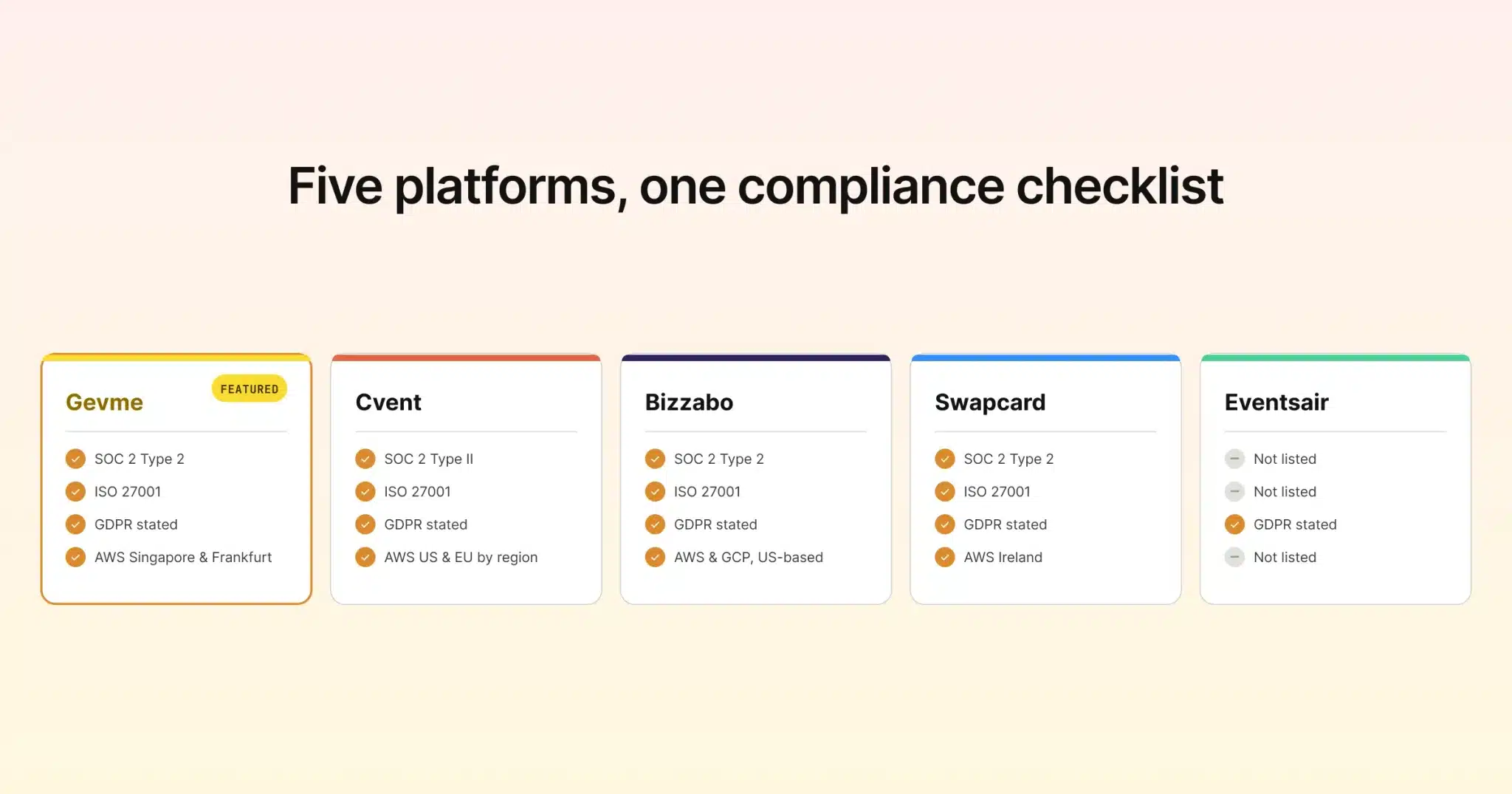
Sources: certifications and claims above come from each platform’s own published trust center, security, or privacy pages, checked mid-August 2026. See Gevme, Cvent, Bizzabo, Swapcard, and EventsAIR. These pages update as vendors complete new audits.
How Much Compliance Does Your Event Actually Need
Not every event carries the same risk profile. It’s worth being realistic about what your organization actually needs, rather than chasing every certification on the list. A small internal team meeting with a simple RSVP form has very different requirements than a healthcare conference collecting professional license numbers. The same goes for a government-adjacent event, where data residency is a contractual requirement, not a preference.
If you’re processing payments directly through the platform, PCI DSS compliance level should be a hard requirement, not a nice-to-have. European attendees, or GDPR obligations of your own, mean confirming the vendor offers a proper data processing agreement, not just a line on a webpage claiming compliance. Your organization’s own internal security review process still applies here. Whatever your IT or legal team already asks vendors in other software categories is worth asking here too. Event platforms handle real personal data and should clear the same bar.
It’s also worth thinking about this by event type rather than treating every event the same. A public marketing webinar collecting only a name and email carries a very different risk profile than a members-only healthcare conference collecting license numbers. So does an internal company event where attendee data might include salary bands or org-chart information. Matching the depth of your security review to the actual sensitivity of what you’re collecting keeps the process proportionate. That beats applying the same checklist to every event regardless of size. It’s a way to avoid skipping the review entirely for the events that genuinely need it.
Security Questions Worth Asking During a Demo
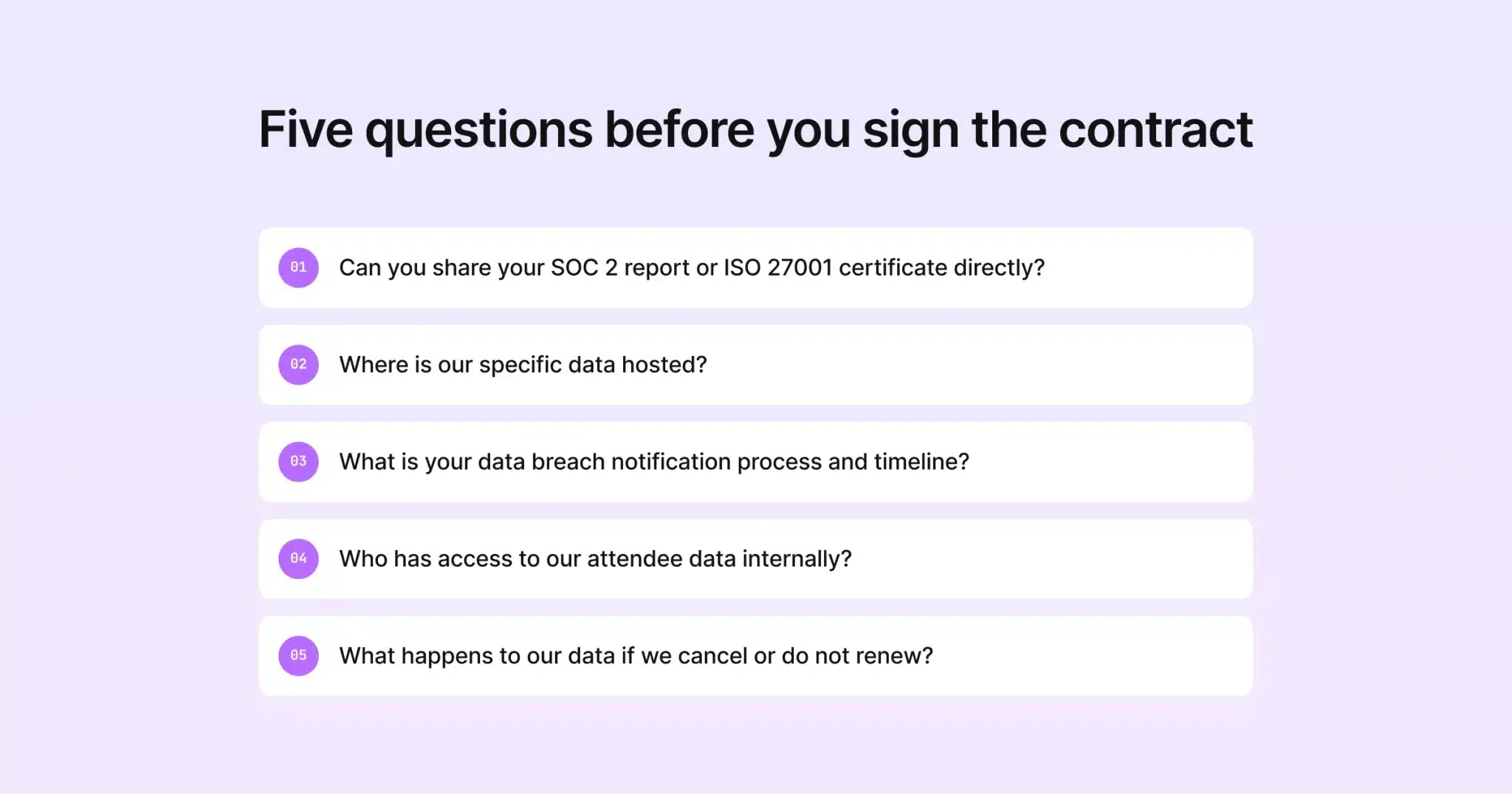
A sales demo rarely volunteers this information unprompted, so it helps to have a short list ready.
- Can you share your SOC 2 report or ISO 27001 certificate directly? A vendor that has genuinely completed these audits should be able to produce the document, typically under a mutual NDA, without much friction.
- Where is our specific data hosted, and does that change by region? Some platforms, like Cvent, host data differently depending on where the customer is based. Get a direct answer for your organization’s specific setup, not a general statement.
- What’s your data breach notification process and timeline? Cvent, for example, publishes a specific 48-hour notification commitment. Ask every vendor what their actual commitment is, in writing.
- Who has access to our attendee data internally, and how is that access controlled? Look for role-based access control and a clear answer about whether employees can view attendee data without a specific business reason.
- What happens to our data if we cancel or don’t renew? Get this in writing as part of the contract, not just a verbal assurance during the sales process.
Pro Tip: Ask for the Audit Report, Not Just the Badge
Certification logos on a website are marketing. The actual SOC 2 report or ISO 27001 certificate is the real document. Reputable vendors will provide it under an NDA when asked directly, since that’s standard practice for this kind of request. A vendor reluctant to share the underlying report, or a rep who doesn’t know it exists, is telling you something too. Treat that as useful information in itself.
Frequently Asked Questions
SOC 2 Type II and ISO 27001 are the two most widely recognized independent audits for this category, and both confirm that a vendor’s security controls have been externally verified rather than just self-described. If you process payments directly through the platform, PCI DSS compliance is also worth confirming at the appropriate level.
Yes. Per Gevme’s trust center and its own privacy policy, checked mid-August 2026, Gevme states GDPR compliance directly. It has also appointed the European Data Protection Office (EDPO) as its GDPR representative under Article 27. It also lists CCPA, ISO 27001, ISO 27017, ISO 27018, PDPA, and SOC 2 Type 2 as compliant or certified.
Among the five platforms compared here, Cvent and Bizzabo publish the most extensive lists. Both cover SOC 2, ISO 27001, GDPR, and PCI DSS compliance directly on their security pages.
Only if the platform handles credit card data directly. Cvent and Bizzabo both publish their own PCI DSS certification. Gevme takes the other legitimate approach. It routes payments through more than 20 third-party payment gateways plus its own Gevme Pay option, rather than certifying PCI DSS itself, per Gevme’s payment gateway page. Either model is a normal way to handle this, but it’s worth knowing which one a vendor uses.
EventsAIR’s privacy policy describes general encryption and access controls and states GDPR compliance. The company doesn’t maintain a dedicated security or trust center page, though, and its published materials don’t name specific third-party certifications like SOC 2 or ISO 27001, the way Cvent, Bizzabo, Swapcard, and Gevme each do.
Still Have Questions?
This depends entirely on the vendor’s data retention policy and your contract terms. It’s genuinely worth asking about before you sign, not after. Confirm whether data is deleted, retained for a defined period, or exportable once your event or contract ends, and get that answer documented rather than assumed.
For most events, less than people assume. It can matter significantly for specific cases, though: healthcare data, government contracts, or organizations under strict regional data residency requirements. Gevme hosts on AWS, and its trust center notes a 2024 migration of its Snapsight product’s hosting to Frankfurt specifically. Swapcard hosts in AWS Ireland, Bizzabo hosts primarily on U.S.-based infrastructure, and Cvent varies by customer region. Residency requirements matter here. If it’s a hard requirement for your event, that’s a detail worth pinning down as part of the contract, rather than leaving as an assumption.
It’s worth a quick check even then. A small internal team meeting collecting only names and emails carries less risk than a large public conference with payment processing. Still, the baseline questions, encryption, data retention, and what happens to your list after the event, take only a few minutes to ask and cost nothing to confirm. The depth of the review should scale with the event, not disappear entirely because the event is small.
Conclusion: Read the Page, Then Ask the Question
Every platform in this comparison takes some version of security seriously. The differences are mostly in how much they’ve chosen to document publicly, and which specific audits they’ve completed. Cvent and Bizzabo currently publish the most extensive certification lists, including their own PCI DSS certification. Swapcard’s EU hosting adds a specific advantage for GDPR-heavy programs. Gevme’s trust center covers GDPR, CCPA, ISO 27001, ISO 27017, ISO 27018, PDPA, and SOC 2 Type 2. It handles payment card compliance by routing through certified third-party gateways, rather than certifying PCI DSS directly.
The honest takeaway is that a comparison blog can only tell you what’s published. It can’t tell you what’s actually true inside a vendor’s infrastructure day to day. Read the trust center or security page yourself, and ask for the underlying audit report before you treat any certification as settled for a compliance-sensitive event.
If unified data across registration, onsite, and virtual delivery matters alongside a documented security posture, it’s worth a closer look. Check out Gevme’s platform or a demo to see how its security practices fit your organization’s requirements.