Chances are you already know Whova. Maybe you have used it. Maybe its name just will not stop coming up in your vendor search. That is not an accident. It has built a real reputation among conference organizers, university event teams, and association planners who want a dependable mobile app and easy networking without a steep learning curve. App store ratings are solid, onboarding is fast, and planners consistently mention that it feels built for attendees first, admins second.
Being the tool everyone knows is not the same as being the tool that fits your event, though. You might run a mix of virtual, hybrid, and in-person events and be tired of juggling three logins. You might need a real number before you can bring a proposal to finance. Or your exhibitor program has outgrown a scan-and-capture app. Whatever brought you here, if you are typing “Whova alternatives” into a search bar, you are almost certainly chasing one of those specific gaps.
This guide walks through what Whova does well, and where teams start looking elsewhere. It compares how its pricing model stacks up against two other players in this space, Gevme and Bizzabo. A feature-by-feature comparison then covers virtual events, onsite check-in, registration, networking, support, and security. By the end, you should have a clearer read on which platform actually fits your next event.
Key Takeaways
- Whova prices per event and keeps the numbers off its site. So you will need to request a quote through its pricing page before you know what you are actually paying.
- Gevme publishes its plan prices for both the Virtual Venue Platform and Registration Platform on its pricing page. Starter begins at USD $1,050 a year, and the Virtual Venue Platform also has a Free plan.
- Bizzabo’s core platform starts at USD $17,999 a year with a three-user minimum, according to its own pricing page. That makes it the priciest entry point of the three.
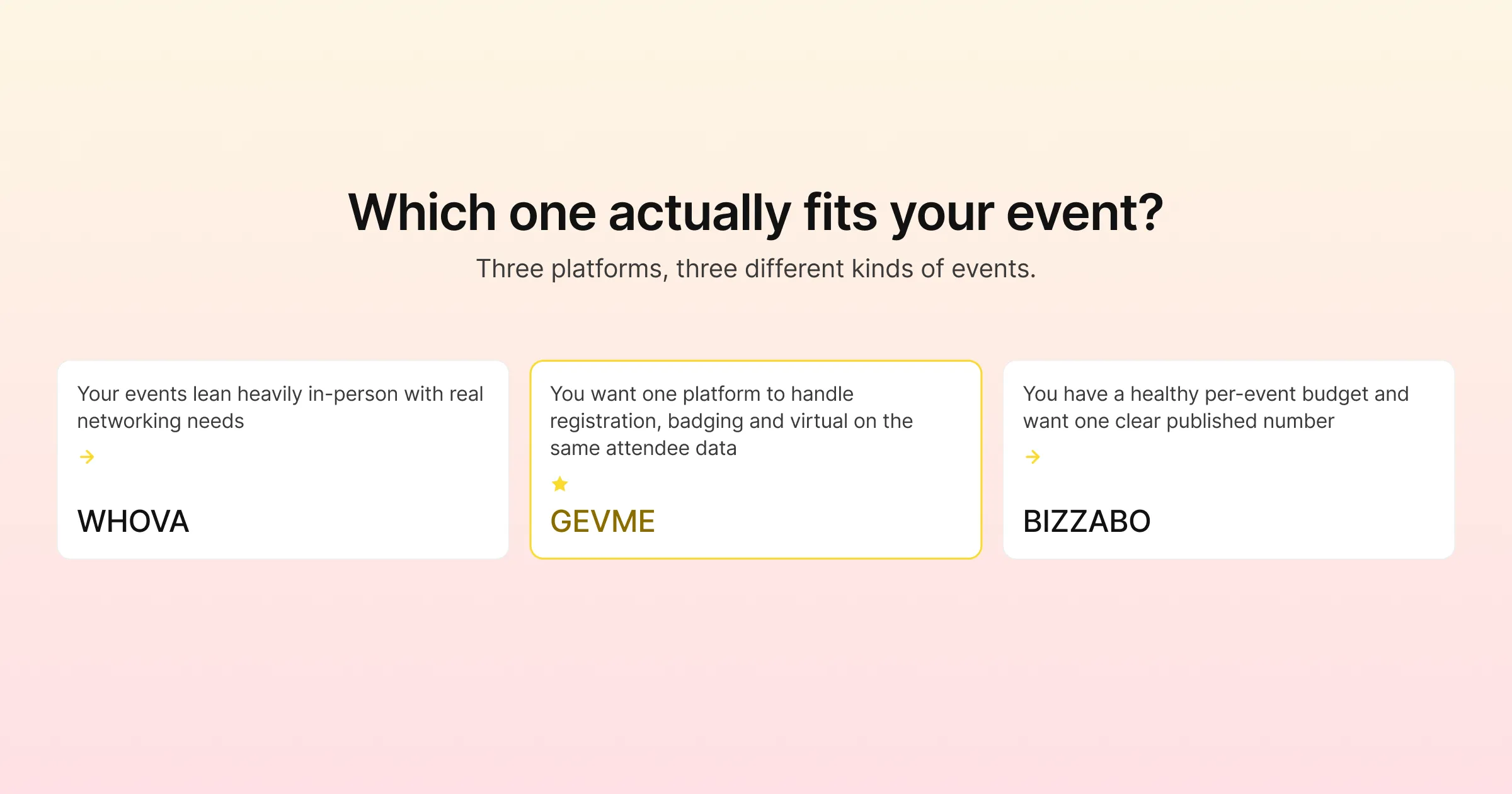
- If your events lean heavily in-person with real networking needs, Whova’s app and matchmaking tools deserve a spot on your shortlist.
- Need one platform to handle registration, badging, and a full virtual venue off the same attendee data? Look at how Gevme’s ecosystem connects those stages.
- Security and compliance certifications are not uniform across vendors. Check for ISO 27001, SOC 2, GDPR, and PDPA coverage directly instead of assuming parity.
- Exhibitor and sponsor tools vary a lot in depth. If lead capture and booth engagement matter to you, compare what each vendor actually shows organizers, not just what exhibitors see.
Why Teams Look for Whova Alternatives
Pricing That Is Hard to Plan Around
Budget certainty is the number one reason people start shopping for alternatives to any event app. Whova does not publish plan prices or per-attendee rates anywhere on its site. Its pricing page instead asks for your event format, duration, expected attendance, and how many events you run a year. It then routes you toward a quote or a demo call. Plenty of event tech vendors work this way. Even so, it means you cannot compare costs early in a search without picking up the phone first, and that slows procurement down for any team that needs a real number before finance will look at a shortlist.
Wanting One System Instead of Several
Consolidation is the second big driver. Most teams start with an event app for onsite engagement, add a separate registration tool, then bolt on a virtual platform the first time they need to run a hybrid session. It works, until attendee data is scattered across three systems and nobody can say which list is current. What people searching for Whova alternatives usually want is one platform where registration, check-in, and the virtual experience all pull from the same attendee record.
Deeper Exhibitor and Sponsor Tooling
Trade shows and B2B conferences want more than scan-to-capture-a-lead these days. They want interactive booths, structured meeting scheduling between exhibitors and attendees, and a dashboard where the organizer can see exhibitor performance without asking someone for a screenshot. Not every event app was built with that depth in mind from day one. So some organizers go looking elsewhere specifically for exhibitor and sponsor features.
Meet the Alternatives
Whova, Summed Up
Whova is an event app built mainly for in-person and hybrid conferences, trade shows, and academic or association events. Per Whova’s homepage, it covers a mobile event app with personalized agendas, registration and ticketing with flexible ticket types, name badge generation, and kiosk-based self check-in. Speaker and call-for-papers management is included, as are exhibitor tools with lead retrieval and business card scanning. It also handles live streaming and virtual sessions for hybrid formats. If your event is primarily in-person and you want an app-first attendee experience, this is exactly what Whova was built for.
Where Gevme Fits
Gevme is organized around three connected stages: Host, Run, and Prove. Those cover pre-event registration, at-event execution, and post-event reporting. All three share the same attendee data instead of exporting between separate tools. Gevme’s ecosystem page walks through how those pieces connect. On registration, it handles ticketing, forms, and attendee management through its event registration software. Onsite, it covers badge printing and check-in through its onsite registration services. For virtual and hybrid formats, the virtual event builder offers over 50 venue themes, quick setup, and native RTMP streaming. So the same platform can run a fully virtual conference or the online half of a hybrid one.
A Quick Look at Bizzabo
Bizzabo is another established name here, aimed at mid-size and enterprise teams running what it calls an “Event Experience OS.” Its pricing page prices the core platform per user per month with a three-user minimum. That starts at USD $17,999 a year on an annual contract, with no option to buy for a single event. Klik SmartBadge wearable technology is a separate add-on with its own custom pricing. It is a capable platform, especially for larger teams already planning to run every event on one system for the year. Still, the entry cost and multi-user minimum rule it out for smaller teams or one-off events.
Pricing Compared
Pricing is where these three platforms diverge the most, both in structure and in how much they tell you before you talk to anyone.
Whova keeps its numbers off the site entirely. Per Whova’s pricing page, cost is quoted per event based on format, duration, and attendee count. That can actually work in your favor for a single small event. It makes year-over-year budgeting harder, though, because your quote can shift every time you ask.
Gevme publishes its plans directly. Per Gevme’s pricing page, the Virtual Venue Platform has a Free plan at $0, then Starter at USD $1,050 a year, Pro at USD $2,400 a year, and Enterprise on a custom quote. The Registration Platform runs Starter and Pro at those same annual rates with no free tier, plus a custom Enterprise option. Attendee add-ons start from USD $2.10 per attendee on Starter and Pro, and an extra organizer seat runs USD $1,300 on those tiers.
Bizzabo asks for the biggest initial commitment. Per Bizzabo’s pricing page, the core platform starts at USD $17,999 a year billed annually with a minimum of three users. That works out to roughly $499 per user per month at that minimum. Klik SmartBadge wearables and professional services are quoted separately.
These numbers do not translate directly across vendors, because each one bundles different features into its entry tier. Treat this as a starting point for your own quote requests rather than a final verdict. One thing is plain, though: Gevme is the only one of the three with starting prices you can see before a sales call.
Feature by Feature
Virtual Events
Whova supports live streaming and virtual sessions mostly as an extension of its in-person app. That works fine for hybrid conferences where most of the audience is in the room. Gevme built its virtual venue as a standalone product first, meant to carry a complete virtual event end to end. It includes over 50 venue themes, native RTMP streaming, and business matchmaking on higher tiers, as detailed on the virtual event builder page. Bizzabo also supports virtual and hybrid formats inside its Event Experience OS, though its own site frames these mainly as an extension of the broader in-person platform.
Onsite and Event App
This is Whova’s home turf. Its mobile app covers personalized agendas, live announcements, on-demand badge printing, and kiosk self check-in. Its own homepage points to attendees making significantly more connections through the app’s networking features. Gevme covers the same ground through its onsite registration services: badge printing, check-in, and an event app. It has one advantage. The attendee record used at check-in also feeds registration and virtual venue data, so nothing needs re-syncing between systems. Bizzabo’s onsite experience runs on its own app plus the optional Klik SmartBadge wearables for automated networking and lead capture at booths.
Registration
Whova bundles ticketing and registration into its all-in-one platform, with flexible ticket types and payment processing. Gevme treats registration as its own product, with dedicated forms, ticketing logic, and attendee management through its event registration software. That works standalone or connected to check-in and the virtual venue. Bizzabo includes registration as part of its Event Experience OS too, generally aimed at teams already committed to its full annual platform.
Networking and Matchmaking
Whova’s networking tools come up constantly as a reason planners choose it. In-app messaging, attendee matching and community boards matter especially for academic and association conferences, where making connections is half the point of attending. Gevme offers business matchmaking on its Pro and Enterprise tiers on the virtual venue side, aimed more at structured B2B meeting scheduling than general socializing. Bizzabo’s Klik wearables add a physical, tap-to-connect layer to in-person networking, at extra cost.
Security
Security posture deserves a closer look than most buyers give it, because not every event platform handles data the same way. Gevme maintains a public trust center covering its certifications: ISO 27001, ISO 27017, and ISO 27018, SOC 2 Type 2 certification, and compliance with GDPR, PDPA, and CCPA. It uses AES-256 encryption at rest and TLS in transit on AWS infrastructure. Details are on Gevme’s security page. Whova and Bizzabo both reference data protection commitments on their sites. Neither lists the same depth of independently certified compliance frameworks that Gevme’s trust center does. If security sign-off from IT or procurement is part of your buying process, check this directly against each vendor’s own documentation before you shortlist anyone.
Terms You Will Run Into
- RTMP streaming: Real-Time Messaging Protocol, the standard method for pushing live video into a virtual venue or streaming platform. Gevme uses it for native live streaming without a third-party plugin.
- Badge printing and onsite check-in: generating and printing an attendee’s name badge on arrival, usually paired with a kiosk or a staffed check-in desk. All three platforms here offer it.
- Business matchmaking: software-driven scheduling that pairs attendees or exhibitors with relevant meeting partners based on interests or goals, distinct from general social networking features.
- SOC 2 Type 2: an independent audit standard confirming that a company’s security controls actually operated effectively over a period of time, not just that they existed on paper.
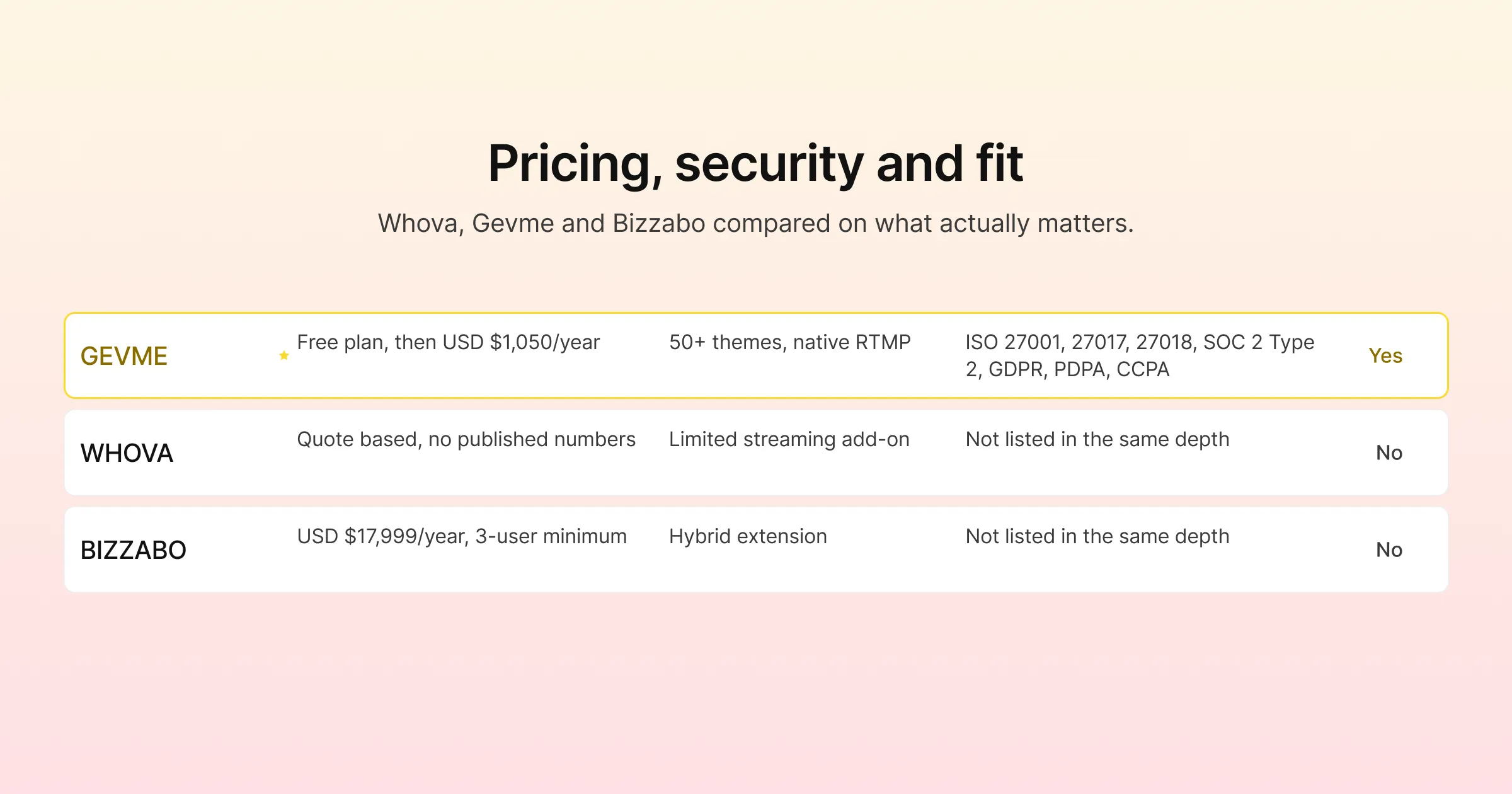
Whova vs Gevme vs Bizzabo at a Glance
| Feature | Gevme | Whova | Bizzabo |
|---|---|---|---|
| Starting price | Free plan, then USD $1,050/year (Starter) | Quote based, no published numbers | USD $17,999/year, 3-user minimum |
| Pricing transparency | Published on site | Available on request | Published on site |
| Virtual venue platform | Yes, 50+ themes, native RTMP | Limited, streaming add-on to in-person app | Limited, framed as hybrid extension |
| Onsite check-in and badging | Yes | Yes, a core strength | Yes, plus optional wearables |
| Registration and ticketing | Yes, standalone or connected | Yes | Yes |
| Business matchmaking | Yes, Pro and Enterprise tiers | Not listed on their site | Available via Klik wearables, extra cost |
| Exhibitor and lead capture tools | Yes, with organizer dashboard visibility | Yes, scanning and digital profiles | Yes, via Klik wearables |
| Security certifications listed | ISO 27001, 27017, 27018, SOC 2 Type 2, GDPR, PDPA, CCPA | Not listed on their site in the same depth | Not listed on their site in the same depth |
| Free tier available | Yes, Virtual Venue Platform | No | No |
Who Should Choose Which
Choose Whova If…
You are running a mostly in-person conference, academic gathering, or trade show. A well-reviewed mobile app and strong attendee-to-attendee networking matter more to you than a unified virtual platform. You also do not mind requesting a quote before you see a number.
Choose Bizzabo If…
You are a larger organization already planning to run every event of the year on one contracted platform. Your budget can absorb a five-figure annual minimum, and you want wearable-based networking built into the onsite experience.
Choose Gevme If…
You need registration, onsite check-in, and a full virtual venue working off the same attendee data, without exporting between tools. Or you would rather see actual plan prices before requesting a custom quote. Or your events mix formats across the year: some fully virtual, some hybrid, some in person. Gevme’s use cases for hybrid events and conferences both walk through how the same account handles different formats.
Pro Tip
Before you request a quote from any vendor, Whova included, write your actual numbers down first. That means expected attendee count, whether you need onsite badge printing, whether any sessions will be virtual or hybrid, and how many events you are running over the next twelve months. Vendors that quote per event will ask for exactly this information anyway. Having it ready before the call means you get a real number faster, instead of a follow-up email asking for details you could have sent upfront. It also makes comparing quotes apples to apples a lot easier.
Frequently Asked Questions
No. Whova does not offer a free plan. Its pricing page routes every request through a quote form based on your event format, size, and frequency. So you will need to submit details or book a demo to get a cost.
Yes, for the Virtual Venue Platform. Gevme pricing page lists a Free plan at $0 that includes the website builder, virtual venue editor, and access to 50-plus themes. The Registration Platform has no free tier and starts at the Starter plan.
Whova supports live streaming and virtual sessions. However, its own site frames this mainly as an extension of its in-person and hybrid event app rather than a standalone virtual venue product. If your event is entirely virtual and needs its own themed environment, compare that specifically against a platform built for virtual-first events.
The two are structured too differently for a direct dollar comparison to mean much. Gevme Starter plan is USD $1,050 a year with attendee add-ons from USD $2.10 per person. Bizzabo core platform starts at USD $17,999 a year with a three-user minimum. Which one costs less depends on how many users and attendees your program needs.
Gevme holds ISO 27001, ISO 27017, and ISO 27018 certifications, SOC 2 Type 2 certification, and compliance with GDPR, PDPA, and CCPA. It also uses AES-256 encryption at rest and TLS encryption in transit, hosted on AWS. Full details are on the Gevme security page.
Yes, all three do, though at different depths. Gevme exhibitor and sponsor tools include a lead scanning app and interactive virtual booths with chat, polls, and product showcases, and organizers see the same dashboard view exhibitors do. Whova offers lead retrieval and business card scanning. Bizzabo offers lead capture mainly through its Klik SmartBadge wearables, at additional cost.
Gevme and Bizzabo both publish plan prices directly on their pricing pages, so you can see a starting number without a sales call. Whova requires you to submit event details through its quote form first.
Conclusion: Fit Over Familiarity
Whova has earned its reputation honestly. Its event app is polished, its networking tools help attendees connect at in-person conferences, and its onsite check-in and badge printing hold up. Bizzabo is a solid pick too, for larger organizations ready to commit to one platform across a full year of events, especially if wearable-based networking appeals to your crowd. Neither is a bad choice for the events they were built around.
The real question is whether your events actually match what each platform was designed for. Maybe you need one system carrying the same attendee data from registration through onsite check-in into a full virtual venue, with no spreadsheets exported between tools. Maybe you would rather see real plan prices than start with a quote request. Gevme is built for that combination. Compare the numbers yourself on the pricing page, or skip ahead to a walkthrough by requesting a demo.