Running a conference or summit is a different kind of project than most other events. You’re juggling a multi-track agenda, a call for speakers, sponsors who expect a return on their booth fee, and a badge line that needs to move fast on the first morning. A single spreadsheet and a generic ticketing tool can carry you through a small meetup. However, conferences are different. Once you’re managing parallel sessions, exhibitor floor plans and a mobile app attendees genuinely open, you need purpose-built software.
The market for that software is crowded. Vendors range from broad enterprise suites to tools built primarily for webinars that have added in-person features later. This guide walks through what conference management software should do, and what Gevme and its main alternatives charge and offer. Cvent, Bizzabo, Swapcard, EventsAIR, EventMobi, Whova and EventX are all covered. It also sets out how to think about which one fits the kind of conference or summit you run.
Specifically, this guide covers why conferences need dedicated software rather than general event tools, and what each major platform costs today. It compares them on agenda building, sponsor management, networking and on-site check-in. Finally, it offers a short glossary for anyone new to the category, plus a decision framework for shortlisting your finalists.
Key Takeaways
- Conference-specific features to look for include a multi-track agenda builder, a call-for-speakers workflow, sponsor and exhibitor management with lead capture, and on-site badge printing, not just basic registration.
- Pricing transparency is inconsistent across the category. Gevme, Bizzabo and EventMobi publish real starting figures, while Cvent, EventsAIR, Whova, BigMarker and EventX keep pricing behind a sales conversation.
- Gevme’s Registration Platform and Virtual Venue Platform are priced separately, both starting at USD $960 a year. So you can scope the spend to what your conference format actually needs.
- If your conference depends heavily on sponsor ROI and attendee networking, Swapcard’s AI-driven matchmaking is the most established feature in that specific niche among the platforms compared here.
- For a large, multi-track, recurring conference or summit series, Cvent and EventsAIR both have the depth to support it, including venue sourcing, complex reporting and high-volume badge printing. The cost is a longer, quote-driven sales process.
- Don’t rule a platform out for hybrid delivery based on assumptions. Gevme runs a genuinely capable virtual venue alongside its on-site tools, and several other vendors here handle both formats well rather than specializing in just one.
- Check each vendor’s own pricing page directly before budgeting. Several platforms in this space, EventMobi, Accelevents and EventX among others, have changed their published pricing structure within the past year.
Why Conferences and Summits Need Dedicated Software
A conference isn’t one event, it’s several running at once. Multiple concurrent tracks need their own schedules and room assignments. Speakers need a submission and review process before anyone finalizes the agenda. Sponsors and exhibitors need their own portal and their own floor plan placement. They also need a way to capture leads that justifies the booth fee. None of that fits comfortably inside a general-purpose ticketing tool built for single-session events.
There’s also a scale problem that shows up specifically at conferences: badge lines. A poorly handled check-in queue on the first morning colors how attendees remember the whole event. So conference organizers need on-site software that prints badges quickly at volume. A system designed for a slow trickle of arrivals over a full day will not do.
Finally, conferences carry more financial pressure than most internal events, because sponsors and exhibitors are paying customers with their own expectations. A platform’s exhibitor tools, lead capture quality and reporting directly affect whether a sponsor renews next year. As a result, those features become a genuine revenue consideration rather than a nice-to-have checkbox.
What Conference Management Software Should Actually Do
At minimum, look for registration and ticketing with support for multiple ticket types. You also want a session and speaker management system that handles a call for proposals and multi-track scheduling. Add sponsor and exhibitor tools with lead capture, plus on-site or mobile check-in with badge printing. Some form of virtual or hybrid delivery for remote attendees rounds that out. Reporting that shows session attendance and sponsor engagement afterward closes the loop for next year’s planning.
Gevme covers this ground through the same Host, Run, Prove structure it applies across its platform. Registration and agenda setup come before the event. On-site check-in and a template-driven virtual venue run during it. Reporting follows once it wraps. The virtual venue side includes more than 50 themes and RTMP streaming for hybrid delivery, plus business matchmaking on its higher tiers, which is directly relevant to the networking side of a conference.
What Conference Management Platforms Actually Cost
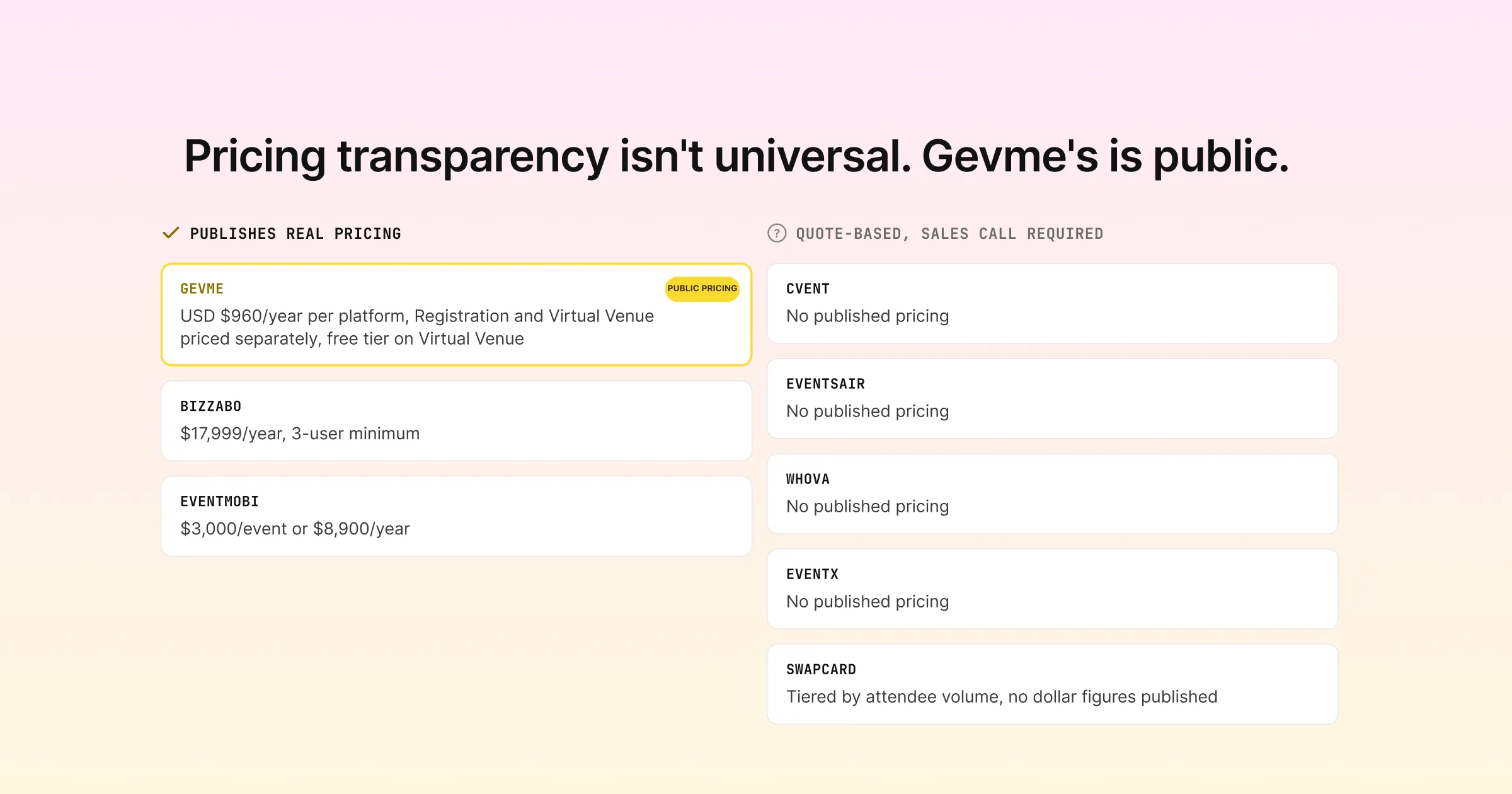
Gevme prices its Registration Platform and Virtual Venue Platform separately. Per Gevme’s pricing page, checked in late August 2026, both start at USD $960 a year on the Starter plan and USD $2,160 a year on the Pro plan, with a quote-based Enterprise tier on each. The Virtual Venue Platform also has a free tier for testing before you commit spend, which the Registration Platform doesn’t offer.
Cvent keeps its pricing behind a sales conversation. Per Cvent’s pricing page, checked in late August 2026, buyers choose between a Professional tier and an Enterprise tier with unlimited logins, SSO and API access. No dollar figures appear anywhere on the page.
Bizzabo publishes a real number, unusually for this category. Per Bizzabo’s pricing page, checked in late August 2026, its Event Experience OS starts at $499 per user per month billed annually with a three-user minimum. That works out to $17,999 a year, with its Klik SmartBadge wearable hardware quoted separately.
Swapcard’s structure has two tiers based on attendee volume before pricing goes fully custom. Per Swapcard’s pricing page, checked in late August 2026, its Starter tier covers up to 1,000 attendees a year and its Professional tier up to 10,000. Swapcard prices an Enterprise tier for unlimited volume on request. The site states that pricing combines an annual license fee with a per-attendee and per-exhibitor component. It does not show exact dollar amounts for either tier.
EventsAIR, EventMobi, Whova and EventX
EventsAIR keeps its Single, Multi and Enterprise tiers named but quote based. Per EventsAIR’s pricing page, checked in late August 2026, EventsAIR includes mobile apps, badge printing and exhibitor services across all three tiers rather than selling them as add-ons. The vendor positions that as a differentiator against competitors that charge extra for those pieces.
EventMobi is one of the more transparent vendors on raw numbers. Per EventMobi’s pricing page, checked in late August 2026, its per-event plan starts at $3,000. Its per-year plan, aimed at organizers running multiple events annually, starts at $8,900 and includes a dedicated Event Success Manager. EventMobi itemizes add-ons too: badges from $3.99 each, streaming packages from $500 an event.
Whova doesn’t show any pricing on its site. Per Whova’s pricing page, checked in late August 2026, the page collects your event details and routes you to a custom quote rather than displaying tiers.
EventX is a Hong Kong-based platform with a strong presence across the Asia-Pacific region, and it also keeps pricing off its site. Per EventX’s pricing page, checked in late August 2026, the page shows no tier names or figures, and routes visitors to a sales conversation instead.
Two Niche Options
Two more platforms are worth knowing about if your conference has a specific shape. BigMarker is quote based across Basic, Enterprise and Enterprise+ tiers sized by attendee capacity, per its pricing page, checked in late August 2026. However, it is built primarily as a webinar platform with in-person conference features as a secondary layer. iVvy is quote based too, per its FAQ page, checked in late August 2026, and built mainly around venue sourcing and room booking rather than attendee-facing conference management.
Feature-by-Feature: Agenda, Sponsors, Networking and On-Site
Agenda and Speaker Management
Multi-track agenda and speaker management separates conference-grade software from general event tools. Cvent, Bizzabo, Swapcard, EventsAIR and EventMobi all offer session and speaker management with varying depth. EventsAIR in particular is built for organizers running complex, multi-track programs. It includes visual agenda building alongside abstract and speaker review workflows. That fits associations and professional conference organizers managing academic-style submission processes.
Sponsor and Exhibitor Tools
Sponsor and exhibitor tools are where conference platforms most clearly earn their keep. Swapcard’s exhibitor lead center includes lead scoring and qualification. Swapcard builds it around what the company calls a revenue-first approach, putting exhibitor ROI at the center. Bizzabo and Cvent both offer sponsor portals and lead capture as part of their broader suites. Gevme, Cvent, Bizzabo, Swapcard and EventsAIR all support virtual exhibitor booths for hybrid conferences. That matters if part of your sponsor base wants a presence without traveling.
Networking and Matchmaking
On networking, Swapcard remains the platform most identified with AI-driven matchmaking, through its Sherlock AI feature that recommends sessions and connections based on attendee behavior. EventsAIR bundles AI-powered meeting matching into its own suite as well. Gevme’s business matchmaking is available on its higher Virtual Venue tiers. It covers similar ground for conferences that want structured networking without adopting a separate matchmaking tool. Whova is well known for mobile app engagement broadly, with features like gamified session check-ins and a call-for-speakers workflow built in. That said, its own site doesn’t make specific matchmaking claims to the same degree as Swapcard or EventsAIR.
On-Site Check-In and Badge Printing
On-site check-in and badge printing is close to universal across this list, but the details differ. EventMobi publishes concrete per-badge and hardware rental costs rather than folding them into a quote. EventsAIR includes badge printing in every tier rather than as an add-on. Gevme’s on-site tools cover badge design and printing alongside self-service kiosk check-in, aimed at moving a queue quickly on a conference’s opening morning.
BigMarker’s own site is weighted heavily toward webinar and virtual-session functionality. It puts less emphasis on the dedicated multi-track agenda building and on-site badge printing that the other platforms in this guide foreground, which matters for conference organizers with a significant in-person component.
Security and Payment Handling
Security and payment handling matter more for conferences than they might first appear, especially once ticket sales and international attendees are involved. Selling paid tickets means the platform processes card payments. So PCI DSS compliance is not optional. Cvent, Swapcard, EventMobi, Whova and Accelevents all state SOC 2 compliance on their own sites. Swapcard and Cvent both confirm PCI DSS and GDPR alignment directly, which matters if your summit draws attendees or sponsors from the EU. If your conference runs across multiple countries, or brings in government or regulated-industry attendees, compliance documentation deserves the same scrutiny as agenda features. Coverage is not identical across every vendor in this category.
A Few Terms Worth Knowing
- Call for speakers (CFP): The process of collecting, reviewing and scheduling speaker submissions before a conference agenda is finalized.
- Multi-track agenda: A schedule with two or more sessions running in parallel across different rooms or stages, requiring attendees to choose between them.
- Lead capture: The tools exhibitors and sponsors use to collect contact information from booth visitors, usually through badge scanning or an app-based exchange.
- Hosted buyer program: A model where an organizer pre-qualifies and invites specific attendees, often procurement decision-makers, to meet with exhibitors. It’s common at B2B conferences and trade-focused summits.
How Gevme and Its Alternatives Compare
| Platform | Starting Price | Agenda & Speaker Management | Sponsor & Exhibitor Tools | On-Site Check-In & Badging |
|---|---|---|---|---|
| Gevme | USD $960/year per platform (free tier on Virtual Venue) | Registration platform handles ticketing and sessions; business matchmaking on top tiers | Included, with virtual exhibitor booths on the Virtual Venue platform | Included, with badge design and self-service kiosks |
| Cvent | Quote based, no published numbers | Full session and speaker management suite | Included, plus a large venue-sourcing network | Included, plus kiosk check-in |
| Bizzabo | $17,999/year (3-user minimum) | Included, with a speaker portal | Included, with sponsor lead management | Included, plus Klik SmartBadge wearable hardware |
| Swapcard | Starter/Professional tiers by attendee volume, Enterprise quote based | Included, with agenda and abstract management | Strong exhibitor lead scoring and hosted buyer programs | Included, with access control |
| EventsAIR | Quote based, no published numbers | Visual multi-track builder with abstract/speaker review | Included in every tier, not sold as an add-on | Included in every tier, with custom badge layouts |
| EventMobi | $3,000/event or $8,900/year starting | Included | Included, with itemized add-on pricing | Included, with transparent per-badge and hardware pricing |
| Whova | Available on request | Included, with a call-for-speakers workflow | Included, with sponsor digital profiles | Included |
| EventX | Quote based, no published numbers | Registration and website builder included | Included, with an AI lead-finder tool | Included, with badge printing |
Sources, checked in late August 2026, are each platform’s own pricing or product pages: Gevme, Cvent, Bizzabo, Swapcard, EventsAIR, EventMobi, Whova, EventX. Vendor pricing pages change often. Confirm directly before you budget against any figure here.
Which Platform Fits Which Kind of Conference
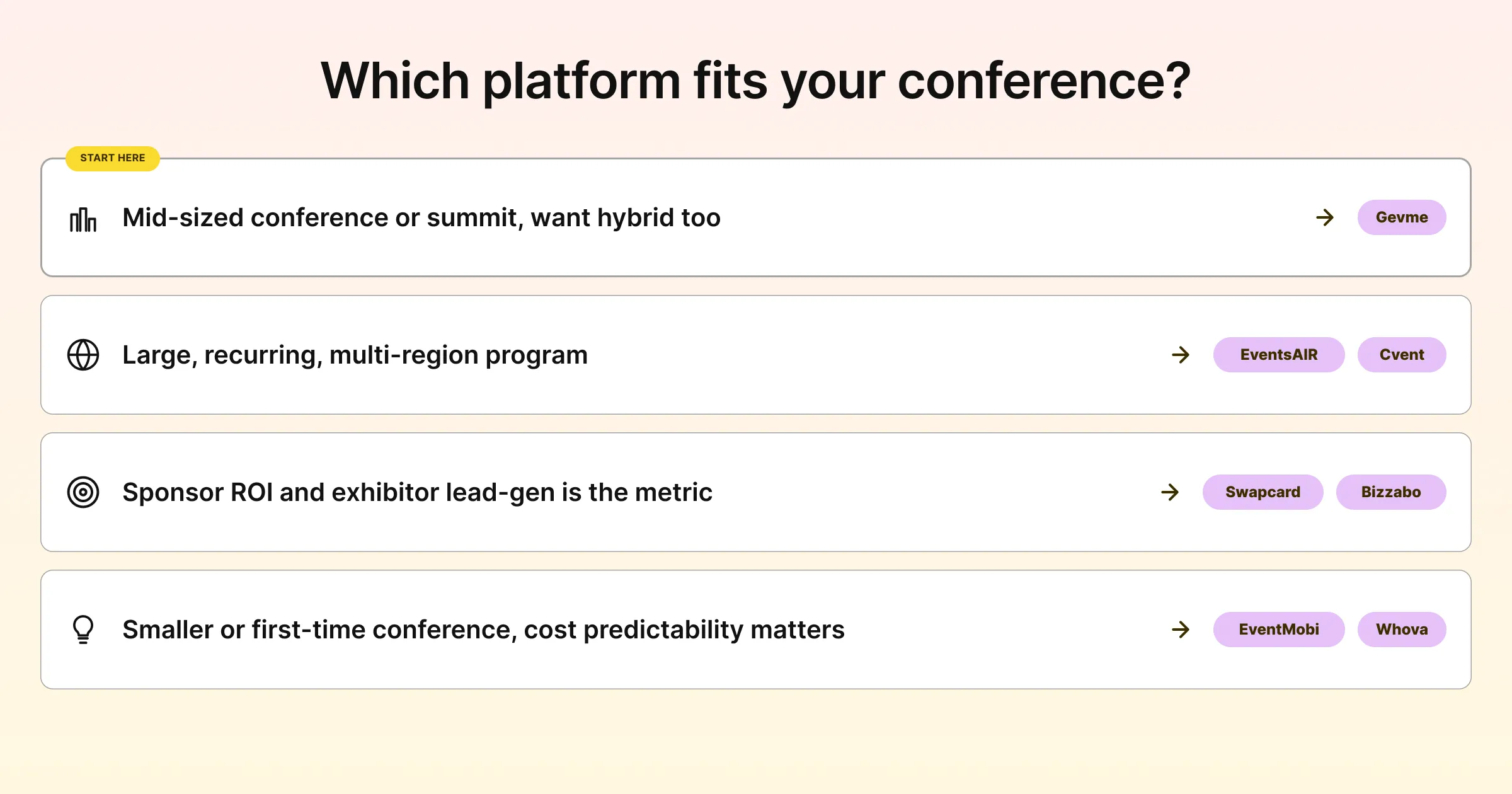
Perhaps you’re organizing a mid-sized conference or annual summit and want registration, agenda management, on-site check-in and a hybrid or virtual option working from the same attendee data. In that case, Gevme’s registration platform paired with its virtual venue is a reasonable starting point. Its published pricing and the option to test the virtual side for free before paying both help.
Larger programs point elsewhere. If your conference is recurring across multiple regions, or run by a professional conference organizer managing dozens of events a year, EventsAIR is built for exactly that. It includes badge printing and exhibitor tools in every tier, plus a multi-track abstract review workflow. Cvent fits a similar high-volume profile, especially if venue sourcing across many cities is part of your job. Expect a longer, quote-driven sales process for both.
Where sponsor revenue and exhibitor ROI are the metric your conference gets judged on, Swapcard’s networking and lead-scoring tools are the most specifically built for that outcome among the platforms compared here. Bizzabo’s CRM integrations serve a similar audience. For a smaller or first-time conference, ease of use and cost predictability matter more than deep configuration. There, EventMobi’s itemized pricing and Whova’s mobile app strength both fit better than a heavier enterprise platform.
Pro Tip
Run your badge-printing and check-in workflow as a live test with real hardware before your event, not just a walkthrough of the software’s dashboard. There is a real gap between how check-in looks in a demo and how it performs with a real queue, a shared wifi network and a printer that’s been running for three hours. That gap causes most conference-morning problems. Catching it a week early costs far less than fixing it on opening day.
Frequently Asked Questions
Conference management software adds features general event tools often lack. Those include multi-track agenda and speaker management, a call-for-speakers workflow, dedicated sponsor and exhibitor tools with lead capture, and on-site check-in built to handle a large badge queue quickly.
Yes. Gevme virtual venue platform runs alongside its on-site check-in and registration tools. It supports RTMP streaming and business matchmaking for remote attendees, while the in-person side handles badging and check-in.
Swapcard and Bizzabo are both built with strong sponsor and exhibitor tooling, including lead capture and, in Swapcard case, lead scoring aimed specifically at exhibitor ROI. Gevme, Cvent and EventsAIR also support exhibitor management, including virtual booths for hybrid formats.
It varies widely by vendor and by how pricing is structured. Some platforms, like Gevme, Bizzabo and EventMobi, publish real starting figures beginning in the low thousands of dollars a year. Others, including Cvent, EventsAIR, Whova and EventX, require a sales quote before revealing any numbers.
It is positioned that way, with a Single tier for one event still available for smaller organizers. Its real strength shows up on complex, multi-track, recurring programs, particularly for associations and professional conference organizers.
Most of the platforms in this guide, including Gevme, Swapcard, EventsAIR and Whova, include networking or matchmaking features directly. So a separate networking app usually is not necessary, unless you have a very specific requirement your chosen platform does not cover.
Beyond the standard feature checklist, run the badge printing and check-in workflow with real hardware ahead of time. Confirm how the sponsor portal looks from an exhibitor perspective. Also check whether the mobile app is something your team can update yourselves, or whether it requires vendor support for every change.
Conclusion: Matching the Platform to the Conference
Cvent and EventsAIR have earned their place with organizers running large, complex, recurring conference programs. Swapcard has built real credibility around sponsor ROI and AI-driven networking. Bizzabo, EventMobi and Whova each serve a slightly different segment of the market well, from portfolio-level event management to straightforward, well-supported mid-sized conferences.
Suppose you’re organizing a conference or summit and want registration, agenda and on-site check-in working alongside a genuinely capable virtual or hybrid option, without stitching several vendors together. Gevme is worth including in your shortlist. Its pricing is public, both product lines start at USD $960 a year, and the free tier on its virtual venue platform means you can test the hybrid experience before spending anything. If that matches the conference you’re planning, request a demo and walk through your actual agenda with the team.