Associations don’t run events the way corporate marketing teams do. A single annual conference might involve a call for abstracts months in advance, a review committee scoring submissions, and continuing-education credits tied to specific sessions. It can also mean member versus non-member pricing and a handful of regional chapter events happening on their own calendars in between. None of that shows up in a generic “event management software” search. That’s why association buyers often end up demoing three platforms before finding one that actually fits how their organization runs.
The good news is that a real category of software has grown up specifically around this. Some platforms built their reputation almost entirely on associations and scientific or medical conferences. Others are broader event platforms that added membership-aware features once enough association customers asked for them. Knowing which is which, and what each one actually does well, saves a lot of wasted demo calls.
This guide covers what to actually look for in event software for associations, an honest look at the platforms association teams compare most, and real pricing where it’s published. It also includes a comparison table and a framework for matching a platform to your organization’s size and structure.
Key Takeaways
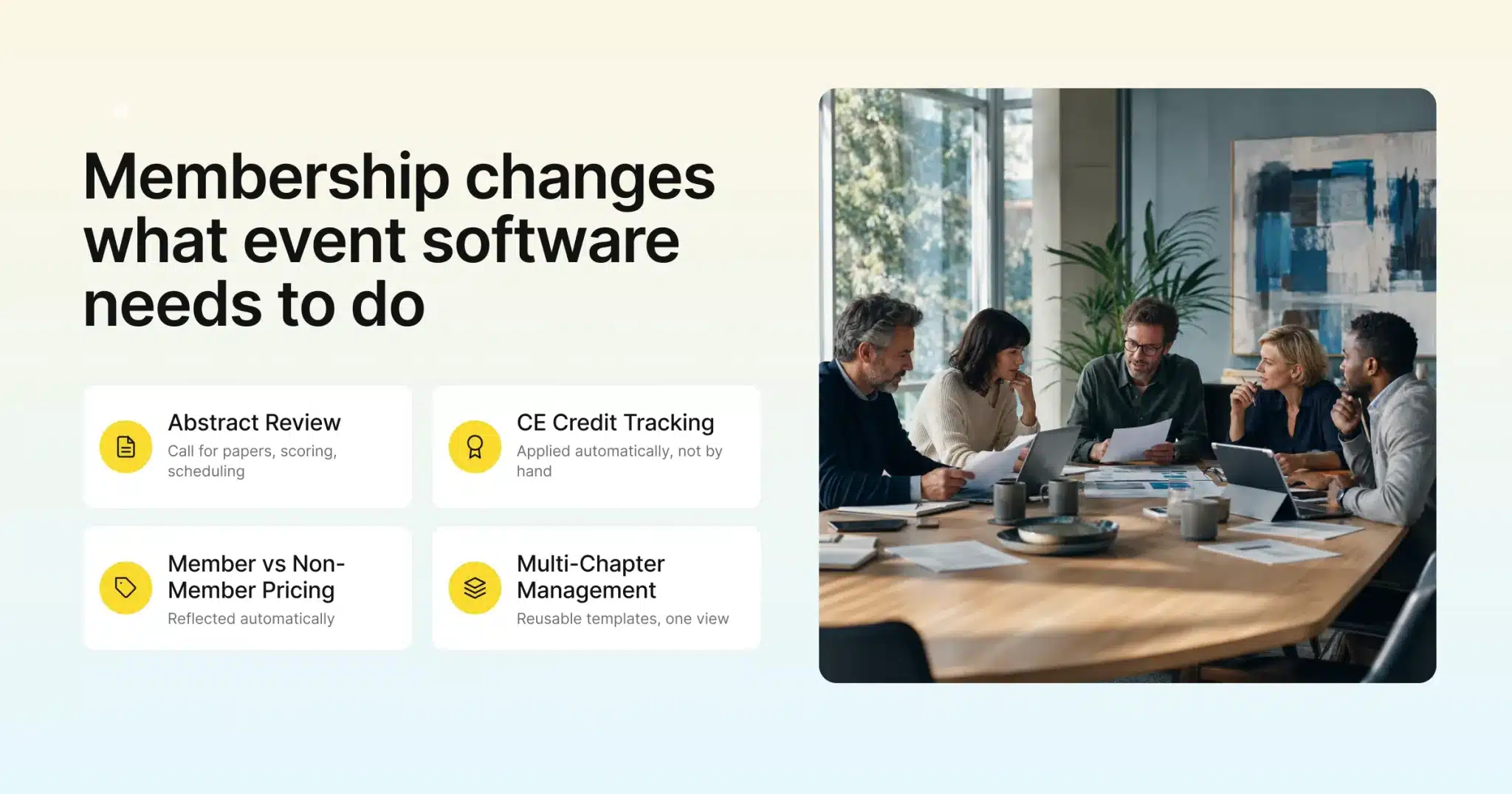
- Association events have specific software needs that generic event platforms often don’t cover well. That includes abstract submission and review, continuing-education tracking, member versus non-member pricing, and multi-chapter management.
- EventsAIR has the strongest track record among the platforms compared here, with continuing-education tracking and abstract management built specifically for association and scientific conference workflows.
- Glue Up is built primarily as membership management software with events as one module. That’s a different starting point than platforms built primarily around running events.
- Cvent brings scale and integrations with association management systems like Salesforce and Personify. It serves over 4,000 association and non-profit customers per its own site.
- Gevme’s advantage for associations spanning virtual, hybrid, and onsite chapter events is unified registration, check-in, and virtual data across every format.
- Pricing varies widely. Glue Up starts around $3,000 to $6,500/year for its Professional tier, and Gevme’s registration and virtual products start at $960/year per product line. Cvent, EventsAIR, and Swapcard are all quote-based.
- The right fit depends heavily on what’s actually complex about your association’s calendar. That could be abstract review, membership tiers, multi-chapter coordination, or simply running a large annual conference well.
Why Associations Need Software Built for Membership, Not Just Registration
A corporate event team usually plans one event at a time. Typically, it sells tickets to whoever wants to attend and moves on to the next one. An association’s calendar looks different. There’s often one flagship annual conference surrounded by a rotating set of chapter meetings, webinars, and regional events. All of it ties back to a membership base that expects different pricing and different content. Sometimes that includes different levels of access, too, depending on their membership tier.
Layer in continuing-education requirements for licensed professionals and a call-for-papers process that needs review and scoring before a single session gets scheduled. Add a board or committee that wants clean reporting at the end of it all. It becomes clear why “just use whatever event platform is popular” doesn’t always hold up for associations. The software needs to understand membership as a first-class concept, not bolt it on as an afterthought.
There’s also a revenue dimension that’s specific to associations. Many rely on their annual conference as a meaningful share of yearly income, through registration fees, sponsorships, and exhibit hall sales. That means the software running that event isn’t just a logistics tool. It’s tied directly to the organization’s budget. A clunky registration flow or a sponsor portal that frustrates exhibitors doesn’t just create a bad experience. It can show up as a real number on next year’s financial statement.
What to Look for in Event Management Software for Associations
- Abstract and session submission management. For academic, scientific, and medical associations especially, the ability to collect submissions, assign reviewers, and score entries matters most. Building a session schedule from the results is often the single most important feature on the list.
- Continuing education (CE/CPD) tracking. Members needing credits for licensure or certification change what to look for. Find a platform that can automatically apply credit when a member attends or completes a session, rather than tracking it manually after the fact.
- Member versus non-member pricing. Registration needs to reflect membership status automatically. Ideally, that status pulls from wherever your membership records already live, rather than requiring manual list management for every event.
- Membership system (AMS) integration. Most associations already run a membership database or association management system. Check how well a prospective event platform connects to it, since re-entering member data for every event gets old fast.
- Multi-chapter and multi-event management. Associations running regional chapters or a recurring calendar of smaller events alongside a flagship conference need something more. Look for reusable templates and centralized visibility across all of them, not a fresh setup every time.
- Sponsor and exhibitor tools. Many association conferences fund a meaningful share of their budget through an exhibit hall. So sponsor self-service portals and lead capture matter here too.
- Reporting for leadership and committees. Boards and committees want clean numbers: attendance, revenue, CE credits issued, session ratings. A platform that makes that reporting straightforward saves real time after every event.
The Platforms Associations Actually Compare
Gevme
Gevme’s core strength for associations is data unification across formats: registration, on-site check-in and badging, and a virtual venue all share the same attendee data. For associations running a flagship in-person conference alongside virtual chapter meetings or hybrid regional events, that matters a lot. Member and attendance data stays connected rather than scattered across separate systems for each format. Gevme’s broader ecosystem also includes ICCA BizWin, a business-development and RFP tool built specifically for associations bidding to host international conferences. That said, it sits outside Gevme’s core registration and event platform. Pricing for the Registration Platform and Virtual Venue Platform each start at $960/year for Starter and $2,160/year for Pro, per Gevme’s pricing page, checked mid-August 2026. There’s a free tier on the virtual side and custom Enterprise quotes on both.
EventsAIR
EventsAIR has built its reputation specifically around associations and scientific or medical conferences. Per EventsAIR’s association page, checked mid-August 2026, the platform offers custom submission management covering tracking, review, and session scheduling. Reviewers are assigned automatically by theme or topic. Its continuing-education module applies credit automatically for scanned sessions and reports on enrollment, attendance, and credits issued. Member-based registration adapts to an association’s specific membership structure, offering distinct pathways for members, non-members, and special categories. Pricing runs on Single, Multi, and Enterprise tiers, all quote-based with no published dollar figure, per EventsAIR’s pricing page.
Cvent
Cvent serves a large base of association customers, claiming over 4,200 association and non-profit customers on its own site. Per Cvent’s association solutions page, checked mid-August 2026, the platform integrates with association management systems including Salesforce, HubSpot, and Personify for member authentication and engagement tracking. It also includes continuing-education credit tracking across events and offers a speaker management hub for handling submissions and logistics. Cvent doesn’t publish pricing; per Cvent’s own site, visitors are directed to request a demo or contact sales for a quote.
Glue Up
Glue Up takes a different starting point than the other platforms here. It’s built primarily as membership management software, with events as one module. The broader system also covers dues, chapter management, a CRM, and community features. Per Glue Up’s own site, checked mid-August 2026, the platform serves associations, chambers of commerce, and nonprofits. Membership renewal flows, recurring payments, and multi-tier chapter support are built in alongside event creation and registration. Per Glue Up’s pricing page, checked mid-August 2026, the Professional tier starts from $3,000 to $6,500/year, and Advanced runs $8,000 to $18,500/year. Enterprise is custom quoted, all billed annually. It’s a strong fit for associations whose core need is membership management with events attached, rather than event management with membership attached.
Swapcard
Swapcard’s strength for associations is on the networking and engagement side. Per Swapcard’s pricing page, checked mid-August 2026, its Event Features plans scale from Starter (up to 200 attendees/year) to Professional (up to 1,000/year) to Enterprise (unlimited). AI-driven matchmaking connects members with shared interests or complementary expertise, a genuine advantage for associations whose annual conference doubles as a member networking event. No flat dollar figures are published; pricing requires a live demo request.
Questions to Ask During a Demo
Feature lists read similarly across most of these platforms. A few workflows are worth walking through directly with a vendor rather than taking their word for it.
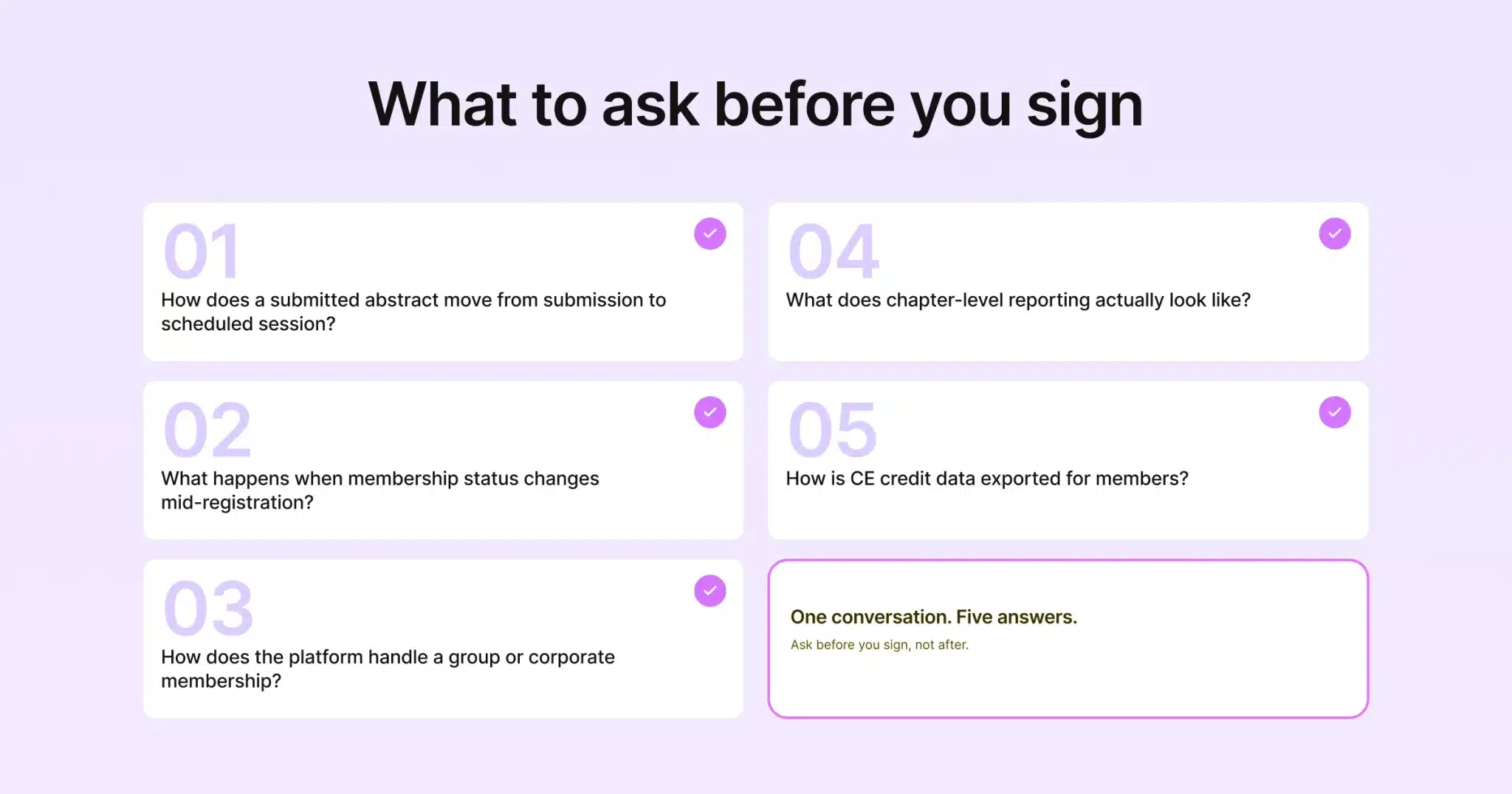
- How does a submitted abstract move from submission to scheduled session? Ask to see the reviewer assignment, scoring, and notification steps end to end, not just the submission form itself.
- What happens when someone’s membership status changes mid-registration? Take a member who lets their dues lapse, or a non-member who joins right before an event. Either way, they should see accurate pricing without manual intervention from your team.
- How does the platform handle a member attending under a group or corporate membership? Some associations offer bulk or corporate memberships covering several individual attendees. That’s a scenario that trips up registration systems built to expect only one membership record per person.
- What does chapter-level reporting actually look like? Associations with regional chapters should ask to see a real report broken down by chapter, rather than just an aggregate number for the whole organization. That’s often the exact report a board asks for after the fact.
- How is CE credit data exported for members who need proof of completion? Members often need documentation for licensing boards. So it’s worth confirming the export format and how quickly it’s available after an event ends.
A Few Terms Worth Knowing
- AMS (Association Management System): the database an association uses to track members, dues, and engagement, often separate from whatever software runs its events.
- CE/CPD credit: continuing education or continuing professional development credit awarded for attending qualifying sessions, common in licensed professions like medicine, law, and accounting.
- Abstract: a short summary of a proposed talk or research paper submitted for review before a conference, the starting point of most academic and scientific event agendas.
- Chapter: a regional or local subgroup within a larger association, often running its own smaller events under the parent organization’s umbrella.
Event Management Software for Associations Compared, 2026
| Platform | Best For | Association-Specific Features | Starting Price |
|---|---|---|---|
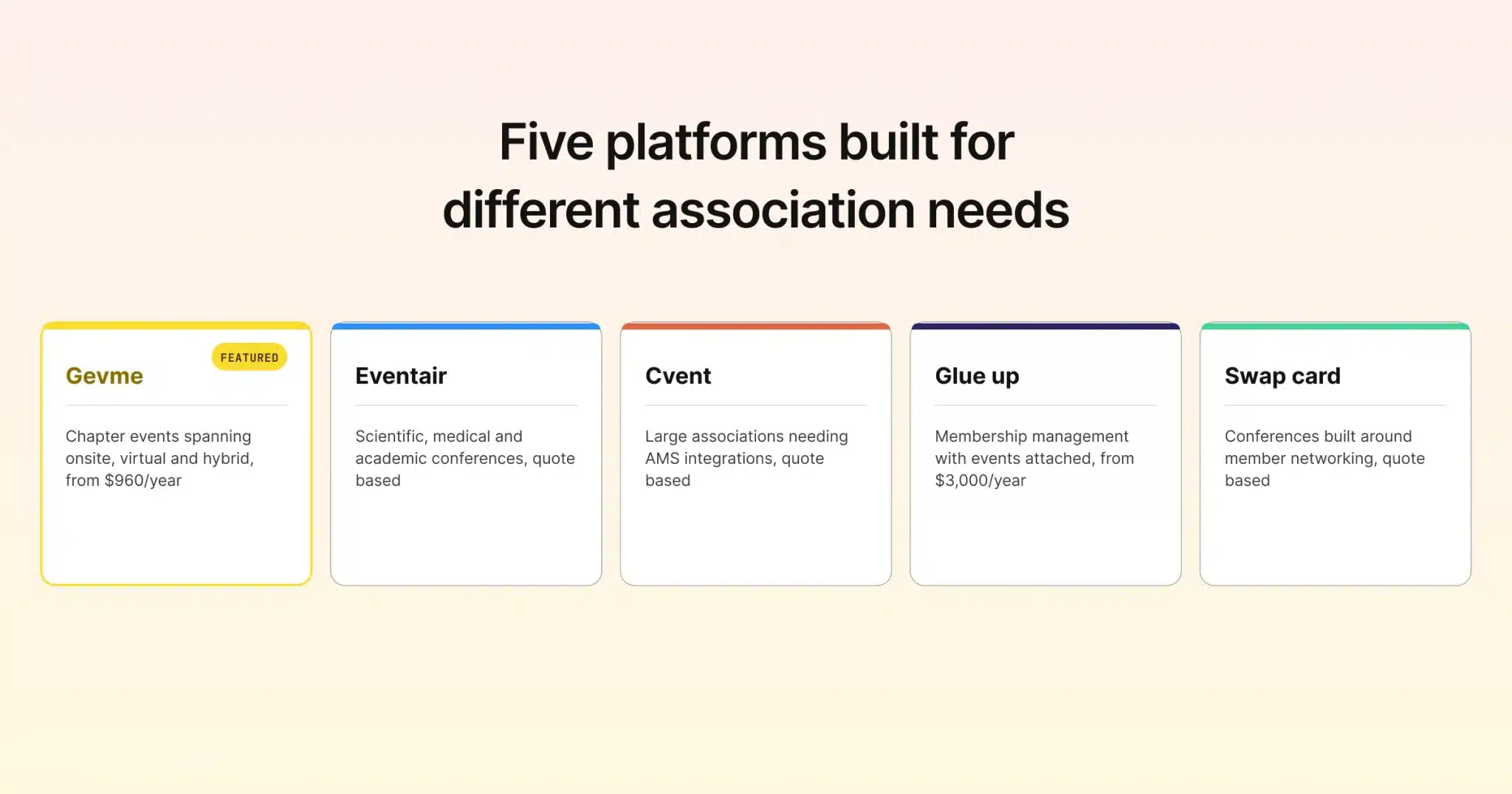
| Gevme | Chapter events spanning onsite, virtual, and hybrid | Unified registration/check-in/virtual data | $960/year per product line (Starter) |
| EventsAIR | Scientific, medical, and academic conferences | Abstract management, CE tracking, member pathways | Quote based, no published numbers |
| Cvent | Large associations needing AMS integrations | Salesforce/Personify integration, CE tracking | Quote based, no published numbers |
| Glue Up | Membership management with events attached | Dues, chapter management, member CRM | $3,000-$6,500/year (Professional, annual) |
| Swapcard | Conferences built around member networking | AI matchmaking, exhibitor tools | Quote based, no published numbers |
Sources: figures above come from each platform’s own pricing or product pages, checked mid-August 2026: Gevme, EventsAIR, Cvent, Glue Up, Swapcard. Vendor pricing pages change, so it’s worth confirming directly before you budget against any figure here.
How to Choose the Right Platform for Your Association
Start with what’s actually complex about your calendar. A flagship event built around a call for papers and continuing-education credits points hard toward EventsAIR. Those workflows are the platform’s core strength there, rather than an add-on. When your association’s real day-to-day complexity is membership itself, dues, renewals, and chapter structures, events are just one piece of that puzzle. Glue Up’s membership-first approach may fit better than starting from an event platform and bolting membership on.
Larger organizations, where AMS integrations and enterprise-grade support matter more than any single specialized workflow, may find Cvent’s scale and integration list a reasonable default. For an annual conference that doubles as members’ biggest networking opportunity of the year, Swapcard is worth a look. Its matchmaking tools solve a real problem the others don’t emphasize as heavily. Events spanning in-person, virtual, and hybrid chapter meetings, where keeping registration and attendance data connected across formats matters most, is where Gevme fits.
Size matters too. A smaller association running one annual conference and a handful of chapter meetings doesn’t need the same depth of AMS integration. A national association running dozens of events a year across multiple regions does. Matching the platform’s complexity, and its price, to your actual event volume avoids paying for enterprise features a smaller team will never use.
Staffing is worth factoring in as well. Associations run lean more often than corporate event teams. Sometimes one or two staff members handle an entire annual conference alongside their other responsibilities. A platform with strong self-service tools helps here, letting sponsors, exhibitors, and even speakers submit their own session details. That reduces how much manual coordination falls on a small team. That matters more for a lean association than it might for a larger organization with dedicated event staff for every function.
Pro Tip: Ask How Membership Status Flows Into Registration
Before you commit to a platform, ask specifically how it handles member versus non-member pricing. Do this during a live demo, not just in a slide. Some platforms sync membership status automatically from an AMS or CRM; others require manually uploading and updating member lists before every event. That difference sounds small in a sales conversation. It turns into a recurring administrative headache once you’re running it for real, especially for associations with frequent membership changes or multiple tiers.
Frequently Asked Questions
The core difference is whether membership, continuing education, and abstract review are treated as native features or afterthoughts. General event platforms can often be configured to approximate these workflows. Purpose-built or association-focused platforms like EventsAIR and Glue Up handle them directly, which usually means less manual work per event.
EventsAIR has the strongest track record here, with abstract management and continuing-education tracking built specifically for that kind of program. Associations also running hybrid or virtual chapter events with an emphasis on unified attendee data should include Gevme in that comparison as well.
Gevme’s core strength is unifying registration, check-in, and virtual data across a single event or series of events rather than deep AMS integration. Associations whose primary need is membership database integration may find Cvent’s AMS integrations or Glue Up’s built-in membership management a closer fit on that specific requirement.
It varies widely by platform and structure. Glue Up’s Professional tier starts around $3,000 to $6,500/year. Gevme’s registration and virtual products start at $960/year per product line. Cvent, EventsAIR, and Swapcard are all quote-based, with final pricing depending on event size, membership volume, and feature needs.
Still Have Questions?
Yes, most of the platforms in this comparison support running multiple events, though the depth varies. EventsAIR and Cvent both structure pricing and workflows around running several events, while Glue Up is built around managing chapters as an organizational structure from the start. Gevme and Swapcard support multiple events as well, though it’s worth confirming during a demo how much setup carries over between them.
Probably not as a first choice. Glue Up’s strength is ongoing membership management, dues, renewals, chapter structures, with events as one module. If your association’s core need is running a single well-executed annual conference rather than managing membership operations year-round, a platform built primarily around events, like EventsAIR, Cvent, or Gevme, is likely a better match. It’s worth demoing both types side by side if you’re unsure, since the difference tends to become obvious once you see how each one presents its event-setup flow versus its membership dashboard.
EventsAIR’s CE module applies credit automatically for scanned sessions and reports on enrollment, attendance, and credits issued. Cvent also offers continuing-education credit tracking across events. If CE tracking is a top priority, it’s worth testing this specific workflow directly during a demo rather than assuming it’s included at the depth you need.
Conclusion: Matching Software to How Your Association Actually Runs
Every platform here earns its place for a specific kind of association. EventsAIR’s depth in abstract management and continuing education is hard to match for scientific and medical conferences. Glue Up solves a genuinely different problem, membership operations, with events as part of the package. Cvent’s scale and AMS integrations suit large, multi-stakeholder organizations. Swapcard’s networking tools, meanwhile, serve associations whose conference is as much about connecting members as it is about content.
For associations running events across onsite, virtual, and hybrid formats, keeping registration, check-in, and attendance data connected matters as much as any single specialized workflow. Gevme’s unified approach tends to be the more direct fit here. That’s particularly true for associations whose chapter calendar spans several formats in the same year, rather than one flagship in-person conference alone.
If that sounds like your association’s next event, it’s worth a closer look. Check out Gevme’s platform or a demo to see how it holds up against your actual calendar.