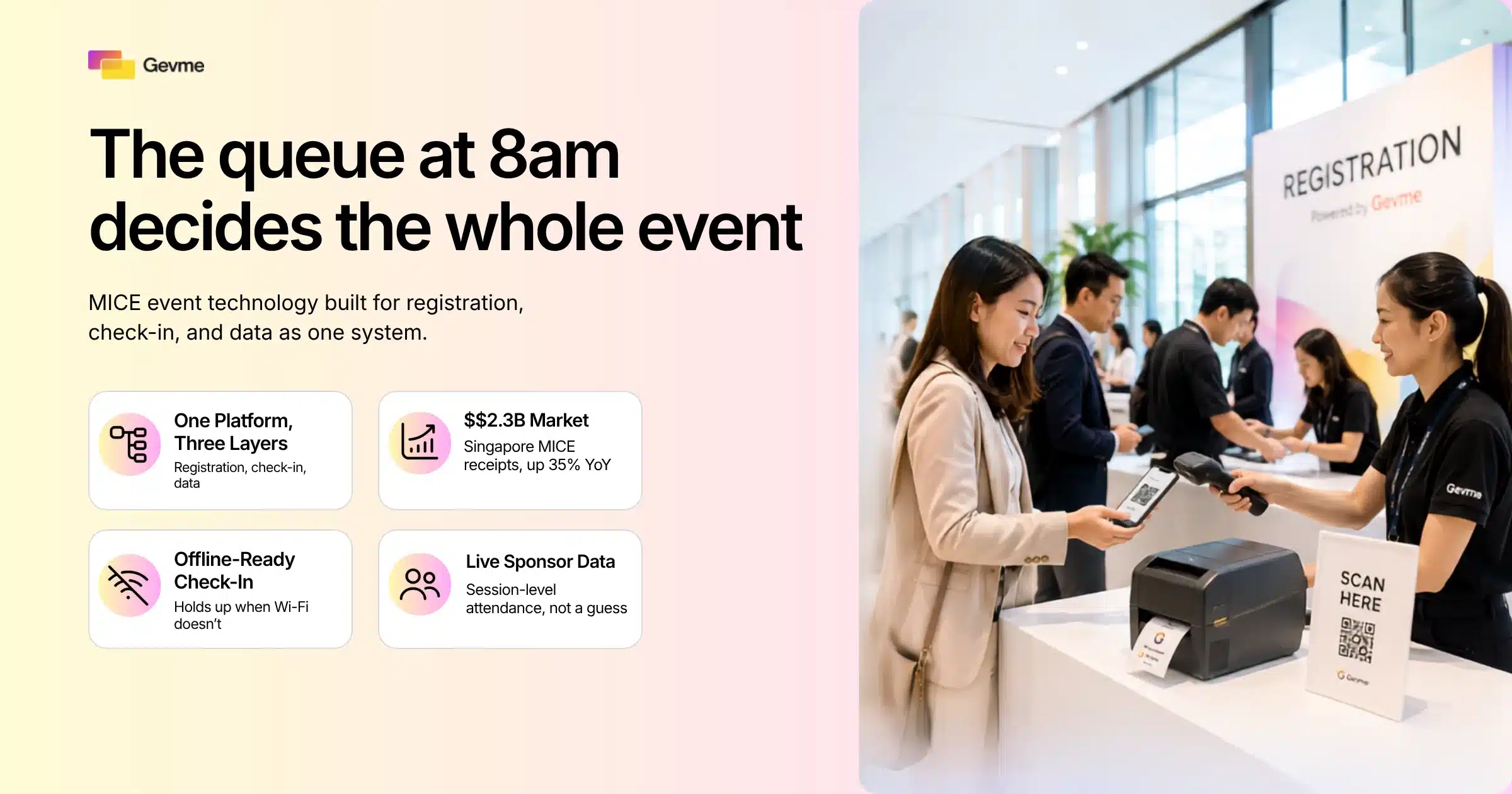
Run one MICE program in Singapore and you learn fast that the tech stack matters more than the venue. Take a three-day conference with 2,000 delegates, forty exhibitors, and a gala dinner. It does not fail because the ballroom was too small. It fails at the registration desk at 8am, when the queue is out the door. Three staff are re-typing names from a printed list. Meanwhile nobody can tell a sponsor how many of their target buyers actually walked in.
MICE programs have gotten big, but the tools running them are still manual. That gap is the real story in Singapore and across APAC right now. Meetings, incentives, conferences, and exhibitions are booming again. Teams are managing more sessions, more exhibitor halls, more hybrid formats, and more sponsors asking for hard data. Often they do it with the same headcount they had three years ago. Spreadsheets and a check-in app that does not talk to the registration system used to be a workable compromise. At today’s volumes, it is where events quietly fall apart.
MICE event technology is the software and hardware that runs registration, on-site check-in, and attendee data. It serves meetings, incentives, conferences, and exhibitions, the four pillars that make up the MICE industry. Done well, it is not three separate purchases stitched together with exported CSVs. Instead it is one connected system that knows who registered, who showed up, and which sessions they sat in. It also knows what a sponsor actually got for their money, without anyone reconciling spreadsheets at midnight.
A Quick Word on Where We Stand
We should say upfront that we build this kind of technology. So read the rest of this with that in mind. In July 2026, Gevme won Event Tech Application of the Year at the Singapore MICE Awards, presented by SACEOS. That marked the fourth consecutive year the company has picked up a top event technology honor at the awards. That is not a reason to trust anything else in this guide. It is just why we have strong opinions about what actually works at 8am. That is the moment when the queue is out the door.
This guide covers what MICE event technology actually needs to do. It also looks at why APAC’s growth is putting more pressure on that technology than most teams realize. Then it covers the mistakes that trip up otherwise well-run programs, and a practical framework for evaluating your next platform.
Key Takeaways
- MICE event technology covers three connected jobs, registration, on-site check-in, and attendee and engagement data, not just ticketing.
- Singapore’s MICE tourism receipts hit S$2.3 billion in 2025, up 35 percent year on year. Regional event volumes are outpacing what manual processes can handle.
- Most technology failures at MICE events happen at check-in, not registration. That is where queues, hardware, and venue Wi-Fi collide in real time.
- Unified platforms connect registration, check-in, and data. As a result they cut the manual reconciliation work that eats into a team’s post-event reporting time.
- Generative AI adoption among APAC event planners jumped from 43 percent to 75 percent in a single year. However, most teams are bolting it onto old workflows instead of using platforms built for it.
- A good evaluation framework asks about data portability and hardware reliability under real venue conditions, not just a feature checklist.
What Counts as MICE Event Technology
MICE stands for meetings, incentives, conferences, and exhibitions, the four formats that make up the business events industry. Take a quarterly leadership offsite and an incentive trip for a top sales team. Add a three-day industry conference and a trade exhibition. All four fall under the same umbrella, because they share a common operational shape. Someone has to register, someone has to check them in, and someone has to prove afterward that the event delivered.
The Three Layers: Registration, Check-In, and Data
Most vendors market one of these three layers and call it a platform. That is worth knowing before you start evaluating anything.
Registration is the layer people think of first: forms, ticket types, payment processing, confirmation emails. It is also the easiest layer to get right and the easiest to outgrow. A form builder that works for a 200 person seminar often buckles under a multi-track conference. Add-on sessions and group bookings make it worse.
On-site check-in is where the theory meets the venue. QR scanning, facial recognition, badge printing, and session-level tracking all live here. This is also the layer most likely to break in public, in front of your attendees. It depends on hardware and network conditions you do not fully control.
Attendee and engagement data is the layer teams underinvest in and then regret. It covers who actually attended versus who registered, which sessions drew a crowd, and how exhibitors and sponsors performed. It also shows whether the event met the goals someone promised a budget holder. Without it, your post-event report is a guess dressed up in a slide deck.
A quick note on terminology
You will see “event registration software,” “event management software,” and “MICE event technology” used almost interchangeably in vendor marketing. In practice, registration software usually means just the first layer above. MICE event technology, done properly, means all three, connected.
Why APAC’s MICE Market Is Outgrowing Manual Event Processes
The numbers explain why this matters more this year than last. Singapore’s MICE tourism receipts reached S$2.3 billion in 2025, up 35 percent from S$1.7 billion in 2024. Those figures come from a Singapore Tourism Board release published in May 2026. The same release notes Singapore’s standing with the International Congress and Convention Association. The country has ranked as the top meeting city in Asia Pacific for 23 consecutive years. It also notes that Cvent named Singapore its top APAC meeting destination for 2026, the eighth time since 2016.
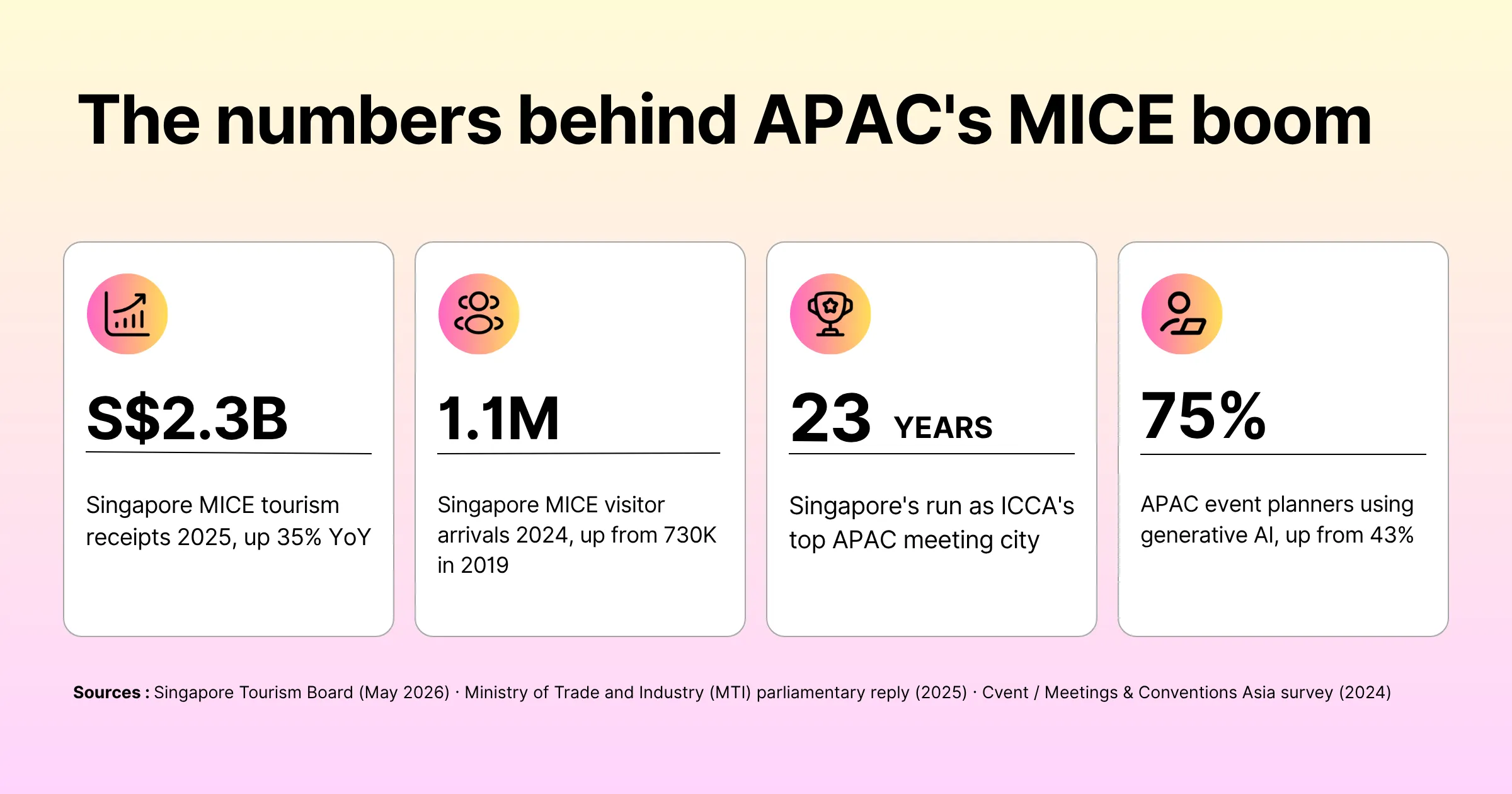
Visitor arrivals tell a similar story. Singapore’s MICE visitor numbers climbed from 730,000 in 2019 to 1.1 million in 2024. That figure comes from a parliamentary reply from the Ministry of Trade and Industry. That is a lot more badges to print and a lot more sessions to track. It is well past the pre-pandemic baseline most teams built their processes around.
What Singapore’s Digital Push Means for Operators
Governments and industry bodies are responding by pushing technology harder, not softer. At the Singapore MICE Forum in July 2026, a Ministry of Trade and Industry speech described an Industry Digital Plan. The ministry developed it with the Infocomm Media Development Authority. The plan covers everything from AI-powered planning tools to lead generation and customer engagement platforms. The same speech pointed to Resorts World Sentosa’s experience implementing an integrated CRM and lead generation platform. It said the platform helped increase sales conversion rates by 36 percent and tripled the venue’s overseas MICE business. That is one of the more concrete, sourced examples of what better technology actually does for a MICE operator’s numbers. It is not just about attendee experience.
| Metric | Figure | What It Tells You |
|---|---|---|
| Singapore MICE tourism receipts, 2025 | S$2.3 billion, up 35% from S$1.7 billion in 2024 | The market is growing faster than most back-office processes were built for |
| Singapore MICE visitor arrivals | 1.1 million in 2024, up from 730,000 in 2019 | Programs are bigger than pre-pandemic baselines, which strains manual check-in |
| Singapore’s ICCA ranking | Top Meeting City in Asia Pacific, 23rd consecutive year | Singapore keeps winning the business, so the bar for attendee experience keeps rising too |
| APAC event planners using generative AI | 75% in 2025, up from 43% in 2024 | Adoption nearly doubled in a year, though it only helps if your platform can actually use it |
The figures above come from three sources. The first two are the Singapore Tourism Board’s May 2026 release and a Ministry of Trade and Industry parliamentary reply. The third is a Cvent-commissioned survey of APAC planners reported by Meetings & Conventions Asia. All are current as of early August 2026.
What Modern MICE Event Technology Should Actually Do
A feature list is easy to publish and hard to act on. What matters more is how registration, check-in, and data behave together under real conditions.
Good registration software for a MICE program handles multiple ticket types, group bookings for delegations, and add-on sessions. It should do that without needing a developer every time the program changes. Your team should be able to update a form the week before the event. Filing a ticket with a vendor and waiting is not good enough.
Good on-site check-in has to work when three hundred people arrive in the same fifteen minutes. It has to work when the exhibition hall’s Wi-Fi is weaker than the meeting room where you tested it. It also has to work when someone’s badge printer jams. That means QR or facial recognition scanning. It also means an offline mode that does not just stop working when the network blips. And it means on-demand badge printing, instead of a pre-printed stack sitting in a box somewhere.
Curious what registration, check-in, and engagement data look like when they run on one platform instead of three? Take a look at how Gevme’s on-site check-in tools handle high-volume MICE programs.
The Data Layer, and Why Sponsors Notice It
Good attendee data means your team can see which sessions are filling up during the event. It also shows which exhibitor booths are getting traffic. After the event, it shows exactly who attended, not just who registered. That data is also what makes event reporting and analytics useful to a sponsor instead of decorative.
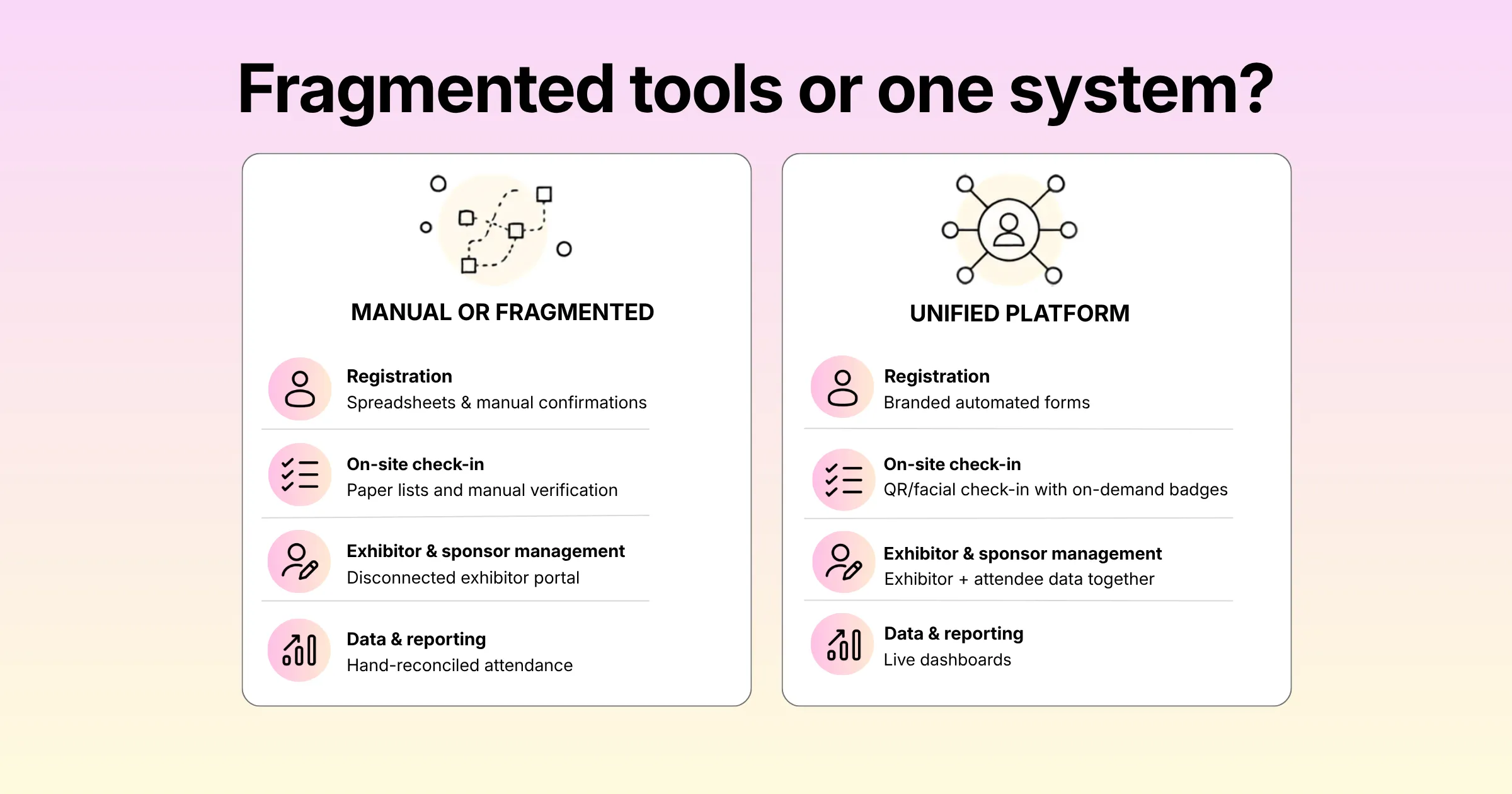
| Program Stage | Manual or Fragmented Approach | Unified Platform Approach |
|---|---|---|
| Registration | Spreadsheets and generic form tools with manual confirmations | Branded forms, automated confirmations, real-time capacity tracking |
| On-site check-in | Paper lists or a standalone scanner with no badge printing | QR or facial recognition check-in with on-demand badge printing |
| Exhibitor and sponsor management | A separate exhibitor portal that does not talk to attendee data | Exhibitor leads and attendee data live in the same system |
| Data and reporting | Attendance reconciled by hand, days after the event | Live dashboards during the event, unified reporting after |
Common Mistakes APAC Event Teams Make With Event Technology
The first mistake is buying registration software and assuming check-in will sort itself out. It will not. Registration and check-in are different technical problems. One is a web form under light load, the other is real-time hardware performance under heavy load. So a vendor that is excellent at one is not automatically competent at the other.
The second is underestimating what a large venue does to Wi-Fi and hardware. A vendor demo in a quiet office with strong signal tells you nothing. Badge printing behaves differently in a cavernous exhibition hall with two thousand phones competing for bandwidth. Ask about offline functionality specifically, not generally.
The third is treating attendee data as a nice-to-have you will “figure out with a spreadsheet after.” Sponsors increasingly expect session-level attendance and lead data as part of what they paid for. Reconstructing that from paper sign-in sheets after a three-day conference is close to impossible.
The fourth is chasing AI features without checking whether they solve a real problem. Adoption of generative AI among APAC planners nearly doubled between 2024 and 2025, and vendors have noticed. Ask what the AI feature actually does with your event data, not whether the platform has one.
If you only have budget to fix one thing
Fix check-in first. It is the most visible failure point, and the one your attendees experience directly. It is also the one most likely to make a sponsor or executive sponsor doubt the rest of the event. That holds even if registration and reporting were flawless.
How to Evaluate MICE Event Technology
A vendor’s feature page will always look complete. These are the questions that tend to surface what a feature page leaves out.
- Does registration, check-in, and reporting run on one platform? Or are you buying three tools and connecting them yourself with exports and imports?
- What happens to check-in if the venue’s internet drops for ten minutes during peak arrival?
- Can your own team edit a registration form and badge design without waiting on the vendor?
- How is attendee data structured? Can you export it in a format your CRM or BI tool can actually use?
- What hardware does on-site check-in require, and is it included, rented, or something you have to source separately?
- Who provides support during the event itself, and what time zone are they in relative to your venue?
A Look at MICE Technology in Action
AIME, the Asia Pacific Incentives and Meetings Event, is exactly the kind of program this guide is about. It is a Melbourne-based trade show built for the MICE industry itself. Exhibitors, hosted buyers, and event professionals there expect the technology to work as well as the content does. At AIME 2025, Gevme ran registration and on-site check-in through the Gevme Kiosk App and EcoKiosks. Gevme also ran an exhibitor portal and Snapsight for multilingual session summaries.
The team’s own account of the event is straightforward rather than dramatic. They said: “From registration to check-in to live insights, Gevme kept AIME running like clockwork.” It is a small case study without a wall of statistics attached to it. We would rather tell you that plainly than dress up a qualitative result as something it is not.
Pro Tip:
Run a full dry run of registration through check-in at your actual venue. Use the real Wi-Fi, real hardware, and a handful of real staff, at least a week before doors open. Demo environments and vendor sandboxes rarely reveal what happens when two hundred people hit a single access point at once. In practice, an exhibition hall’s signal strength is almost always worse than the meeting room where you tested it.
Frequently Asked Questions
What is MICE event technology?
MICE event technology is the software and hardware used to run meetings, incentives, conferences, and exhibitions. It covers registration, on-site check-in, and attendee data and engagement. It replaces manual processes like paper sign-in sheets and spreadsheet-based tracking with connected digital tools.
What is the difference between event registration software and full MICE event technology?
Event registration software handles sign-ups and ticketing before the event. Full MICE event technology extends that into on-site check-in, badge printing, session tracking, and post-event data and engagement reporting. As a result, information flows through the whole program instead of resetting at each stage.
How is Singapore’s MICE industry using technology in 2026?
Singapore’s MICE tourism receipts reached S$2.3 billion in 2025, up 35 percent from the year before. The Singapore Tourism Board has paired that growth with an Industry Digital Plan built with IMDA. The plan pushes AI-powered planning, lead generation, and customer engagement tools across the sector.
What should event teams look for in on-site check-in technology?
Look for check-in technology that holds up under real venue conditions, not just a clean demo. That means patchy Wi-Fi, high attendee volume, and multiple entry points. Badge printing speed, offline functionality, and session or zone-level attendance data matter more day to day. A long feature list matters less.
Does event technology actually improve post-event reporting for MICE programs?
Yes, when registration, check-in, and engagement data live on one platform instead of three disconnected tools. MICE teams often cannot give sponsors or leadership accurate numbers within a reasonable timeframe. Manually reconciling spreadsheets after a multi-day conference is one of the most common reasons why.
How long does it take to set up event technology for a MICE program?
It depends on the size and complexity of the program. That includes the number of ticket types or sessions, and how much existing registration data you need to migrate. A single conference with straightforward registration can be set up in days. A multi-track exhibition with exhibitor portals and custom badge logic takes longer. Therefore ask any vendor for a realistic timeline based on your specific event, not a generic number.
Conclusion: MICE Event Technology That Keeps Pace With APAC’s Growth
The programs getting harder to run are not getting smaller. Singapore’s MICE receipts are up 35 percent in a year, and visitor numbers have climbed well past pre-pandemic levels. Meanwhile the government is actively pushing operators toward AI-powered planning and engagement tools. None of that pressure shows up as a single dramatic failure. It shows up as a slower check-in line and a sponsor report built from memory. It also shows up as a team that spends the week after an event reconciling spreadsheets. That is time they could spend planning the next one.
Treat registration, check-in, and attendee data as one connected system, rather than three separate purchases. That is the difference between a program that scales with the market and one that gets more stressful every year. The MICE industry in Singapore and across APAC is not slowing down. So the technology running it should not be the reason your team feels like it is falling behind.
If you are evaluating event technology for your next MICE program, book a walkthrough with Gevme’s team. You will see how registration, check-in, and reporting work as one system instead of three.