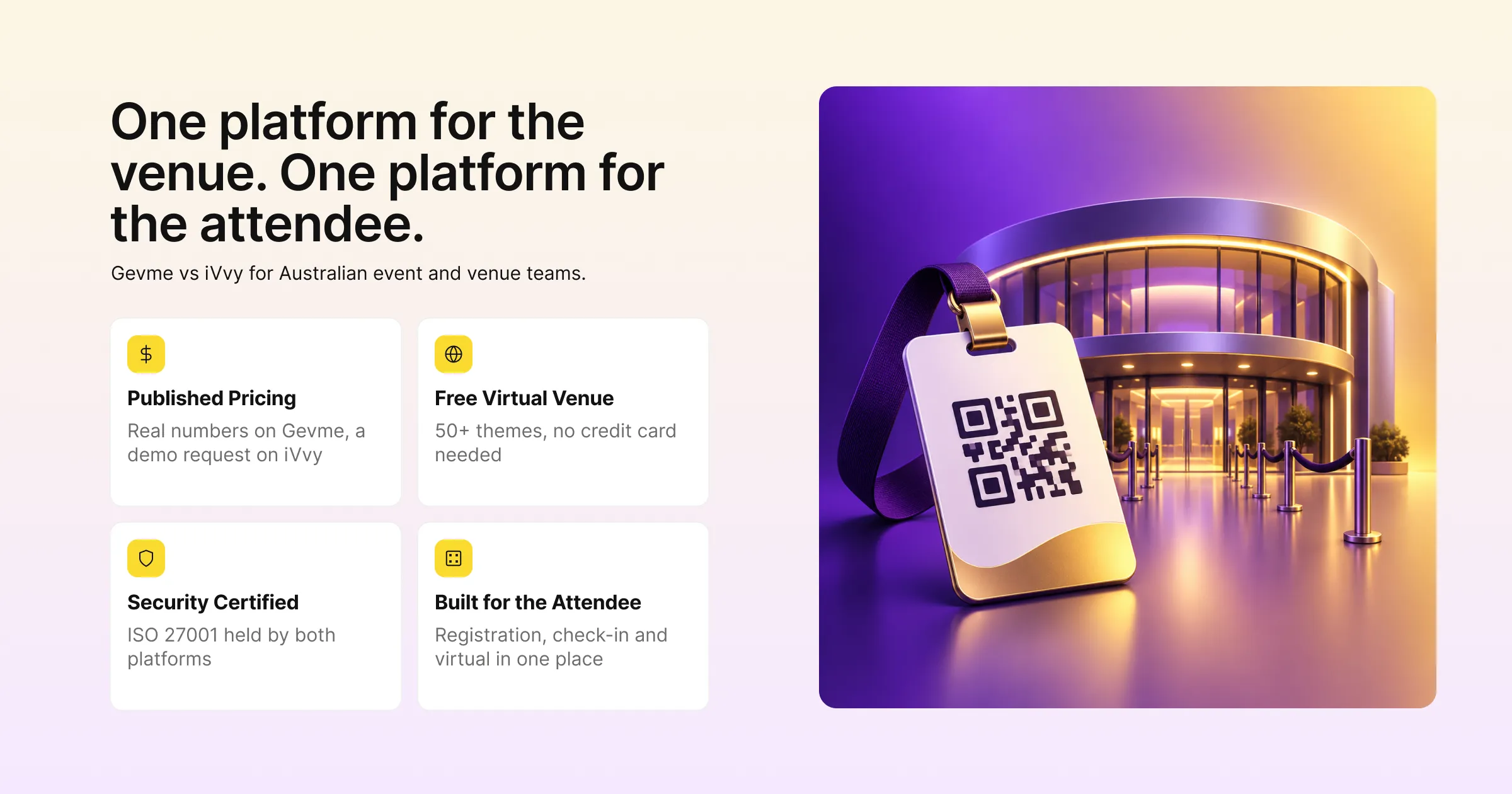
If you’re comparing Gevme and iVvy, there’s a good chance you fall into one of two camps. You might be an Australian venue trying to manage enquiries and bookings more efficiently. Or you might run registration, check-in and a hybrid program from one place. Both platforms show up in the same shortlist conversations across Australia. However, they didn’t start out solving the same problem. That history still shows in what each does best today.
iVvy has real credibility here. It was built on Australia’s Gold Coast, and it has spent years refining tools specifically for venues and hospitality teams. Function diaries, banquet event orders and proposal generation form the operational backbone. A hotel or convention centre sales team lives in those every day. Gevme started somewhere else entirely. It was built around the attendee’s journey through registration, check-in and a hybrid event experience, all sharing the same data.
This guide covers what each platform actually is, and what’s publicly known about pricing. It compares them on registration, on-site tools, virtual and hybrid event support, and security. Finally, it sets out which one fits which kind of Australian team.
Key Takeaways
- iVvy was founded in 2009 on Australia’s Gold Coast. It now serves 15 countries. Venues, hotels and function centres rate it highly for managing enquiries, proposals and bookings.
- Gevme publishes real, current pricing on its site for both its Registration Platform and Virtual Venue Platform. iVvy routes pricing entirely through a demo request.
- Gevme’s Virtual Venue Platform has a permanently free plan with more than 50 themes to start from. That’s useful if you want to test a virtual or hybrid format without committing budget upfront.
- iVvy’s core strength is the venue side: function diary and group room control, banquet event orders, and a built-in CRM. That CRM tracks enquiries across multiple properties.
- Gevme’s Registration Platform connects to more than 20 third-party payment gateways alongside its own native Gevme Pay option. iVvy states 30-plus supported gateways for its event ticketing product.
- Both platforms name real security certifications on their own sites. Gevme states ISO 27001, 27017, 27018 and SOC 2 Type 2 certification. iVvy states ISO 27001, PCI DSS Level 1 and GDPR compliance.
- Filling function rooms and managing venue sales enquiries? iVvy’s tools target exactly that. If your main job is running the attendee experience, Gevme’s platform is built around that instead.
Why Australian Teams End Up Comparing These Two
Australia has a fairly concentrated events and hospitality market. So both platforms show up often in the same conversations, even though they were built for slightly different jobs. Venues, hotels, conference centres and function spaces tend to find iVvy first, often through word of mouth. It was built in that world from day one. Event organisers, associations, corporates and agencies find Gevme differently. They arrive through the registration and virtual event side of things.
The overlap happens because both companies have expanded beyond their original core. iVvy added event ticketing software for organisers running their own registrations. Gevme’s platform includes on-site check-in tools that any venue-adjacent event team would recognise. So a team choosing between the two needs to know which core strength matches their daily work. Assuming the products are interchangeable, because they sit in the same category, is the mistake to avoid.
Why This Comparison Comes Up in Australia Specifically
There’s a practical reason this is an Australian question rather than a generic global search. iVvy’s local roots run deep in the Australian and New Zealand hospitality scene. That spans independent function centres and hotel groups managing multiple properties. So it’s often the incumbent a new events hire inherits rather than actively chooses.
Gevme, meanwhile, tends to enter the conversation when a team’s registration, check-in and virtual delivery needs have outgrown a patchwork of separate tools. Picture a generic registration form here, a separate check-in app there, and a webinar tool bolted on for remote attendees. At that point teams want one connected platform instead. Work out which starting point describes your team. The rest of this comparison then becomes much easier to apply.
What Each Platform Actually Is
Gevme is built around three connected pieces that share the same attendee data. There’s a Registration Platform for building forms, selling tickets and collecting payments. There’s an on-site check-in and badging system. And there’s a Virtual Venue Platform for running virtual or hybrid events with a template-driven builder. Gevme calls this the full event lifecycle: host, run, and prove. It runs from before the event through to reporting afterward.
iVvy takes a different shape. Per its own site, checked in early September 2026, it describes its core product as handling “your entire workflow: enquiries, proposals, contracts, BEOs, event execution, and payments,” built specifically around how venues and hospitality sales teams operate. Its Function Diary and Group Room Control show quoted, tentative and confirmed bookings across multiple properties in one view. Its digital proposals module sends a branded, e-signable contract in minutes. No emailing a PDF back and forth. iVvy also offers a separate event ticketing product for organisers running their own registration. It includes drag-and-drop forms, an organiser check-in app and an attendee-facing mobile app.
Pricing: What’s Actually Public
Gevme’s pricing page, checked in early September 2026, splits pricing into two product lines. The Registration Platform starts at USD $960 a year on its Starter plan, rising to USD $2,160 a year on Pro. Both plans cover custom registration forms, unlimited emails, smart attendee lists and event reporting. Pro adds custom landing pages, email templates and payment gateway integration. Enterprise pricing on both lines stays custom. It adds multiple organisation support, advanced security features and a custom integrations engine.
The Virtual Venue Platform actually starts free, with no credit card required. That free plan includes a website builder, virtual venue editor and more than 50 themes and experiences to start from. It then moves to the same $960 and $2,160 a year Starter and Pro tiers, with added features like an event mobile app and business matchmaking on Pro.
iVvy doesn’t publish pricing on its site. Every path on ivvy.com, checked in early September 2026, leads to a “Get a Demo” request rather than a price list or calculator. That applies from the homepage through to its individual product pages. Platforms selling to venues and hospitality operators often work this way. Pricing varies by property size, room count or transaction volume. Even so, it means an Australian team can’t get a rough sense of cost without a sales conversation first.
Registration and Ticketing Compared
Both platforms handle event registration, but from different starting points. Per its own product page, checked in early September 2026, Gevme’s Registration Platform offers customisable forms with multi-step flows. It also covers ticket type differentiation, group registration and session selection. It also pre-populates fields for returning attendees. Its payment system supports more than 20 third-party gateways alongside native Gevme Pay. Offline options like bank transfer and pay-later are included.
Per its own page, checked in early September 2026, iVvy’s ticketing product offers custom forms with skip logic and multiple ticket types. A drag-and-drop event website builder comes with it. Payment processing runs through more than 30 gateways, including Stripe, PayPal, Afterpay and Worldpay. Its own iVvyPay option sits alongside those. It also includes project management tools for the organising team, covering task assignment, deadlines and role-based access. Interactive session features like live Q&A and polling are built into its attendee app.
Both platforms also build in reporting for the organiser. iVvy states more than 20 standard report templates with scheduled automated delivery, alongside budget tracking by department. Gevme’s registration platform includes event reporting and Google Analytics integration on Starter. Pro adds Google Tag Manager support. So marketing teams tie registration performance back into existing campaign tracking, rather than working from a separate export every time.
On-Site Check-In and Venue Operations
This is where the two platforms’ different starting points show up clearly. Gevme’s on-site tools, checked in early September 2026, centre on the attendee check-in moment. They cover QR code scanning, facial recognition, ID card scanning, and a badge designer for on-demand printing. Kiosk hardware options back that up, from a full self-serve unit down to a portable tabletop version.
iVvy’s operational strength sits a step earlier in the process, on the venue’s side of a booking. Its Function Diary and Group Room Control show every quoted, tentative and confirmed booking across properties in one view. Its Banquet Event Orders and virtual run sheets open on a tablet or phone. Event-day staff then work from the same up-to-date instructions. That beats a printed sheet that’s already out of date by the time doors open. iVvy’s own event ticketing product includes an organiser check-in app for scanning attendees on arrival. Still, its deeper tooling targets the venue operator rather than attendee-facing check-in.
Virtual and Hybrid Events
Gevme treats virtual and hybrid delivery as a dedicated product in its own right. Per its own page, checked in early September 2026, it offers a visual builder for 2D, 3D or blended environments. A Venue Store of pre-designed templates gives you a starting point. Business matchmaking is available on higher tiers for events that need structured networking alongside content. It’s available on a genuinely free plan before any paid commitment.
iVvy’s platform includes engagement features aimed at hybrid attendees: live Q&A, polling and an attendee app with private messaging and activity feeds. Those are useful for events that mix in-person and remote participation. However, it doesn’t market a dedicated virtual venue product the way Gevme does. Its site content leans heavily toward the physical, on-property side of an event. For a team whose event is genuinely virtual-first, Gevme’s dedicated virtual venue product is the more purpose-built option of the two.
Security and Compliance
Both platforms name real certifications on their own sites rather than leaving security to a sales conversation. Gevme’s Australia page, checked in early September 2026, states it is “ISO 27001, 27017, 27018, and SOC2 Type 2 certified,” with its platform locally hosted. iVvy’s security page, checked in early September 2026, states ISO 27001 certification, PCI DSS Level 1 compliance and GDPR alignment. A multi-data-centre hosting setup provides redundancy.
Neither company’s site details every specific control an Australian Privacy Principles review would need. So a team handling sensitive attendee data across a large event program should still confirm the specifics directly against each platform’s published certifications.
A Few Terms Worth Knowing
- Function diary: A venue’s master calendar of quoted, tentative and confirmed bookings across one or more properties. It’s the core tool a hotel or venue sales team works from every day.
- Banquet Event Order (BEO): A detailed instruction sheet covering everything operational staff need to execute an event, including room setup, catering, timing and equipment.
- Virtual venue: A template-based digital environment, built to resemble a real venue layout, where remote attendees can move between sessions, booths and networking areas during a virtual or hybrid event.
- PCI DSS: A security standard for handling card payment data. Any platform processing payments on your behalf should be able to confirm compliance with it.
How Gevme and iVvy Compare
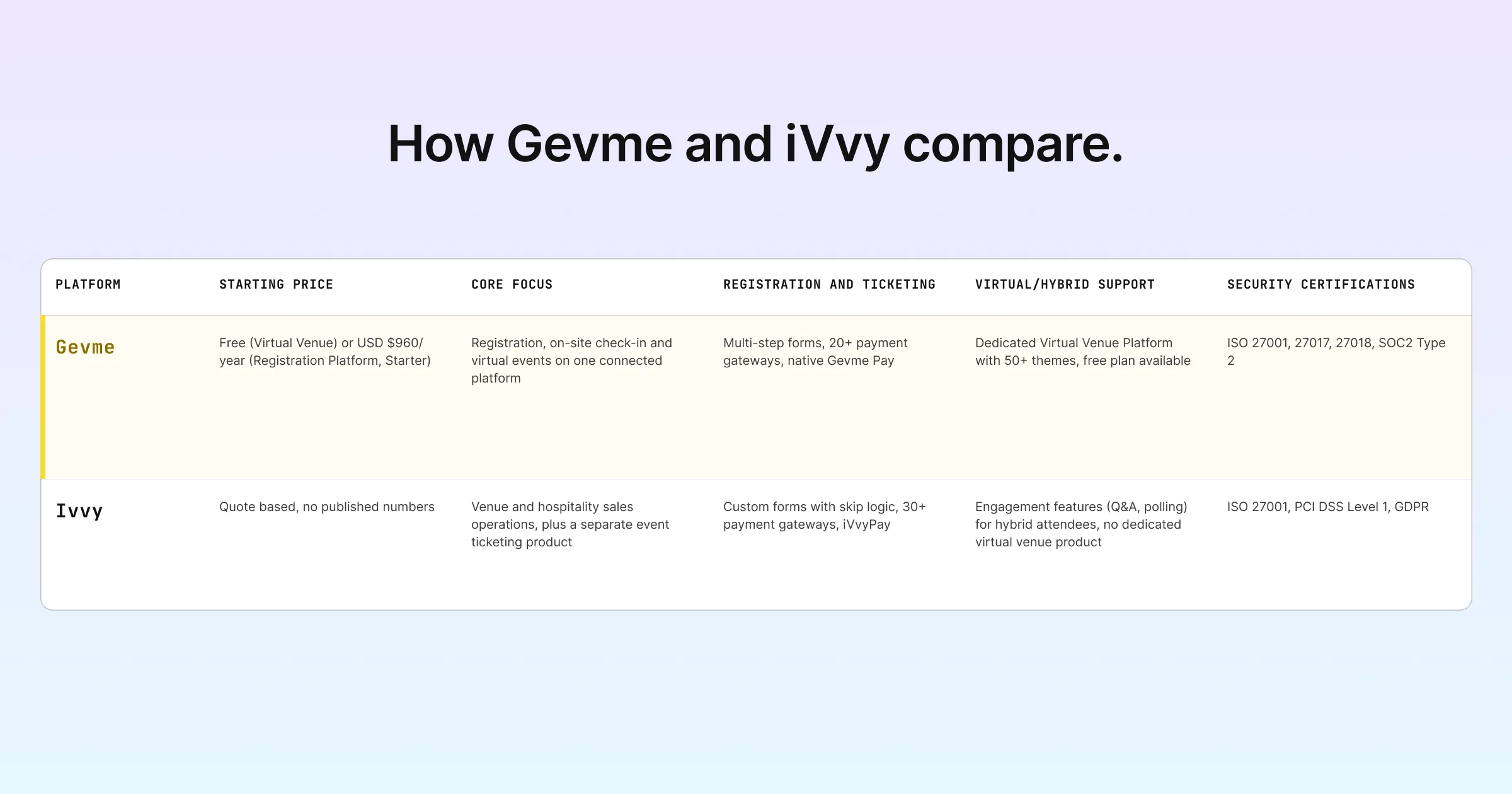
| Platform | Starting Price | Core Focus | Registration & Ticketing | Virtual/Hybrid Support | Security Certifications |
|---|---|---|---|---|---|
| Gevme | Free (Virtual Venue) / USD $960/year (Registration Platform, Starter) | Registration, on-site check-in and virtual events on one connected platform | Multi-step forms, 20+ payment gateways, native Gevme Pay | Dedicated Virtual Venue Platform with 50+ themes, free plan available | ISO 27001, 27017, 27018, SOC2 Type 2 |
| iVvy | Quote based, no published numbers | Venue and hospitality sales operations, plus a separate event ticketing product | Custom forms with skip logic, 30+ payment gateways, iVvyPay | Engagement features (Q&A, polling) for hybrid attendees, no dedicated virtual venue product | ISO 27001, PCI DSS Level 1, GDPR |
Sources, checked in early September 2026, are each platform’s own pricing, product or security pages: Gevme, iVvy. Vendor pricing and feature pages change often. Confirm directly before you budget against any figure here.
Which Platform Fits Which Kind of Australian Team
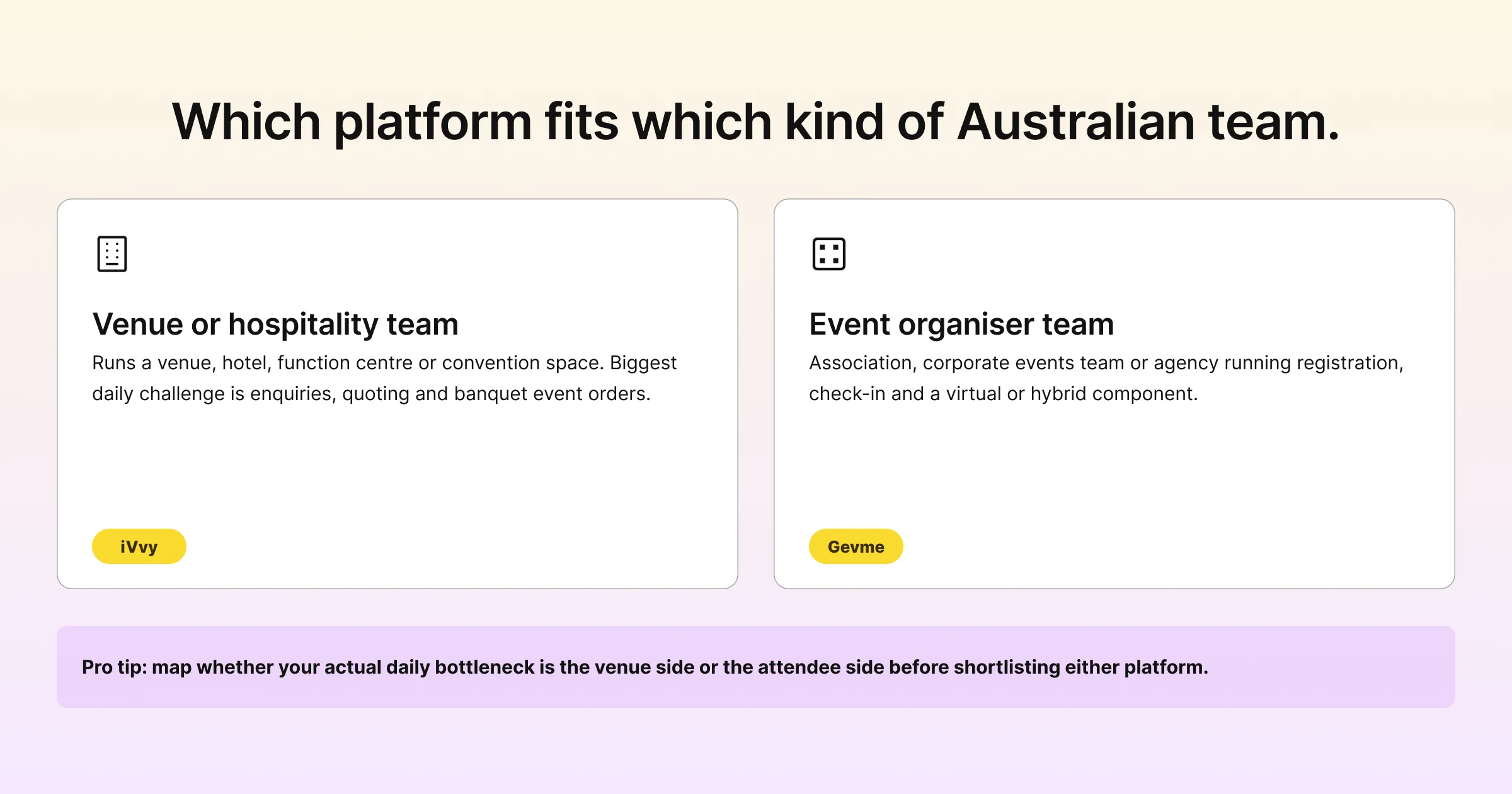
Do you run a venue, hotel, function centre or convention space? Managing enquiries, quoting multiple spaces at once, and keeping banquet orders accurate takes real effort. iVvy’s function diary and CRM tools target that job directly. Its Gold Coast roots mean it understands the Australian hospitality market from the inside.
Event organisers, associations, corporate events teams and agencies sit on the other side of this. Gevme’s registration platform pairs with its virtual venue builder. Together they connect registration, on-site check-in and hybrid delivery to the same attendee data. Pricing is published, and a free tier lets you test the virtual side before committing any budget. Some teams need both a venue booking workflow and a full attendee platform. They often use each tool for the job it was built for.
What This Looks Like in Practice
For a mid-sized Australian association or corporate events team running a handful of conferences a year, two connected pieces of Gevme’s platform tend to matter most. Registration data flows straight into check-in on the day, so a badge printed at the door reflects the ticket type someone actually paid for. A virtual venue can then host a livestreamed keynote for interstate colleagues who couldn’t fly in. iVvy’s strengths line up differently. They matter most for a hospitality group juggling dozens of enquiries a week across multiple function spaces. There, the function diary and CRM stop a sales team double-booking a room or losing a proposal sent three weeks ago.
Pro Tip
Before shortlisting either platform, map out where your team’s actual daily bottleneck sits. Is it on the venue side, meaning enquiries, quoting and banquet orders? Or is it on the attendee side, meaning registration, check-in and virtual delivery? Sit through a demo built for the wrong half of that job and you end up with software your team quietly avoids six months in.
Frequently Asked Questions
Yes. iVvy was founded in 2009 on Australia’s Gold Coast. It has since expanded to offices in Australia, South Africa, the USA and the UK, serving customers across 15 countries.
Yes. Gevme publishes Australian dollar pricing on its Australia pricing page, with Starter at A$1,000 per user per month including one user, Pro at A$460 per user per month including three users, both billed annually, and Enterprise on request. The same Australia-focused pages confirm the platform is locally hosted and holds ISO 27001, 27017, 27018 and SOC2 Type 2 certification.
Only partially. Gevme publishes its Registration Platform and Virtual Venue Platform pricing directly on its site. iVvy does not publish pricing for either its venue management or event ticketing products, so a full side-by-side dollar comparison is not possible from public information alone.
Gevme is the more purpose-built option for this specifically. Its Virtual Venue Platform is a dedicated product with a visual builder and more than 50 themes. iVvy hybrid features are more about attendee engagement tools layered onto an event that is primarily happening in person.
iVvy is built specifically for this. Its function diary, group room control and banquet event order tools are designed around how a venue or hospitality sales team actually works day to day, which is not the primary focus of Gevme platform.
Yes, though differently. Gevme check-in tools centre on the attendee, covering QR codes, facial recognition, ID scanning and a badge designer with kiosk hardware options. iVvy event ticketing product includes an organiser check-in app, but its deeper operational tools are built for the venue side of an event.
Both name real, verifiable certifications on their own sites rather than leaving it to a sales conversation. Gevme states ISO 27001, 27017, 27018 and SOC2 Type 2 certification. iVvy states ISO 27001, PCI DSS Level 1 and GDPR compliance. Either set of credentials is worth weighing against your own organisation specific compliance requirements.
Conclusion: Two Platforms Built for Different Halves of the Same Industry
iVvy has earned its reputation in Australia for a reason. Its function diary, banquet event orders and venue-focused CRM solve real problems for hotels, function centres and venue sales teams. Its Gold Coast origins give it a genuine feel for the local hospitality market. If managing venue enquiries and bookings is your team’s actual daily work, it’s a strong, purpose-built choice.
Your work may sit on the other side of the same industry, running registration, checking attendees in, and delivering a virtual or hybrid event experience. Gevme’s connected platform targets exactly that. Published pricing and a free tier let you test the virtual side before spending anything. If that sounds closer to what your team actually does day to day, request a demo and walk through your specific event program together.