Do you run registration for your church retreat, a youth conference, a mission trip, or the annual banquet? Then you already know the job is bigger than it sounds. You’re collecting sign-ups and payments, sending confirmation emails, printing name badges, and checking people in at the door. Usually you’re doing all of it alongside your actual ministry work, not instead of it. A sticky-note sign-up sheet or a plain online form gets you through a small gathering. It starts to fall apart fast. That happens once you’re managing a few hundred attendees, multiple ticket types, or a live stream for members at home.
Most event software on the market is built and priced for corporate marketing teams. That makes it feel like overkill, and expensive overkill at that, for a church or ministry budget. The good news is that several platforms are genuinely accessible for smaller teams and tighter budgets. None of them strip out the features you rely on. This guide compares Gevme with a handful of budget-friendly alternatives for faith-based teams: Whova, Glue Up, EventMobi and Accelevents.
Specifically, it covers why churches need dedicated registration software rather than a plain form. It also sets out what each platform costs. It compares them on registration, check-in, payments and virtual delivery. Finally, it offers a short glossary for anyone new to this software. A simple framework then helps you pick the right one for your next event.
Key Takeaways
- Look for software that handles both free and paid registration cleanly. Churches often run a mix of no-cost services and ticketed events like galas, retreats or conferences in the same year.
- Gevme’s Registration Platform starts at USD $960 a year. Its Virtual Venue Platform has a free tier you can test before paying anything, which matters when a board approves your budget.
- Whova, EventMobi and Accelevents all publish real starting prices. So you can budget in advance without a sales call.
- Does your ministry run occasional large gatherings rather than a packed calendar? Then a per-event option, like EventMobi’s, can work out cheaper than an annual subscription.
- Does your church also manage ongoing membership or small group communication? Then Glue Up is worth a look. Its roots are in membership and community management, and events are just one part of what it does.
- Don’t assume you have to choose between an easy setup and real functionality. Several of these platforms, Gevme included, work fine for a small volunteer team with no IT person.
- If any part of your congregation joins remotely, check each platform’s virtual or hybrid options before you commit. Not all of them treat this as more than an afterthought.
Why Faith-Based Teams Need Purpose-Built Registration Software
Church and ministry events have a few things in common that make a plain form or spreadsheet risky. There’s usually money involved. That might be a ticket price for a retreat, or a fundraising goal for a mission trip. So you need reliable payment processing and clear records for your treasurer. There’s often a mix of formats too. An in-person gathering runs alongside a livestream for people who are traveling, homebound, or at another campus. Finally, there’s rarely a dedicated events staff person. So the tool has to be simple enough for a volunteer or part-time coordinator to run without much training.
On top of that, faith-based organizations tend to plan a genuinely varied calendar in a single year. A youth conference, a retreat, a mission trip, a banquet and a training day each come with different needs. Ticket types and audiences differ every time. Software that flexes across all of that saves real hours over a year, because you avoid a new setup process every time.
What Church and Ministry Event Software Should Actually Do
At minimum, look for a platform that handles registration forms with both free and paid ticket options. It should send automatic confirmation and reminder emails, and offer simple on-site check-in on the day. Afterward, it should give you a straightforward attendee list and payment report for your records. If any of your events reach members remotely, a virtual or hybrid option matters too. Even a simple livestream page counts, rather than a full production.
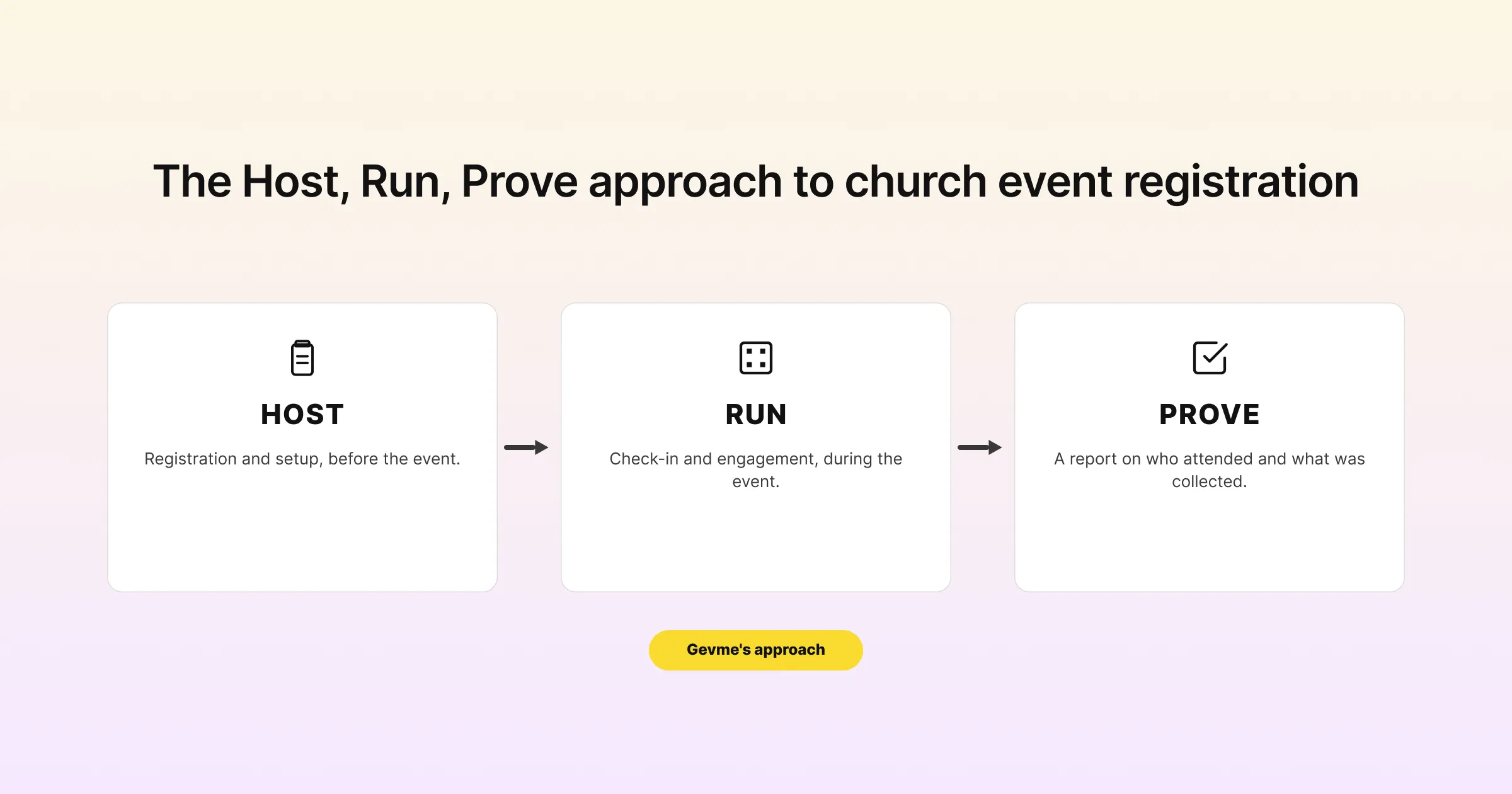
Gevme covers this ground through what it calls a Host, Run, Prove approach. Registration and setup come before the event. Check-in and engagement happen during it. A report follows afterward, showing who actually attended and what was collected. Its template-driven virtual venue suits organizations that want a branded online space. More than 50 ready-made themes mean a small team never designs one from scratch.
What These Platforms Actually Cost
Gevme sells its Registration Platform and Virtual Venue Platform separately, so you only pay for what a given event needs. Per Gevme’s pricing page, checked in late August 2026, the Registration Platform starts at USD $960 a year on its Starter plan, with a Pro plan at USD $2,160 a year. The Virtual Venue Platform has the same starting prices, plus a free plan. So a smaller ministry can try the virtual side before committing any budget. Both offer a quote-based Enterprise tier. That suits larger, multi-campus organizations needing advanced security or custom integrations.
Whova doesn’t publish pricing on its site. Per Whova’s pricing page, checked in late August 2026, you submit your event details through a form. A custom quote follows, rather than visible tiers. That model is common among platforms serving smaller organizations and nonprofits.
Glue Up publishes clear ranges. Per Glue Up’s pricing page, checked in late August 2026, its Essential tier runs $3,000 to $6,500 a year. Its Advanced tier runs $8,000 to $18,500 a year, with a quote-based Enterprise tier above that. Glue Up is worth noting for a different reason than pure event pricing. It’s built primarily as a membership and community management platform. Event registration is one part of a broader toolkit. That can be a natural fit if your church already thinks in terms of membership rather than one-off events.
EventMobi and Accelevents
EventMobi offers two ways to buy, which suits ministries with an uneven events calendar. Per EventMobi’s pricing page, checked in late August 2026, its per-event plan starts at $3,000. That’s useful if you only run one or two big gatherings a year. Its per-year plan starts at $8,900 and includes unlimited events plus a dedicated Event Success Manager for teams running a fuller calendar.
Accelevents publishes real starting figures too. Per Accelevents’ pricing page, checked in late August 2026, its Professional tier starts at $7,500 for a single event and its Business tier at $13,500 for unlimited events. Quote-based Enterprise and White Label tiers sit above that. Accelevents also deserves a mention for ministries running fundraising events. Its own site lists fundraisers explicitly among the event types it supports.
Feature-by-Feature: Registration, Payments, Check-In and Virtual Delivery
Registration and payment collection are the baseline every platform here handles. Still, a few differences matter for a church or ministry context specifically. Accelevents’ fundraiser-friendly positioning earns a closer look. That applies if much of your calendar is donation-driven rather than ticketed. Glue Up’s membership tools go further than the others. That helps if you manage an ongoing roster of members alongside events.
On check-in, Gevme, EventMobi and Accelevents all offer on-site tools that a volunteer team can run without much training. Generally that means a mobile check-in app plus simple badge printing. Kiosk-heavy trade show setups are not the model here. EventMobi is unusually upfront about the real cost of the physical side of check-in. It publishes per-badge pricing from $3.99 each and hardware rental costs. That helps with budgeting for a one-time event like a conference.
On virtual and hybrid delivery, don’t assume a budget-friendly platform means a weak virtual option. Gevme’s virtual venue includes RTMP streaming and more than 50 event themes. So a multi-campus church or a ministry with a global mission network can put together a branded online experience without a big production budget. Whova and EventMobi both support virtual and hybrid formats as well. They generally lean toward simplicity over the deeper AI-driven networking features found in more expensive enterprise platforms, which is often exactly what a smaller team needs.
Data Privacy and Security Still Matter, Even for a Small Team
It’s easy to assume security certifications are a corporate concern that doesn’t apply to a church or ministry. However, you’re still collecting names, emails, home addresses and sometimes payment details for your congregation, which deserves the same care any organization would give it. Per their own security pages, checked in late August 2026, Whova is SOC 2 Type 2 compliant and GDPR compliant, and EventMobi is SOC 2 Type II certified and GDPR compliant as well. Accelevents states SOC 2 Type 2 and GDPR compliance on its pricing page, and Glue Up notes GDPR compliance on its pricing page too.
None of this needs to be a barrier to a small team. It just means asking your finalist a simple question before you sign up: where does our attendee data live, and who can see it. A platform that can answer that clearly, in plain language, is one your board or leadership team can approve with confidence.
Getting Your Volunteer Team Comfortable With the Software
Most churches and ministries run events with volunteers rather than paid events staff, which changes what “easy to use” needs to mean in practice. It’s not just about the coordinator who sets up the registration form. It’s also about the greeter checking people in at a folding table on a Saturday morning, who may only touch the software a handful of times a year. Look for a platform where check-in works from a phone or tablet without special training. A volunteer should be able to look up a name and check someone in within a few seconds, and fix mistakes on the spot rather than calling whoever set up the event.
Gevme, EventMobi and Accelevents all build their check-in tools around this kind of simplicity, rather than the more complex kiosk setups designed for trade-show-scale crowds. Whether more than one volunteer can be logged into check-in at the same time on different devices matters too. A single line moving through one phone gets slow fast, once a few hundred people arrive within the same fifteen minutes before a service or session starts.
A Few Terms Worth Knowing
- Registration platform: The software attendees use to sign up for your event, pay if there’s a fee, and receive their confirmation and tickets.
- On-site check-in: The process of confirming someone has arrived at your event, usually by scanning a ticket or QR code, often paired with printing a name badge.
- Hybrid event: An event where some attendees are physically present and others join live online at the same time. It’s common for churches with a livestream campus or members who can’t travel.
- Per-event pricing: A pricing model where you pay for a single event rather than an annual subscription. It’s useful if your organization only runs one or two larger gatherings a year.
How Gevme and Its Alternatives Compare
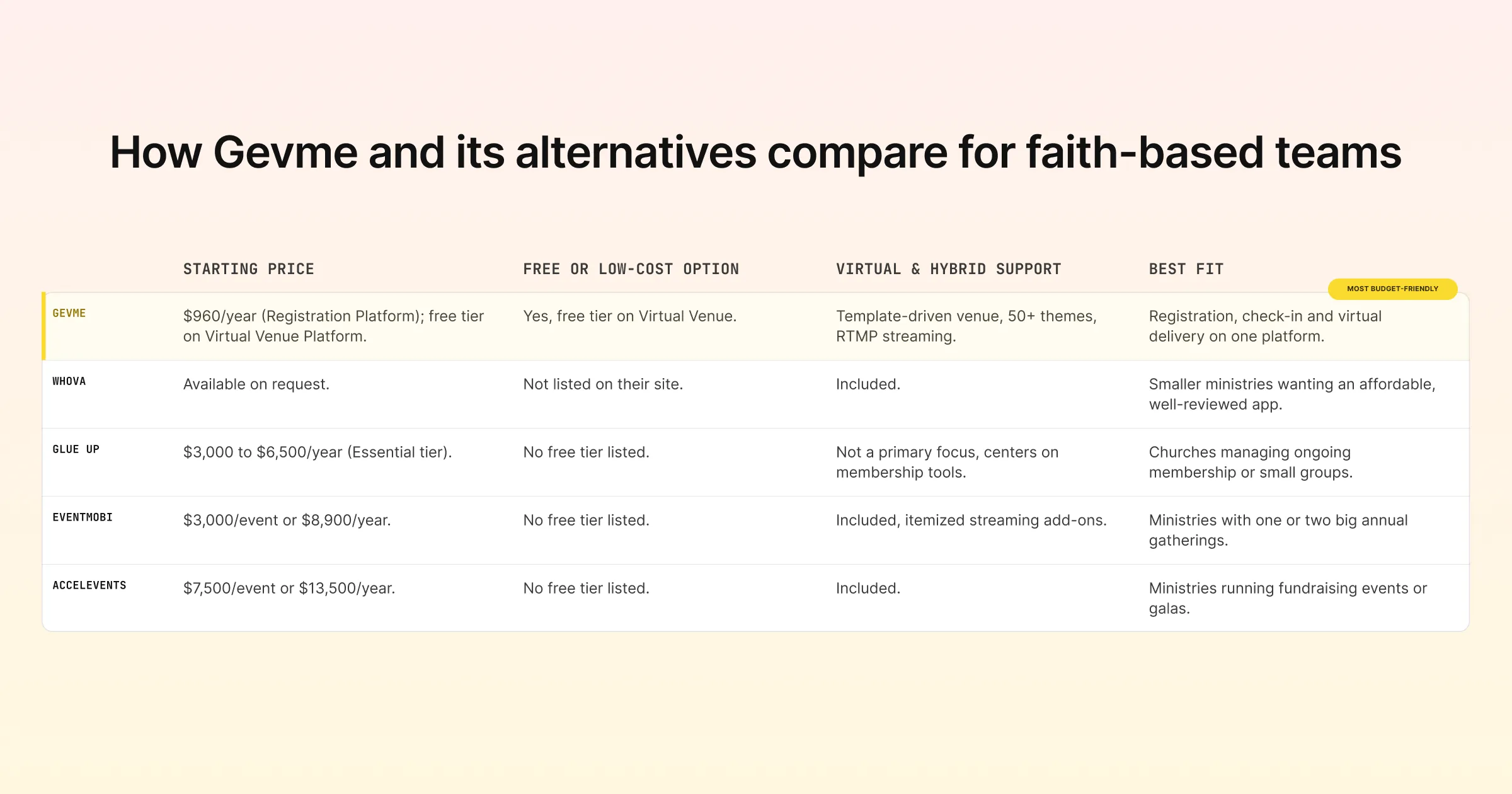
| Platform | Starting Price | Free or Low-Cost Option | Virtual & Hybrid Support | Best Fit for Faith-Based Teams |
|---|---|---|---|---|
| Gevme | USD $960/year (Registration Platform); free tier on Virtual Venue Platform | Yes, free tier on Virtual Venue | Template-driven virtual venue, 50+ themes, RTMP streaming | Ministries wanting registration, check-in and virtual delivery on one platform |
| Whova | Available on request | Not listed on their site | Included | Smaller ministries wanting an affordable, well-reviewed mobile app |
| Glue Up | $3,000 to $6,500/year (Essential tier) | No free tier listed on their site | Not a primary focus; platform centers on membership tools | Churches managing ongoing membership or small groups alongside events |
| EventMobi | $3,000/event or $8,900/year starting | No free tier listed on their site | Included, itemized streaming add-ons | Ministries with one or two big annual gatherings rather than a full calendar |
| Accelevents | $7,500/event or $13,500/year starting | No free tier listed on their site | Included | Ministries running fundraising events or galas |
Sources, checked in late August 2026, are each platform’s own pricing or product pages: Gevme, Whova, Glue Up, EventMobi, Accelevents. Vendor pricing pages change often. Confirm directly before you budget against any figure here.
Which Platform Fits Which Kind of Faith-Based Team
Does your church or ministry run a genuinely varied calendar, with a retreat here, a conference there, and a fundraising banquet in the fall? If you want one platform covering registration, on-site check-in and a virtual option for members who can’t attend in person, Gevme’s registration platform paired with its virtual venue is a reasonable place to start. The free tier lets you test the virtual side first.
A lighter calendar points elsewhere. For one big annual conference or retreat, EventMobi’s per-event pricing avoids paying for a year-round subscription you don’t need. Where fundraising is a bigger part of your work than ticketed conferences, Accelevents’ fundraiser-focused features are built specifically for that. Finally, if your organization thinks less in terms of individual events and more in terms of an ongoing membership or small group community, Glue Up’s broader membership toolkit might serve you better than a pure event platform.
Pro Tip
Before you commit to a platform, run one small, low-stakes event through it first. A single small group sign-up or a volunteer orientation works well, rather than starting with your biggest event of the year. That gives your team time to learn the check-in process and payment flow when the pressure is low. Then nothing is unfamiliar on the day your retreat or conference actually fills a room.
Frequently Asked Questions
It depends on how many events you run and how much manual work a spreadsheet or plain form is already costing your team. If you are spending hours each week chasing payments or manually building a check-in list, even an affordable platform can pay for itself in time saved.
Yes. Gevme virtual venue platform is built for exactly this kind of hybrid setup, with RTMP streaming and a branded online space that can run alongside your in-person check-in and registration.
Among the platforms in this guide, Gevme registration platform and EventMobi per-event plan both start at the lower end. Gevme virtual venue platform can also be tested for free before you pay anything.
Accelevents explicitly lists fundraising events among what its platform supports, which makes it a reasonable option if your ministry runs donation-driven gatherings. Most of the other platforms in this guide handle paid registration but are not built specifically around fundraising.
Look for a simple setup process, mobile-friendly check-in that does not require special hardware, and clear reporting that a treasurer or board member can understand without training. Avoid platforms that assume a dedicated, full-time events staff.
Gevme Virtual Venue Platform includes a free tier for testing before you pay. The Registration Platform and the other platforms in this guide do not list a free tier on their own sites, though several publish affordable starting prices.
If you run one or two larger events a year, a per-event plan like the one EventMobi offers usually costs less overall. If your calendar includes several events across the year, an annual plan tends to work out more efficiently.
Whova, EventMobi and Accelevents each state SOC 2 and GDPR compliance on their own sites, and Glue Up states GDPR compliance as well. Where attendee data is stored, and who has access to it, is worth having a clear answer on before your board approves the choice.
Conclusion: Finding the Right Fit for Your Ministry’s Events
Whova, Glue Up, EventMobi and Accelevents each serve a real need in this space. Whova and EventMobi make a strong case on simplicity and cost. Glue Up fits naturally if your organization already manages an ongoing membership community. Accelevents stands out for anyone running fundraising events regularly.
If your ministry wants registration, on-site check-in and a virtual option that can grow with you, without assembling that from several separate tools, Gevme is worth a look. Its registration platform is priced for a modest budget, and its virtual venue platform lets you test the hybrid experience for free before spending anything. If that sounds like what your team needs for the next event on your calendar, request a demo and walk through it together.