If you’re weighing Gevme vs vFairs for your next event, you’ve already moved past the stage of comparing ten random platforms off a listicle. Both names show up constantly in searches for virtual and hybrid event software. Both have built a real reputation, just not for exactly the same reason. Working out which one actually fits your events means looking past the marketing pages. It means looking into pricing, setup, and what each platform actually does well.
vFairs has built its name around big, immersive virtual environments. Think 3D booths, animated avatars, and a virtual trade show floor. It feels like an actual space rather than a webinar with a chat box bolted on. Gevme takes a different approach. It centers on registration, on-site check-in, and virtual attendance living in one connected system. It also includes a template-rich virtual venue. That venue can carry an online event on its own, not only as an add-on to an in-person one. That doesn’t make either one weak at the other’s specialty. It just means they’re put together differently. That difference shows up in your team’s day-to-day far more than a feature list ever will.
This guide covers what each platform actually is and how Gevme and vFairs pricing compares based on what’s published. It also covers how the two stack up on virtual, onsite, and registration capability, plus a side-by-side table. From there, you get a straightforward way to decide which one fits the events you actually run.
Key Takeaways
- vFairs is well known for immersive, 3D-style virtual environments and animated booths. It backs that up with a genuinely deep virtual toolkit.
- Gevme is strong in virtual too, with 50+ venue themes and a template-driven Virtual Venue Editor. It carries that same strength into onsite check-in and registration. You’re not juggling a different mindset for each event format.
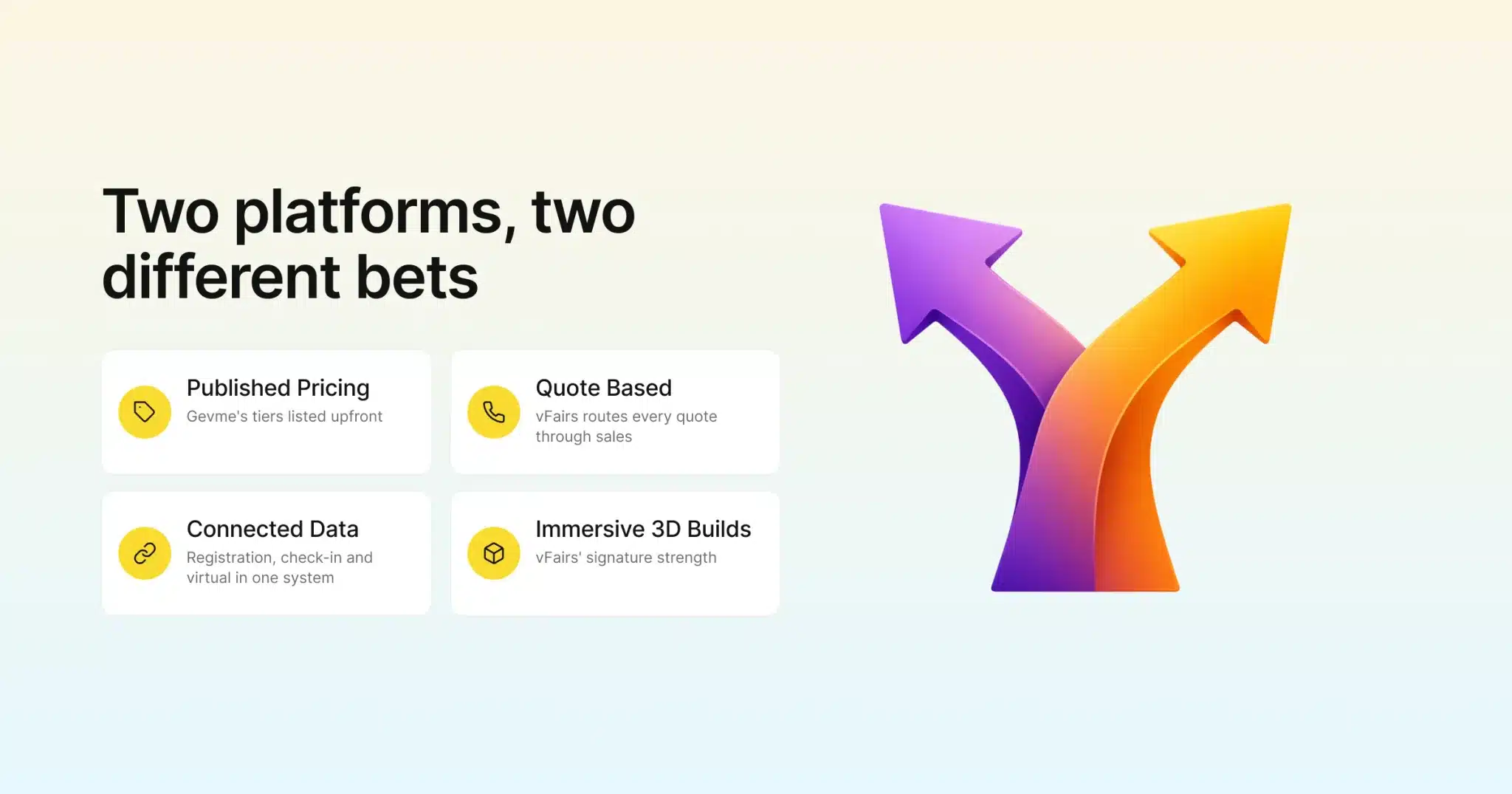
- Gevme publishes its pricing tiers upfront on its pricing page. vFairs does not publish numbers, and instead routes every quote through a sales conversation, per vFairs’ own pricing page, checked mid-August 2026.
- Registration, on-site check-in, and virtual attendance data sit in one connected system with Gevme. That matters most for teams running a mixed calendar of formats rather than one flagship event a year.
- vFairs leans heavily into large-scale immersive builds, gamification, and accessibility tooling. That suits big virtual trade shows and career fairs particularly well.
- There’s no universally wrong pick here. The right one depends on your event mix and your budget process. It also depends on how much you value seeing pricing before you talk to sales.
Why Teams End Up Comparing Gevme and vFairs
These two platforms don’t usually show up on the same shortlist by accident. A few recurring situations tend to push teams toward comparing them directly.
Budget Season and the Sales-Call Problem
Most event budgets get locked in months before the events themselves happen. That means whoever owns the number needs something concrete to work with. Gevme’s published tiers make that easy since you can put a real figure into a spreadsheet without waiting on anyone. vFairs’ quote-based model works fine once you’re deep into planning a specific event. It’s a harder fit for a team trying to estimate an annual platform cost in advance, though. That gap is often the first thing that puts vFairs and a platform like Gevme side by side in the same conversation.
A Growing Mix of Event Formats
Plenty of teams start out running mostly in-person events, then add a virtual arm. Within a year or two, they find themselves managing a real hybrid calendar. That shift is usually what triggers a serious look at the current platform, or a new one. The real question is whether it can keep registration, on-site check-in, and virtual attendance connected. Without that, the data ends up scattered across separate tools and exports.
Wanting Depth Without Losing Speed
Immersive, 3D-style virtual environments look great in a demo, and for the right event, that depth matters. But not every event needs a fully custom build. Teams running several events a year often care just as much about speed as polish. How fast can they get a new one live, versus how elaborate it looks? Depth versus speed is a big part of why Gevme and vFairs end up compared so often. The two platforms solve for slightly different priorities within the same broad category.
What Gevme and vFairs Actually Are
Before getting into pricing and features, it helps to know what each platform is actually built around. That’s what shapes everything else about how they feel to use.
Gevme in a Nutshell
Gevme is an omnichannel event management platform. It’s built around three connected pillars: hosting an event, running it, and proving its impact afterward. In practice, that means registration, a template-driven virtual venue, and on-site check-in and badging all live inside the same system. Attendee data doesn’t need to be exported and stitched back together after the fact. Gevme’s virtual events platform suits teams that want to launch a branded virtual event quickly. It draws on a library of ready-made themes. Meanwhile, event registration and on-site check-in tools plug into the same attendee record rather than operate as separate products.
vFairs in a Nutshell
vFairs centers on large-scale, immersive virtual and hybrid events. It puts a strong emphasis on 3D-style environments, animated booths, and avatar-based navigation. Together, those make a virtual trade show floor feel like an actual space to walk through. Per vFairs’ own site, the company states it has powered more than 50,000 events for over 100 million attendees. Those events span higher education, nonprofits, healthcare, and corporate career fairs. Registration, ticketing, mobile apps, and check-in are also part of the platform. The vendor bundles these together with dedicated project management support for each event.
Gevme vs vFairs Pricing: What’s Actually Public
Pricing transparency is usually the first thing that separates these two platforms in a real evaluation. Here’s exactly what each vendor publishes.
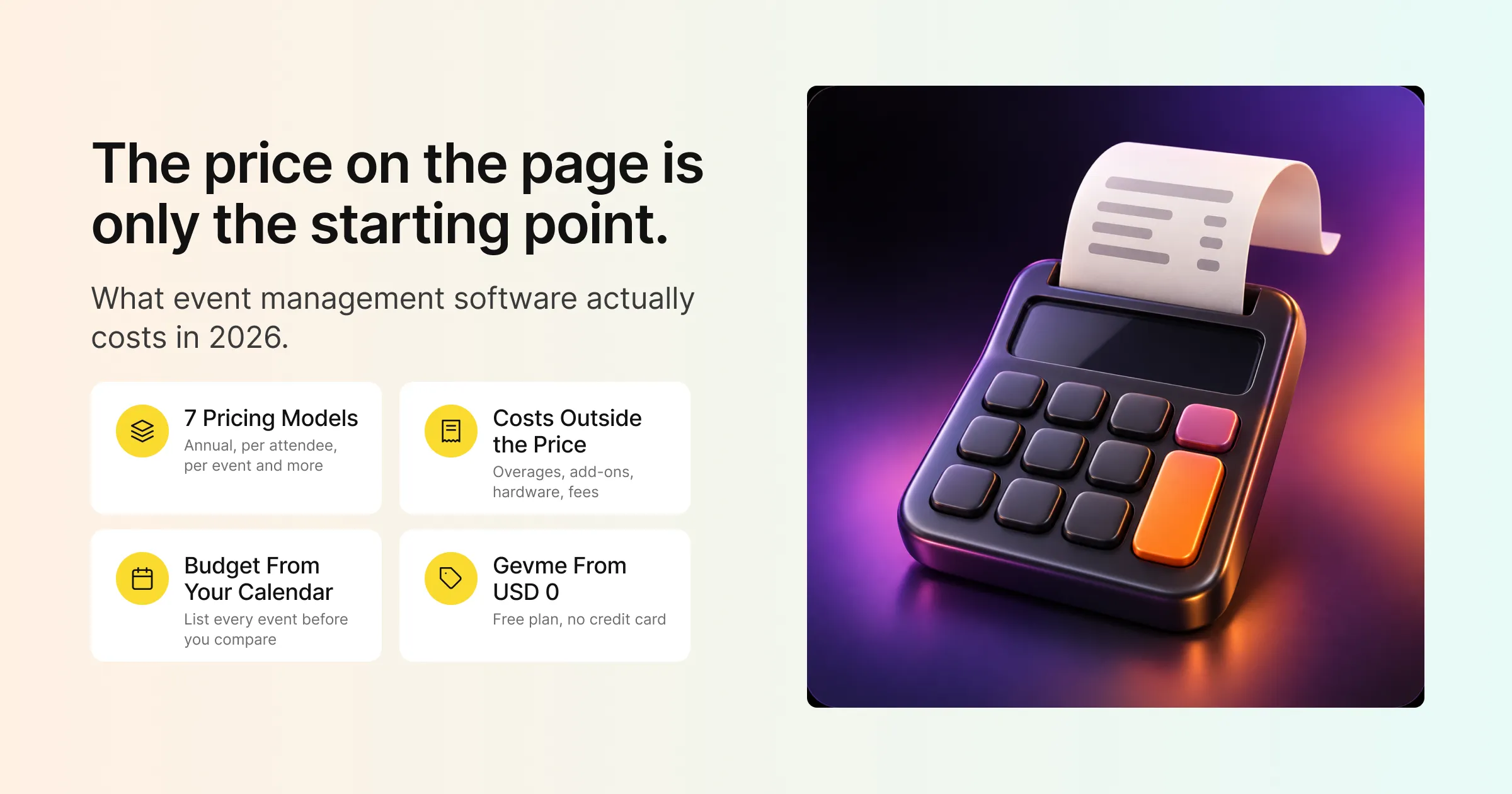
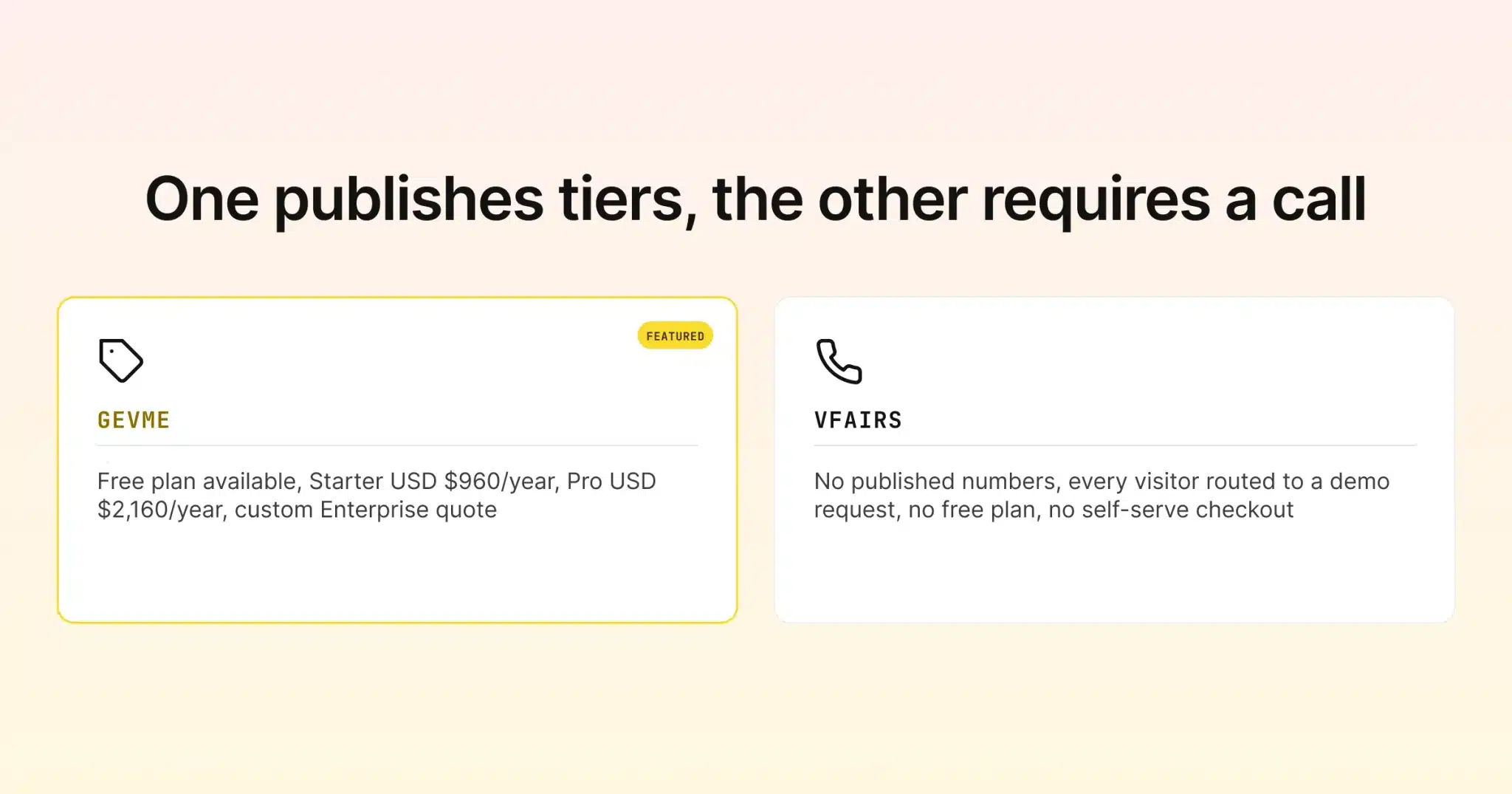
Gevme publishes its tiers directly on its pricing page, split across two product lines. The Virtual Venue Platform starts with a Free plan. It includes the website builder, virtual venue editor, and over 50 themes and experiences. From there, Starter runs USD $960 per year and adds the event mobile app and unlimited media hosting. Pro runs USD $2,160 per year and adds custom themes, business matchmaking, and RTMP streaming support. Enterprise is a custom quote that adds white-label branding and dedicated support. The Registration Platform follows a similar structure. Starter runs USD $960 per year and Pro runs USD $2,160 per year, plus there’s a custom-quoted Enterprise tier for organizations that need multiple sub-organizations or advanced compliance reporting.
vFairs doesn’t publish specific numbers. Its pricing page centers on a “Get Pricing For All Your Events” model. It states plainly that you pay only for what your event needs. It points every visitor toward a demo request or a sales conversation rather than a rate card. There’s no published starting price, no free plan, and no self-serve checkout. That’s not unusual for a platform built around large, custom builds. It does mean, though, that you can’t budget a real number against vFairs without a call. Gevme’s tiers, by contrast, are visible the moment you land on the page. This reflects what’s shown on each vendor’s own pricing page as of mid-August 2026. Pricing pages change, so double-check both directly before you budget against them.
Feature Comparison: Registration, Virtual, and Onsite
Pricing visibility is one piece of the decision. The other is whether each platform actually covers the formats you run.
Virtual Events
This is where both platforms actually compete, just with a different flavor. vFairs’ virtual environments lean into 3D animated graphics and customizable booth designs. Animated avatars let attendees move around a branded virtual space. The platform backs this up with smart and AI-driven matchmaking, live polls, and gamification like leaderboards and scavenger hunts. It also includes accessibility tooling, including screen reader support and live captions. It’s a deep toolkit, built specifically for big, immersive events.
Gevme’s virtual venue is just as capable of carrying a standalone online event, not only supporting an in-person one. The Virtual Venue Editor ships with more than 50 themes and experiences you can launch quickly. It also includes a fully customizable template system for landing pages and event microsites. It also includes a LiveBar widget for polls and live chat, plus business matchmaking on the Pro tier. RTMP channel streaming rounds it out, for pushing content to external platforms. For teams that want a virtual event live fast without building everything from a blank canvas, that combination holds its own against vFairs’ more elaborate 3D builds. That’s especially true for recurring events, where speed to launch matters as much as visual depth.
Onsite and In-Person Events
Gevme was built with on-site check-in as a first-class part of the platform, not a bolt-on. Check-in kiosks, badge design and printing, and on-site software all connect back to the same registration and attendee record used for the virtual side of the event. A hybrid event, then, doesn’t mean reconciling two separate systems afterward. vFairs also supports in-person and hybrid formats. Its strongest reputation and most detailed public feature set center on the virtual and immersive side of the business, though. Teams running heavy on-site logistics alongside virtual attendance may find Gevme’s connected approach a more natural fit.
Registration and Setup Speed
Both platforms handle core registration: custom forms, ticketing, email communications, and attendee reporting. Gevme’s registration tools plug directly into the same attendee data used across virtual and on-site check-in. Custom landing pages, payment gateway integration, and event analytics are available from the Starter and Pro tiers. vFairs bundles registration and ticketing into its broader event package. Dedicated project management support helps set up more complex, custom builds.
Support Model
vFairs includes dedicated project managers and 24/7 technical support. That’s part of its white-glove approach to running larger, more custom events. That suits organizations that want a vendor team closely involved in the build. Gevme’s support scales with plan tier instead. Priority support is available on Pro, and dedicated premium support on Enterprise, aimed at teams that want responsive help without needing a project manager assigned to every event.
Security, Compliance, and Integrations
Both vendors treat data handling seriously, which matters once you’re collecting attendee information at scale. vFairs states it maintains GDPR, SOC 2, and ISO 27001 compliance on its own site. That’s aimed squarely at enterprise and higher-education buyers with strict procurement requirements. Gevme’s Enterprise tier adds advanced security features, compliance reporting, and a custom integrations engine on top of the standard plan. That way, larger organizations aren’t stuck choosing between security and the connected data model. Both come as part of what makes Gevme useful in the first place. For most small and mid-size teams, either platform’s standard tier covers the basics. It’s the enterprise-level buyers who should ask both vendors for specifics before signing anything.
A Few Terms Worth Knowing
If some of the terminology above isn’t familiar, here’s a quick plain-English rundown.
RTMP streaming is a way of pushing your event’s video feed out to other platforms, like YouTube or a custom player. It happens at the same time the feed is playing inside the event platform itself.
Hybrid event simply means an event that runs both in person and online at the same time. Some attendees are in the room, and others join virtually.
On-site check-in covers the kiosks, badge printing, and scanning tools used to get attendees through the door and into the event quickly. The goal is no long line at a registration desk.
Business matchmaking is a feature that suggests relevant connections between attendees, exhibitors, or sponsors based on shared interests. It works similarly to how a networking app might recommend people to meet.
Gevme vs vFairs at a Glance
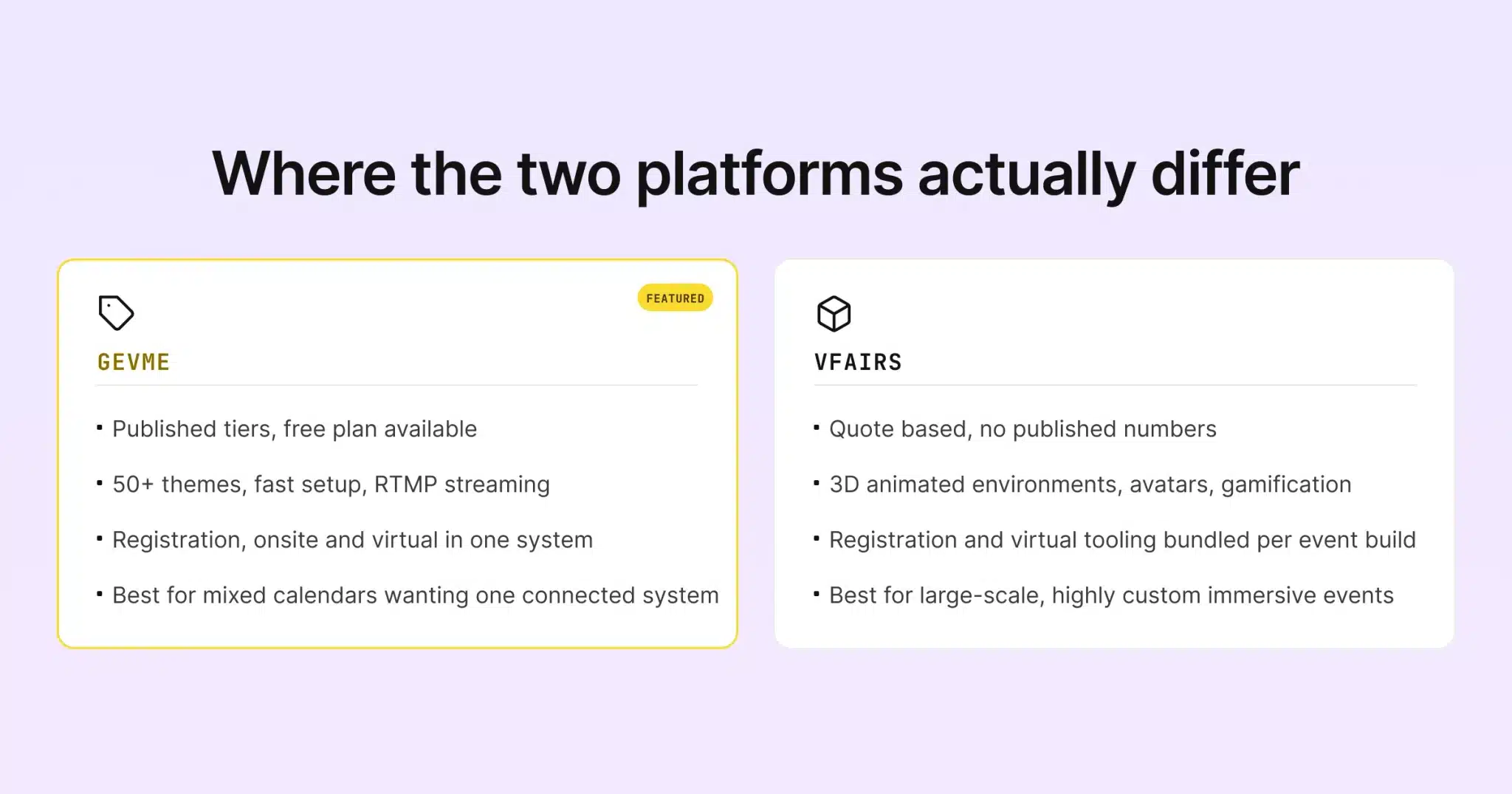
| Dimension | Gevme | vFairs |
|---|---|---|
| Pricing transparency | Published tiers, Free plan available | Quote based, no published numbers |
| Virtual event strength | Strong, 50+ themes, fast setup, RTMP streaming | Strong, 3D animated environments, avatars, gamification |
| Onsite and hybrid | Built-in check-in, badging, and on-site software connected to the same data | Available, with virtual and immersive builds as the primary focus |
| Data unification | Registration, on-site, and virtual data live in one system by design | Registration and virtual tooling bundled together per event build |
| Support model | Tiered support, priority and dedicated options on Pro and Enterprise | Dedicated project manager and 24/7 support included |
| Best fit | Teams running a mixed calendar of virtual, hybrid, and in-person events who want one connected system | Large-scale, highly custom virtual trade shows, career fairs, and immersive experiences |
Sources: Gevme’s figures above come from its own pricing page and virtual events page. vFairs’ figures come from its own pricing page and virtual events page. Both were checked as of mid-August 2026 and are worth verifying directly since vendor pages change.
Who Should Choose Gevme, and Who Should Choose vFairs
There isn’t a single better choice here. It comes down to your event mix and how your team likes to budget.
When Gevme Is the Better Fit
If you’re running a varied calendar across the year, some fully virtual, some hybrid, some entirely in person, Gevme’s connected approach tends to help. It saves real time. That’s especially true if you want registration, check-in, and virtual attendance data to live in one place without extra exports. It also fits teams that want to see actual pricing before booking a call, since every tier is published. And it suits teams that want a virtual event live quickly, using a ready-made theme rather than a fully custom build from scratch.
If pricing transparency matters to how your team plans, and having virtual, onsite, and registration in one system does too, see how Gevme’s pricing and platform work together before your next event.
When vFairs Is the Better Fit
If your priority is a single, large-scale virtual event with a highly immersive, custom-built environment, animated avatars, and deep gamification, look at vFairs. Its strength in that specific niche is hard to argue with. That holds as long as you have the budget and timeline. You’ll need both to work through a custom build with a dedicated project manager. It’s a strong choice for big annual virtual trade shows and career fairs. In those settings, the visual depth of the environment is central to the experience.
Pro Tip
Before you commit to either platform, list out every event you’re running in the next twelve months. Sort them by format: virtual, hybrid, and in person. Then ask each vendor for one number that covers the whole calendar, not just your biggest event. Gevme’s published tiers make that math easy to do yourself in a few minutes. For vFairs, bring that same list to the sales conversation instead. Ask for a single annual figure rather than a per-event quote, so you’re comparing like for like once you have real numbers from both sides.
Frequently Asked Questions
Gevme publishes its pricing tiers directly, starting with a free plan and moving up to USD $960 and USD $2,160 per year. You can see actual numbers without a sales call. vFairs doesn’t publish pricing, so a direct dollar-for-dollar comparison depends on the quote you receive for your specific event. What’s clear is that Gevme lets you budget before you talk to anyone. That’s a real advantage if pricing certainty matters to your process.
Yes. vFairs’ 3D animated environments, customizable booths, and avatar-based navigation are built specifically for large virtual trade shows and career fairs. Attendees at those events expect to browse a space rather than sit through a single stream. It’s one of the platform’s clearest strengths.
Gevme is strong in virtual as well as onsite. The Virtual Venue Platform ships with more than 50 themes and experiences. It also includes a dedicated Virtual Venue Editor, plus RTMP streaming support. Teams use it to run fully virtual events on its own. It’s not only the online half of a hybrid one.
Yes, both platforms support hybrid events. Gevme’s advantage is that registration, on-site check-in, and virtual attendance connect to the same attendee record by default. vFairs supports hybrid formats too, generally as an extension of its virtual-first, project-managed build process.
Still Have Questions?
Gevme centers on getting a first event live quickly, using pre-built themes and a more focused core workflow. That suits teams on a tighter timeline. vFairs’ custom, immersive builds generally involve a longer setup process, though, supported by a dedicated project manager. That fits teams planning further ahead for a large flagship event.
Sometimes, but not always. Teams evaluating both are usually weighing a connected, published-pricing platform against a highly customized, immersive one. Organizations running a steady, varied calendar tend to lean toward Gevme. Those planning one very large, visually elaborate virtual event tend to lean toward vFairs.
Depending on your event mix, a few other names deserve a glance too. Zoom Events covers simpler, lower-cost virtual sessions well. Platforms like Cvent and Bizzabo compete more directly at the large-scale enterprise end. None of them combine Gevme’s connected registration, on-site, and virtual data model with published pricing. That combination is usually the deciding factor for teams that land on Gevme after a broader search. You can see how Gevme’s full event management ecosystem fits together, if you want the wider picture beyond just this comparison.
Conclusion: Matching the Platform to How You Actually Run Events
Gevme and vFairs are both capable platforms, just built around different priorities. vFairs earns its reputation for immersive, large-scale virtual builds. For a big annual trade show or career fair, that depth pays off. Gevme, meanwhile, suits a different kind of team. It fits teams that want virtual, onsite, and registration data connected in one system, published pricing they can act on without a sales call, and a virtual venue that’s just as ready to run on its own as it is to support a hybrid event.
The right choice comes down to your calendar, not which platform has the flashier demo. If you run a mix of formats throughout the year and want to see real numbers before you commit, request a demo with Gevme. Bring your actual event list to the call.