Swapcard has built one of the more publicly documented AI matchmaking stacks in the event industry. It runs on a named recommendation engine (Gismo), an AI assistant (Sherlock), and a model-agnostic language layer (Cortex) that can call on providers like OpenAI, Gemini, or Anthropic. If your team is using Swapcard, evaluating it, or comparing it against other networking-first platforms, you already know that AI matchmaking is the centerpiece of its pitch. That is especially true for trade shows and B2B conferences, where exhibitor lead quality drives the ROI conversation.
That said, Swapcard isn’t the only platform selling AI-driven networking. The way each vendor implements it, prices it, and pairs it with registration and on-site tools varies more than the marketing pages let on. Some platforms build matchmaking into a full event management suite. Others sell it as a standalone networking layer meant to sit on top of whatever registration system you already run.
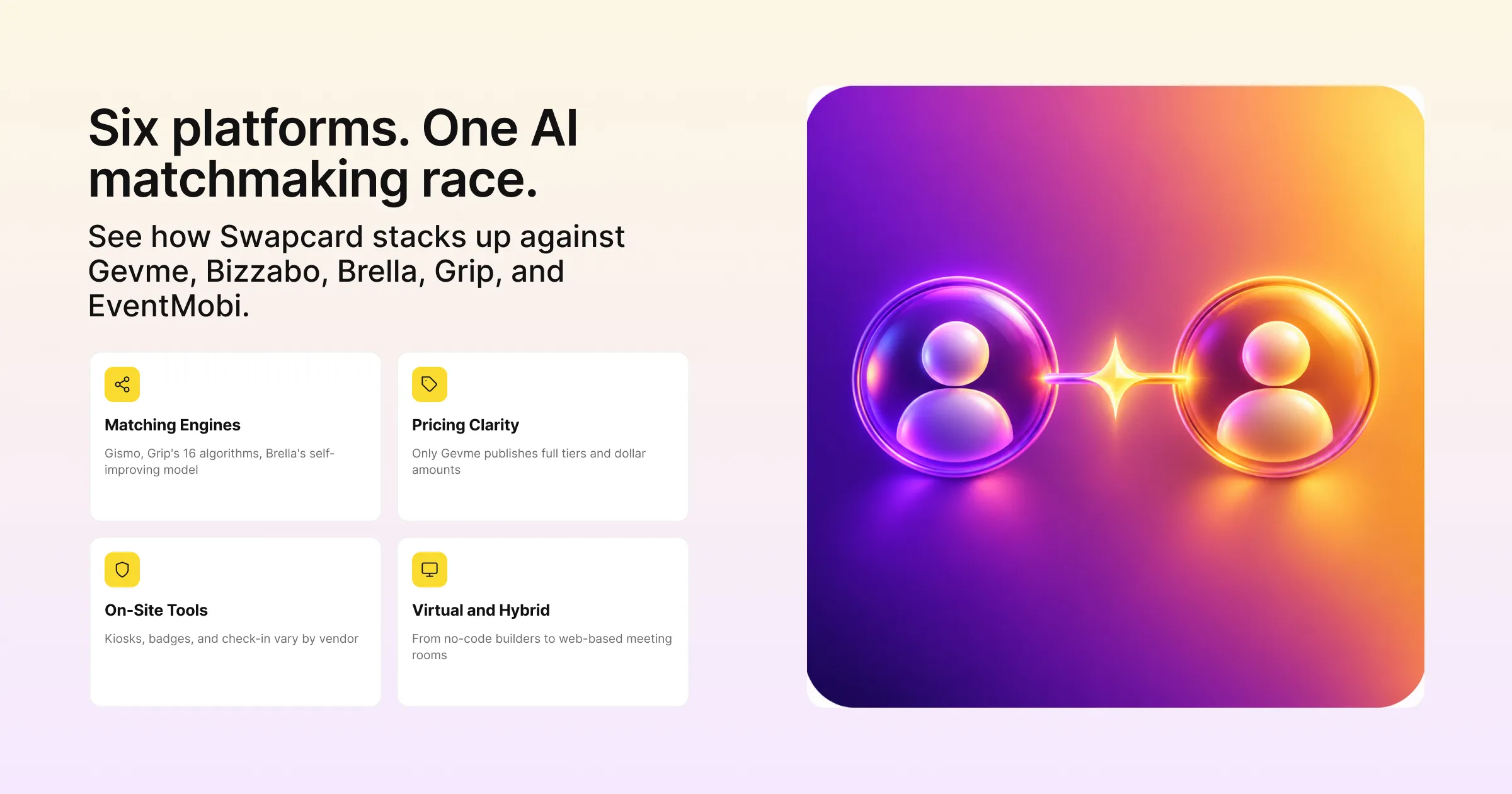
This guide covers what Swapcard’s matchmaking stack actually includes, and how five other platforms approach AI-powered networking: Gevme, Bizzabo, Brella, Grip, and EventMobi. It sets out what each one costs where pricing is available. Then it looks feature by feature at matchmaking mechanics, registration, on-site tools, and virtual delivery. Finally, it offers a decision framework for picking the right fit.
Key Takeaways
- Swapcard’s matchmaking runs on three named components. Gismo is the matching engine, Sherlock is the AI assistant, and Cortex is the model layer that lets Sherlock call different large language models.
- Grip and Brella are dedicated matchmaking specialists first. Grip cites 16 machine learning algorithms, while Brella emphasizes a self-improving, learning matchmaking model.
- Bizzabo and Gevme both build AI matchmaking directly into a broader event management platform, rather than selling it as a standalone add-on.
- EventMobi’s own site describes profile- and appointment-based networking tools without branding them as AI matchmaking. That is worth knowing if AI-driven matching specifically is the deciding factor.
- Pricing transparency is uneven across the board. Gevme is the only platform here with full published tiers and dollar amounts for its matchmaking-inclusive product line.
- Every vendor reports its own performance numbers, such as acceptance rates, leads generated, and meetings booked, without third-party verification. Treat those figures as vendor claims worth testing on your own event rather than guarantees.
- On-site check-in and badging support varies widely. Gevme, Grip, and Swapcard all offer dedicated hardware, while Brella’s site shows no standalone check-in product beyond QR-based lead scanning inside its app.
Why Teams Look Beyond Swapcard for AI Matchmaking
The first reason is pricing structure. Swapcard prices its platform around a mix of an annual license fee plus attendee and exhibitor volume. Most of its tiers stay behind a demo request rather than a self-checkout number. Its Event Engagement plan does list a starting figure of $610 a year, but that’s only a floor. The final number still depends on a full quote, and the core Registration and Management Platform has no published pricing at all.
The second reason is scope. Swapcard positions itself as a “revenue-first” platform built around exhibitor ROI and lead generation. That is a strong fit for trade shows and sponsor-heavy B2B conferences. However, some teams run association events, member conferences, or programs where networking matters but exhibitor monetization isn’t the main goal. Those teams often want a platform where matchmaking sits alongside registration and on-site check-in, rather than being the headline feature.
The Category Now Has Real Competition
The third reason is that AI matchmaking, as a category, has matured. Grip and Brella both built their entire products around matching first, with years of iteration specifically on that problem. Bizzabo and Gevme take the opposite route. Both fold AI matchmaking into a wider platform, where it shares data with registration and on-site tools instead of running as a separate system that needs its own integration.
What Swapcard’s AI Matchmaking Actually Does
Swapcard names three components working together. Gismo is the underlying recommendation engine. Swapcard describes it as open-source and built on a custom variant of TF-IDF combined with a random-walk approach, mapping attendees, sessions, and exhibitors into a knowledge graph to surface relevant matches. Sherlock is the AI assistant attendees and exhibitors interact with directly. It answers questions about sessions and logistics, offers personalized itineraries, and surfaces exhibitor leads based on who viewed a profile or bookmarked a product. Cortex is the layer that makes Sherlock model-agnostic, letting Swapcard choose between providers like OpenAI, Gemini, Anthropic, Mistral, and Meta rather than locking into one.
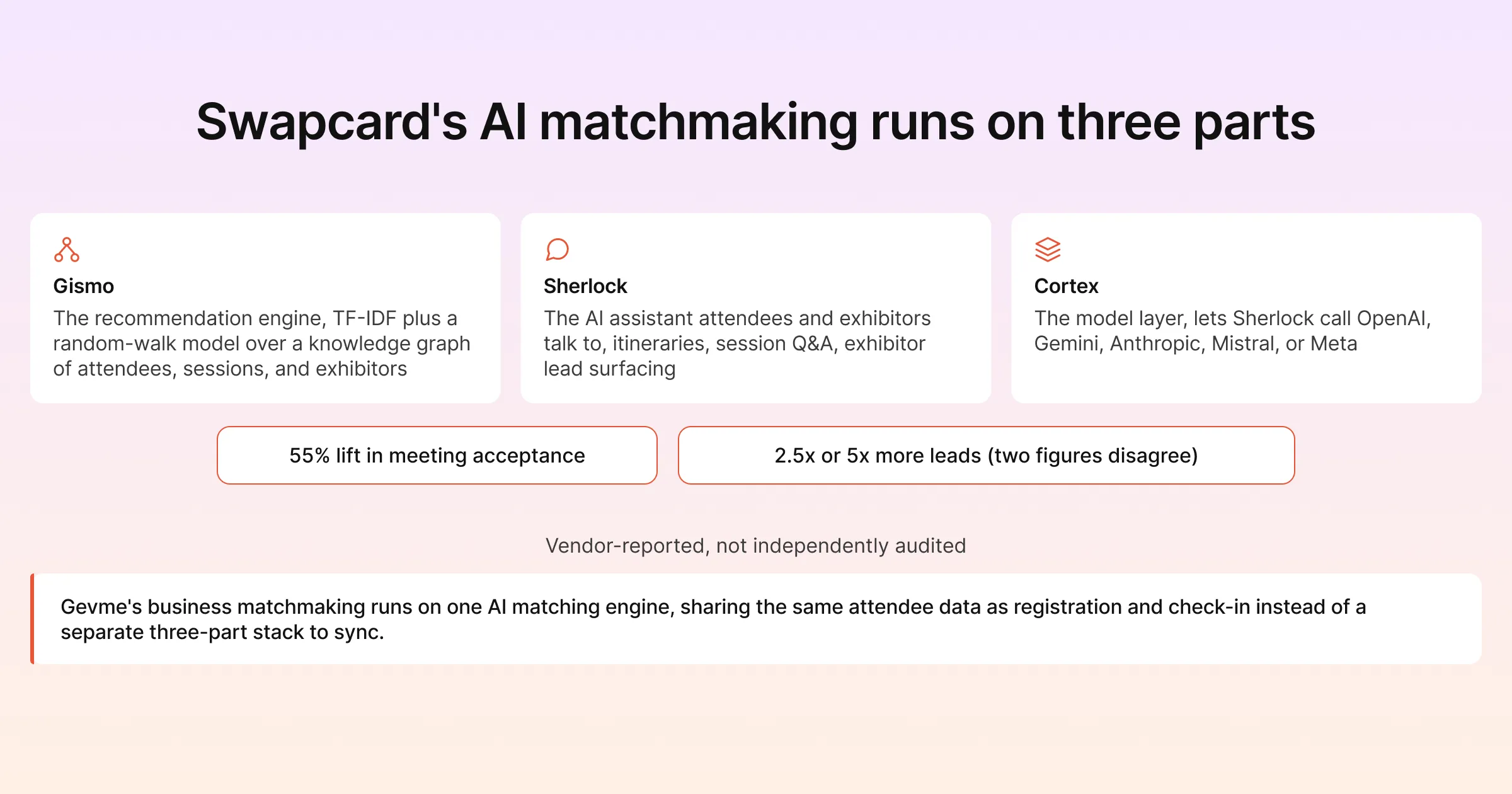
On the matching side, Swapcard pulls from stated profile data such as interests, goals, job role, and company size. It also uses real-time behavior like booth visits and session views. Recommendations are then ranked separately for people, sessions, and exhibitors. Its Smart Meeting Generator automates structured formats like speed networking, building optimized schedules from that same data. Swapcard states that AI-enriched profiles lift meeting acceptance rates by 55%. It separately claims either 2.5x or 5x more qualified exhibitor leads depending on which page you check, which is worth noting since the two figures don’t match. These are Swapcard’s own reported numbers rather than independently audited results.
Pricing: How Much Each Platform Shows You
Checked in late August 2026, here’s what’s visible on each vendor’s own site.
Swapcard doesn’t show dollar pricing on its main pricing page. That page names Starter, Professional, and Enterprise tiers by attendee volume, with no numbers attached. A separate plans overview lists its Event Engagement plan starting at $610 a year, with the Registration and Management Platform staying fully custom.
Gevme shows full tiers on its pricing page. Its business matchmaking capability lives on the Virtual Venue Platform, available from the Pro tier at $2,160 a year, after a Free tier and a Starter tier at $960 a year. The separate Registration Platform runs Starter at $960 a year, Pro at $2,160 a year, and a custom Enterprise tier.
Bizzabo lists one real starting number. Its Event Experience OS, which includes AI-powered matchmaking, starts at $499 per user per month or $17,999 a year with a three-user minimum, per its pricing page. Its Klik SmartBadge networking hardware is priced separately, on request.
Brella, Grip and EventMobi
Brella shows no pricing anywhere on its pricing page, which lists feature categories with “Contact sales” as the only call to action. The one concrete number on the entire site is a ticketing transaction fee, standard Stripe processing plus 2%, disclosed on its ticketing page.
Grip has no pricing page at all. Its pricing URL returns nothing, and no plan names or figures appear anywhere else on the site. Every path leads to a demo request.
EventMobi publishes starting prices on its pricing page: $3,000 per event or $8,900 a year for unlimited events. Networking is included in the base platform, while add-ons like streaming and integrations are priced separately.
None of this is locked in stone. Vendors update these pages often enough that a number from last quarter can already be wrong.
Feature-by-Feature: Matchmaking, Registration, On-Site, and Virtual
How the Matchmaking Engines Compare
Grip leans hardest into the technical story. It cites 16 machine learning algorithms, though a separate page on its own site says “over 15 different strategies,” a discrepancy worth flagging if precision matters to your evaluation. Those algorithms process roughly 70 million data points to generate more than 70 million recommendations a year. Its “Learn, Recommend, Meet” model automatically allocates a meeting time and location once two people show mutual interest. Its MustMeet scheduling tool claims to cut manual meeting-arranging work by 95% compared to spreadsheets.
Brella describes a similar self-improving model. Its AI analyzes hundreds of data points per attendee and, per Brella, keeps getting better as more people join an event and generate more matching signal. It also supports a wider range of meeting formats than most platforms here, including investor-startup pairings and mentor-mentee matching alongside standard one-to-one meetings.
Bizzabo’s AI matchmaking sits inside its broader networking product, surfacing relevant connections and enhanced attendee profiles. Its Klik SmartBadge adds a physical tap-to-connect layer that Bizzabo credits with a 250% boost in networking activity.
Gevme’s business matchmaking runs on an AI-powered matching engine. It connects people to people, people to sponsors, and people to sessions, with both scheduled and instant meetings. It also includes Metacards, QR-scannable digital business cards carrying custom calls to action. Because it’s part of the same Virtual Venue Platform as Gevme’s registration and event delivery tools, matchmaking runs on the same attendee data as the rest of the event rather than a separately synced dataset.
EventMobi is the outlier here. Its dedicated networking page describes customizable profiles, appointment booking, messaging, and a social activity feed. Those are all useful tools, but none of it is described as AI-driven matching on that page. EventMobi does mention a general AI toolset called MobiAI and an AI concierge tied to registration elsewhere on its site. Still, if AI-powered matching specifically is your deciding factor, it’s fair to treat EventMobi’s networking as solid and manual rather than AI-branded.
Event Registration
Swapcard’s registration supports conditional-logic forms that vary by attendee type, unlimited ticket types, and no added transaction fees beyond standard payment gateway rates. Gevme’s registration platform adds multi-step forms, prepopulation for returning attendees, and automated email workflows. Bizzabo includes a referral tool called Ticket Boost and CRM enrichment on signup. Brella supports free, paid, and coupon-based ticket types with a branded post-purchase page. Grip offers conditional branching forms and a single login that carries through from registration into its mobile app. EventMobi rounds this out with 19-language support and automatic timezone detection for global audiences.
On-Site Check-In and Lead Retrieval
Gevme and Grip both offer the most complete on-site hardware stories here. Gevme’s on-site check-in covers QR, facial recognition, and ID-scan check-in with its own kiosk hardware line. Grip offers self-service badge-printing kiosks, entrance scanning, and Bluetooth-enabled Smart Badges for tap-to-exchange contact info, which Grip credits with a tenfold increase in participant connections. Swapcard’s SwapAccess and Swapcard Go bundle support both digital badges and on-demand color printing, scaling from a single kiosk to dozens of stations at large trade shows.
EventMobi’s BadgeON system uses wireless printers that event staff can set up without a technician. Bizzabo pairs its Onsite Command App with the Klik SmartBadge wearable. Brella is the exception. Its own site doesn’t show a dedicated check-in or badge-printing product, only QR-based lead scanning built into its event app for exhibitor lead retrieval. So if full on-site badging is a requirement, that’s worth confirming directly with Brella before assuming it’s included.
Virtual and Hybrid Capabilities
Gevme’s virtual venue platform is a no-code, template-driven builder with more than 50 themes, a modular content-block editor, and RTMP streaming on its Enterprise tier. It is built to run alongside its matchmaking and registration tools rather than as a separate product. It’s a strong virtual environment in its own right, built with the same depth as Gevme’s registration and on-site tools rather than added on as an afterthought.
Brella and Grip both describe support for virtual, physical, and hybrid formats. Brella frames it as pivoting formats “with the click of a button,” while Grip offers web-based virtual meeting rooms that can plug into an organizer’s existing app. Swapcard includes virtual events and webinars as part of its Event Engagement plan, though a dedicated virtual product page wasn’t easy to find on its site. EventMobi supports three distinct hybrid formats, depending on whether virtual and in-person sessions run at the same time, after the fact, or on different days. Bizzabo’s virtual and hybrid layer, The Venue, centers on a visual destination with pre-session lounges and a centralized Command Center.
A Few Terms Worth Knowing
- Matchmaking engine: The underlying software that decides which attendees, exhibitors, or sessions to recommend to a given person. It typically works from profile data, stated interests, and behavior at the event.
- Knowledge graph: A way of mapping people, sessions, and companies as connected data points, so a matching algorithm can find relevant relationships between them rather than relying on simple keyword tags.
- LLM (large language model): The type of AI model behind conversational assistants like Swapcard’s Sherlock. It understands and responds to natural-language questions rather than just running fixed rules.
- Lead retrieval: The process exhibitors use to capture and qualify contact information from attendees who visit their booth, usually through badge scanning inside a mobile app.
Swapcard Alternatives Compared
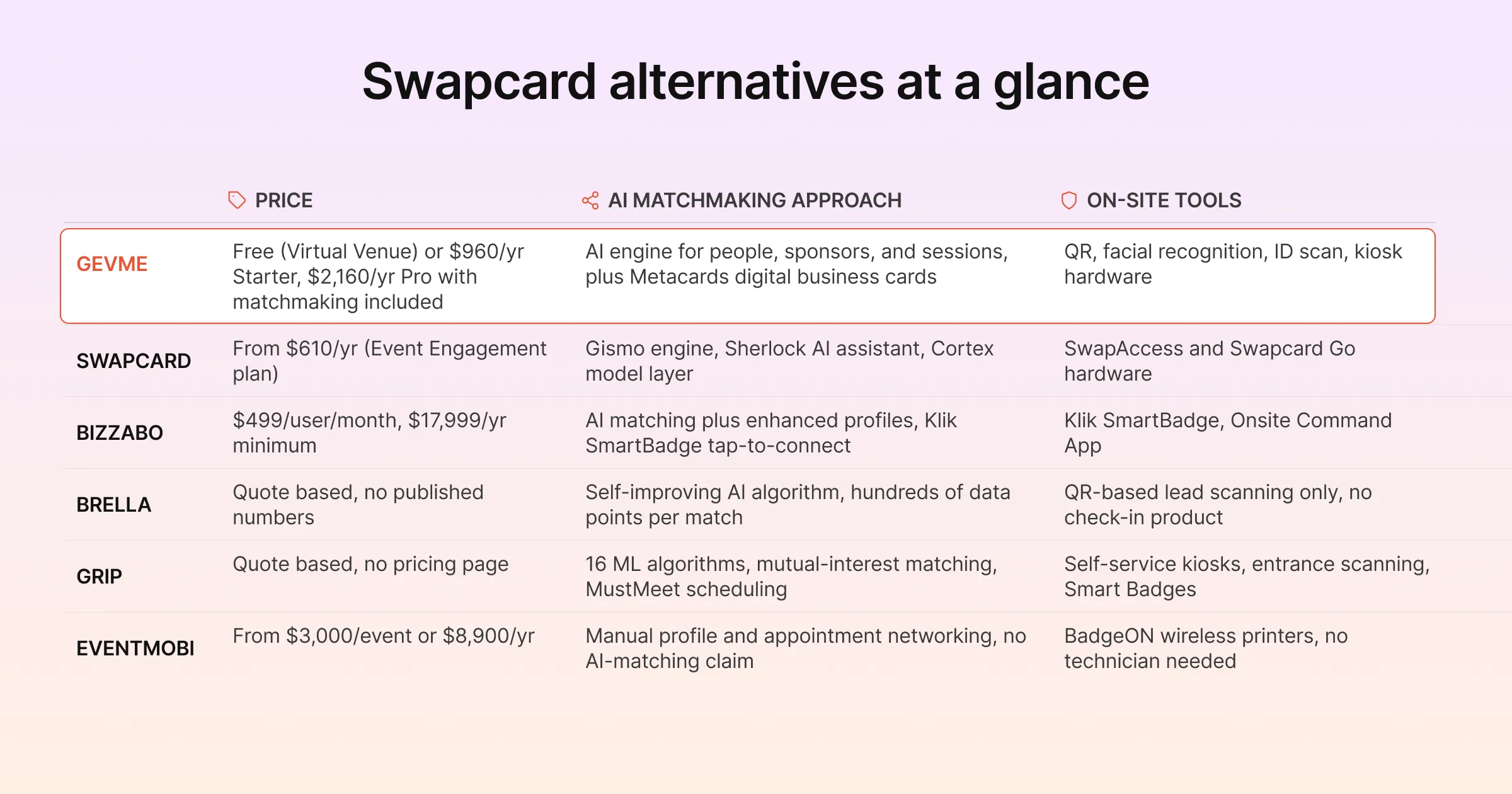
| Platform | Starting Price | AI Matchmaking Approach | On-Site Tools | Virtual/Hybrid |
|---|---|---|---|---|
| Gevme | Free (Virtual Venue) / $960 per year (Starter, either product line) | AI matching engine for people, sponsors, and sessions, Metacards for digital business cards | QR, facial recognition, ID scan, kiosk hardware | No-code builder, 50+ themes, RTMP on Enterprise |
| Swapcard | From $610 per year (Event Engagement plan) | Gismo engine, Sherlock AI assistant, Cortex model layer | SwapAccess, Swapcard Go hardware | Included in Event Engagement plan |
| Bizzabo | $499 per user per month ($17,999 per year minimum) | AI-powered matching, enhanced profiles, Klik SmartBadge tap-to-connect | Klik SmartBadge, Onsite Command App | The Venue, pre-session lounges |
| Brella | Quote based, no published numbers | Self-improving AI algorithm, hundreds of data points per match | QR-based lead scanning only, no dedicated check-in product found | Virtual, physical, and hybrid formats |
| Grip | Quote based, no published numbers | 16 machine learning algorithms, mutual-interest matching, MustMeet scheduling | Self-service kiosks, entrance scanning, Bluetooth Smart Badges | Web-based virtual meeting rooms |
| EventMobi | From $3,000 per event or $8,900 per year | Manual profile and appointment-based networking; no AI-matching claim on its own site | BadgeON wireless, no technician needed | Three hybrid formats, native VOD |
Sources, checked in late August 2026, are each platform’s own pricing or product pages: Gevme, Swapcard, Bizzabo, Brella, Grip, EventMobi. Vendor pricing pages change often. Confirm directly before you budget against any figure here.
Who Should Choose Which
Is exhibitor lead generation and sponsor ROI the core of your event? For a trade show or large B2B conference, Swapcard’s matchmaking stack is purpose-built for exactly that, with Sherlock doubling as an exhibitor lead-surfacing tool.
Perhaps you want matchmaking running on the same platform and the same attendee data as your registration and virtual delivery, without a separate integration to manage. Gevme’s business matchmaking covers people-to-people, people-to-sponsor, and people-to-session matching from the Pro tier up. It sits alongside a fully built-out registration and virtual venue.
Where matchmaking is the entire point of your event, Brella and Grip deserve a close look. Think mentor-mentee programs, investor pitch days, or dedicated networking conferences. Both were built around that single problem first, and it shows in the range of meeting formats each supports.
Teams that want a proven physical networking layer alongside AI matching should test Bizzabo. Its Klik SmartBadge and its 250% networking-boost claim are worth trying at a pilot event before a full rollout.
Finally, your event may need strong appointment scheduling and profile-based networking without AI-branded matching specifically. EventMobi’s networking tools are functional, and its BadgeON check-in system is one of the easiest to set up without dedicated AV staff.
Pro Tip
Every acceptance-rate, lead-quality, and connection-boost statistic in this comparison comes directly from the vendor that built the feature. No independent audit sits behind any of it. So before you choose a platform based on a matchmaking claim, ask for a trial or pilot run on a smaller event. Then look at your own numbers: meeting acceptance rate, no-show rate, and how many of those connections turned into something after the event. A demo environment with sample data will look better than your real audience until you’ve tested it against your real audience.
Frequently Asked Questions
Generally, it means the software analyzes attendee profile data and behavior, like session views, booth visits, or stated interests, and automatically ranks or suggests connections. That replaces attendees searching a static directory. How sophisticated that analysis is varies a lot between vendors, from simple interest tags to the multi-model approach Swapcard describes with Gismo, Sherlock, and Cortex.
Swapcard can handle networking-first events. That said, its own positioning and feature set lean toward exhibitor ROI and lead generation, which makes it the strongest fit for trade shows and sponsor-driven B2B conferences specifically.
Grip and Swapcard both position themselves heavily around trade shows and exhibition-style events. Grip emphasizes hosted-buyer formats and lead scoring, while Swapcard emphasizes exhibitor lead quality through its AI assistant.
Most do. Gevme, Grip, Swapcard, Bizzabo, and EventMobi all offer some form of dedicated check-in or badge-printing hardware. Brella is the exception among this group, because its own site shows QR-based lead scanning inside its app rather than a standalone check-in product.
It depends heavily on the vendor. Gevme is the only platform in this comparison with a fully published price for its matchmaking-enabled tier, starting at $2,160 a year for the Pro tier on its Virtual Venue Platform. Swapcard, Bizzabo, and EventMobi show starting figures with the final cost tied to volume or add-ons, while Brella and Grip keep pricing entirely behind a sales conversation.
It depends on the platform. Grip and Brella are both built to layer matchmaking on top of an existing setup, which can work well if you are happy with your current registration tool. Gevme, Bizzabo, and Swapcard all build matchmaking into a broader platform alongside registration. That usually means fewer moving parts, but a bigger switch if you are not already using one of them for registration.
Swapcard publishes the most detail about its underlying approach. It names its engine (Gismo), describes its knowledge-graph method, and names the specific language models available through Cortex. Grip also shares a fair amount of detail about its algorithm count and data volume. Most other vendors describe their matching in more general terms.
Conclusion: Matching Software to How Your Event Runs
Swapcard has put real effort into documenting its AI matchmaking approach. For trade shows and B2B conferences built around exhibitor ROI, that combination of Gismo, Sherlock, and Cortex is a legitimate reason it keeps coming up in comparisons. Grip and Brella earn their place in this conversation too. Both were built from day one around solving the matching problem specifically, with years of iteration to show for it.
What if you want matchmaking that lives on the same platform as your registration, on-site check-in, and virtual delivery, without stitching together a separate networking tool and syncing attendee data by hand? Gevme’s business matchmaking runs on the same Virtual Venue Platform as its registration and event-delivery tools, with pricing you can see before you talk to sales. If that kind of unified setup sounds closer to what your next event needs, request a demo and see the matchmaking engine in action.