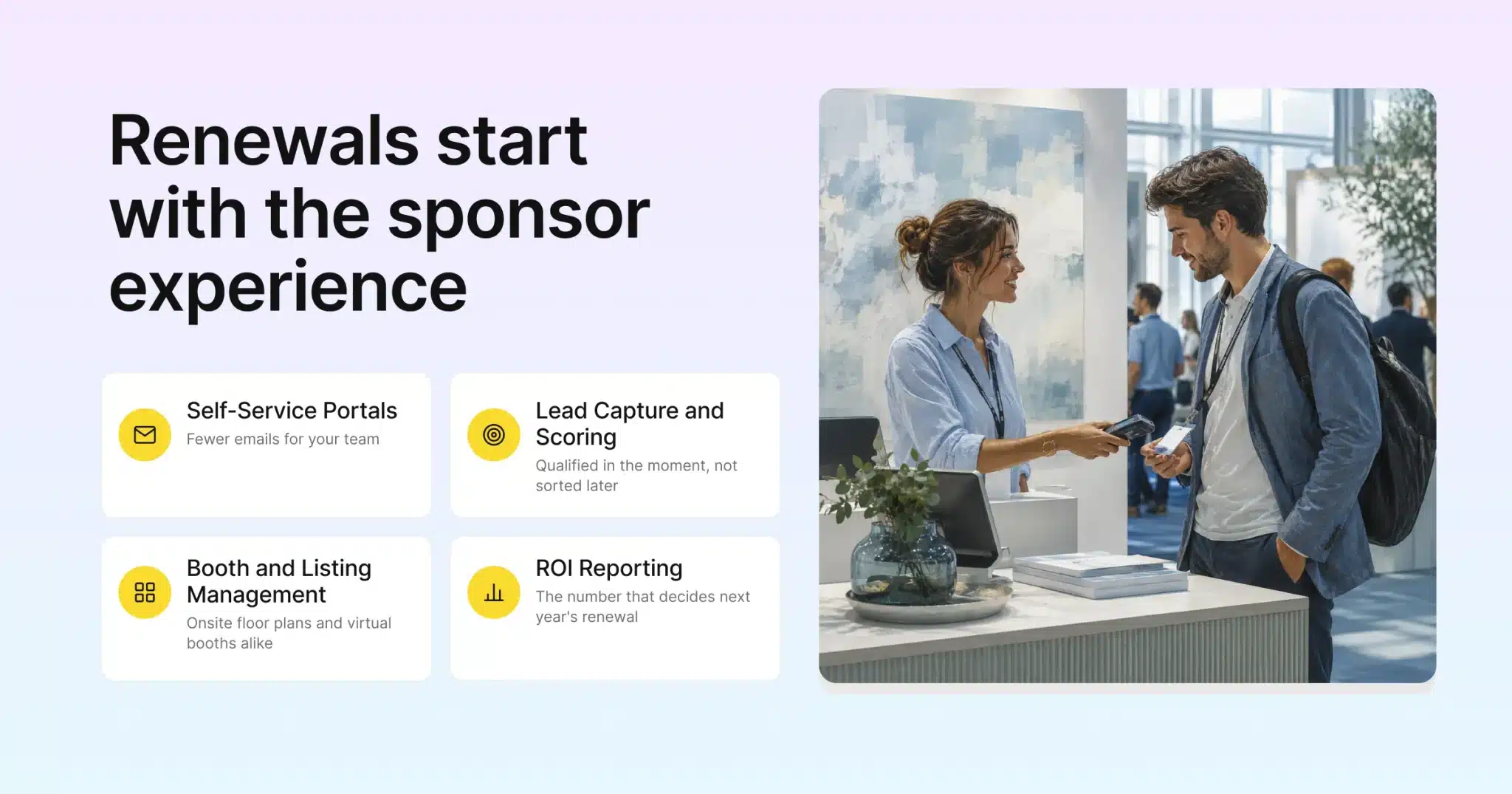
Sponsors and exhibitors fund a meaningful share of most event budgets. The tools you give them shape whether they come back next year. A sponsor who can’t get a straight answer on lead counts remembers that experience. So does an exhibitor stuck emailing a spreadsheet back and forth to confirm booth details, as much as they remember the event itself. Sponsor and exhibitor management software exists to fix exactly that. It gives partners self-service access to what they need, and gives organizers a clear view of who owes what and who’s delivering value.
This is a narrower category than general event management software. It matters disproportionately, though, since renewal decisions for next year’s sponsorship often come down to how easy this year’s experience was. Some platforms treat it as a core strength; others offer it as one feature among many. That difference is often invisible until a sponsor is already frustrated mid-event.
This guide covers what to actually look for in sponsor and exhibitor management software. It also gives an honest look at what Gevme, EventsAIR, Cvent, Swapcard, and Bizzabo each offer. It also includes a comparison table and a framework for matching the right tool to the kind of exhibit hall or sponsorship program you run.
Key Takeaways
- Sponsor and exhibitor management software should cover self-service portals, lead capture, booth or listing management, and ROI reporting. It shouldn’t be just a line item in a broader event platform.
- EventsAIR includes sponsor and exhibitor tools, interactive floor plans, self-service portals, and real-time revenue tracking. All of it comes at no additional cost, as part of its core platform.
- Swapcard’s strength is AI-driven matchmaking and lead scoring, connecting exhibitors with attendees most likely to convert rather than just capturing every badge scan.
- Cvent’s LeadCapture and Exhibitor Portal emphasize measurable ROI reporting, with published case studies citing specific pipeline and cost-savings figures.
- Bizzabo offers a Lead Booster app for on-site scanning and a sponsor portal for partner communication. Sponsorship options extend to app, session, and poll branding, too.
- Gevme supports both virtual booths with interactive features (chat, polls, product showcases) and on-site lead scanning. That gives organizers direct dashboard visibility into what exhibitors see.
- The right platform depends on your event format. It also depends on what sponsors actually value most: virtual booth engagement, on-site lead volume, high-quality matched meetings, or measurable pipeline reporting.
What to Look for in Sponsor and Exhibitor Management Software
- Self-service portals. Sponsors and exhibitors should be able to manage their own deliverables, payments, and booth details without emailing your team for every small update. This alone often determines how much staff time a large exhibit hall consumes.
- Lead capture and retrieval. Badge scanning, whether via a dedicated app or a mobile device, is the baseline expectation. Look for how leads are qualified in the moment, not just collected as a raw list to sort through later.
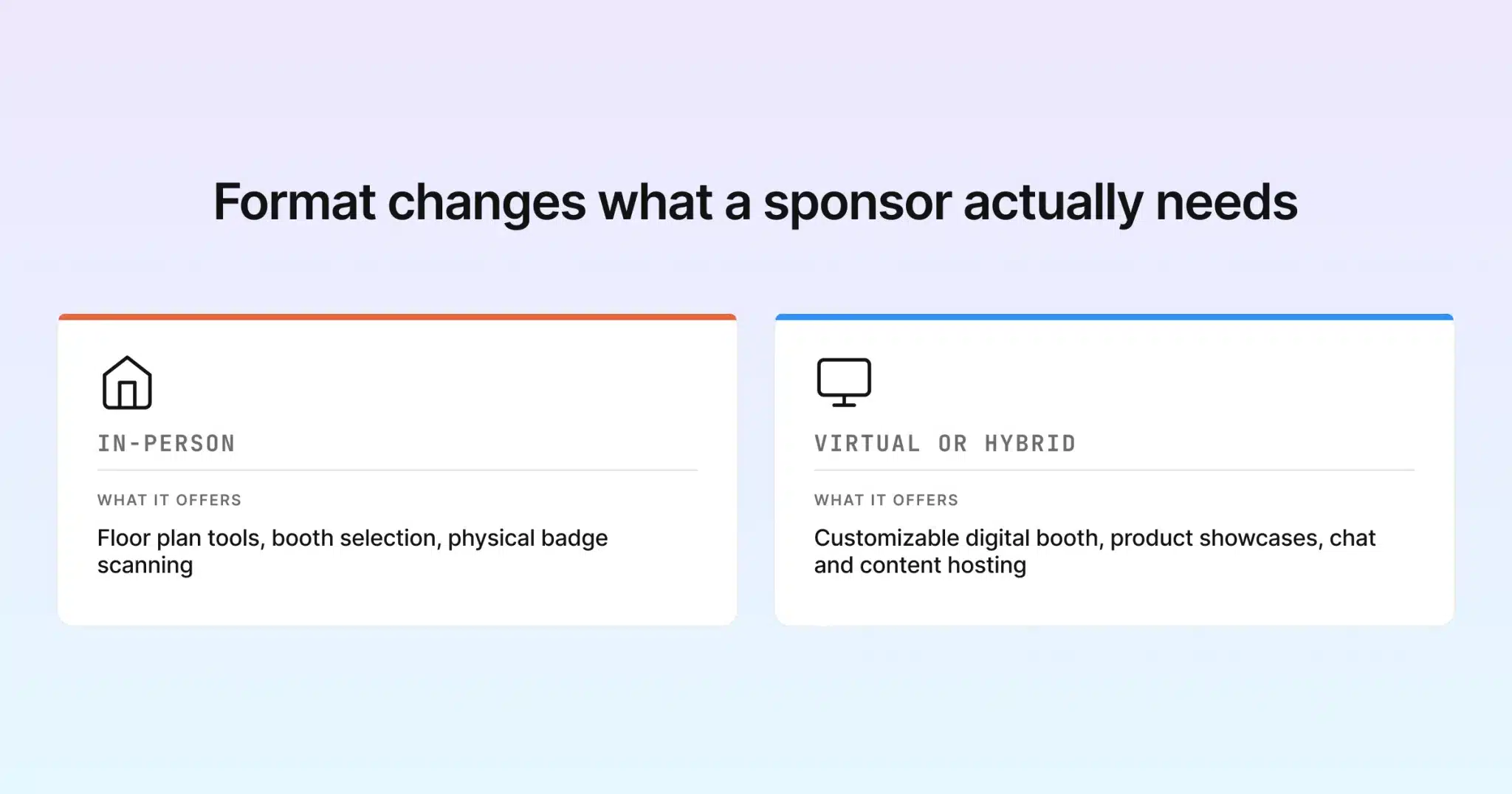
- Booth or listing management. For in-person events, this means floor plan tools and booth selection. For virtual or hybrid events, it means a customizable digital booth with product showcases, chat, and content hosting.
- Matchmaking and meeting scheduling. The strongest platforms don’t just let attendees stumble onto a booth. They proactively connect exhibitors with attendees whose interests or roles suggest a real fit, which tends to produce higher-quality leads than badge scans alone.
- ROI reporting. Sponsors renew based on results. Look for reporting that shows booth traffic, lead volume and quality, meeting counts, and engagement. Ideally, it’s in a format a sponsor can take back to their own leadership to justify next year’s spend.
- Organizer oversight. As the organizer, you need visibility into what exhibitors are doing on the platform. It shouldn’t be just a black box you hand over and hope for the best.
- Connection to the rest of your event data. A lead captured at a booth is more useful when it connects back to the same attendee record used for registration and check-in. That beats living in a separate export that has to be manually reconciled after the event.
Onsite, Virtual, and Hybrid: Why Format Changes What Sponsors Need
The right sponsor and exhibitor tools depend heavily on your event’s format mix. It’s worth being specific about this, rather than assuming one setup covers everything. A fully in-person trade show lives or dies on floor plan tools, physical badge scanning, and booth logistics. EventsAIR’s interactive floor plan and Bizzabo’s Lead Booster app are both built with that scenario in mind.
Virtual and hybrid events change the calculus, though. A sponsor paying for a virtual booth needs it to do more than display a logo. It needs product showcases, chat, and a way to actually talk to interested attendees. That’s where Gevme’s interactive virtual booth features and Swapcard’s chat-driven lead capture both come into play. This matters most for events that run both formats in the same year, or the same event with an onsite and virtual track simultaneously. It’s worth checking whether a platform treats virtual exhibitor tools as a true equal to onsite ones, rather than a stripped-down afterthought. Do that before you commit sponsors to a package that under-delivers on one side.
What Five Platforms Actually Offer
Gevme
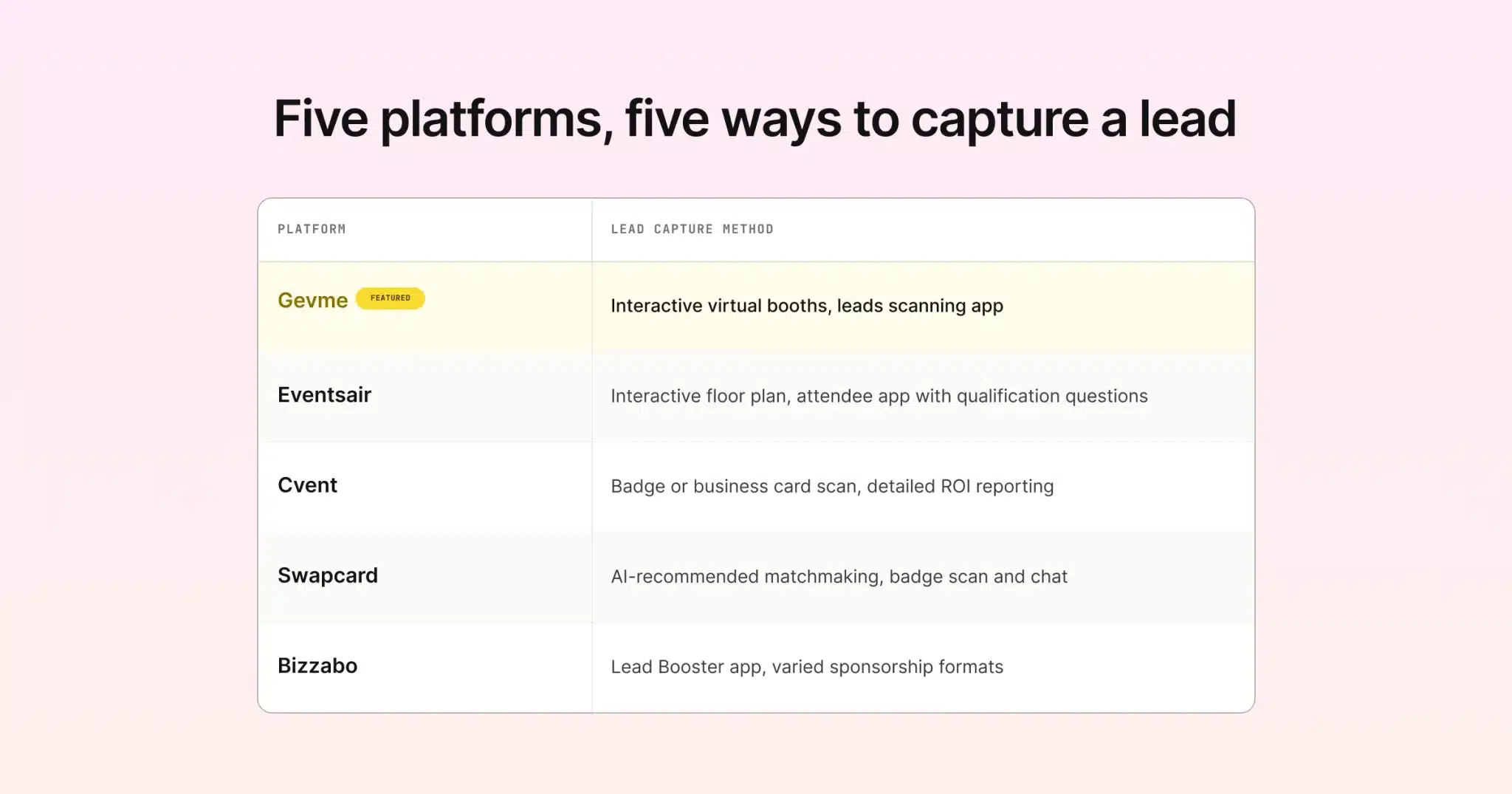
Gevme’s approach centers on what it calls complete exhibitor autonomy paired with full organizer control. Per Gevme’s exhibitors and sponsors page, checked mid-August 2026, exhibitors get a leads scanning app for on-site capture through Gevme’s onsite check-in system. Virtual venue booths support interactive elements too, including chat, polls, Q&A, product showcases, live streaming, and content hosting. Exhibitor and sponsor records connect back to the same registration data used for the rest of the event. That means a lead captured at a booth reflects the same attendee profile organizers see everywhere else. Exhibitors can also arrange one-on-one meetings directly with attendees. On the organizer side, dashboards let the team see exactly what exhibitors see and troubleshoot in real time. There’s also the ability to raise information requests and assign asset owners. Gevme’s page doesn’t detail formal sponsor tier structures or built-in ROI reporting templates the way some competitors do.
EventsAIR
EventsAIR bundles sponsor and exhibitor tools directly into its core platform. Per EventsAIR’s sponsorship and exhibitor management page, checked mid-August 2026, sponsors and exhibitors get self-service portals for managing deliverables, payments, and registrations independently. There’s also an interactive floor plan for booth selection, and custom sponsorship packages beyond standard tiers. Lead capture happens directly through the EventsAIR Attendee App with customizable qualification questions and automated follow-up. A real-time dashboard tracks sponsor and exhibitor financial performance against goals. Notably, EventsAIR states these tools are included with the core platform “at no additional cost,” rather than sold as a separate add-on.
Cvent
Cvent’s LeadCapture and Exhibitor Portal lean into measurable outcomes. Per Cvent’s lead capture page, checked mid-August 2026, exhibitors scan badges or business cards via mobile device and add notes. They score leads in real time, too, using custom qualification questions. The Exhibitor Portal gives real-time access to lead count and quality, with reporting built specifically to help exhibitors “justify future participation.” Cvent also publishes case studies with specific figures. One cites 6,000 marketing-qualified leads and a $1 million pipeline from a single event. Leads export directly or integrate with CRM and marketing systems for fast follow-up.
Swapcard
Swapcard’s differentiator is matchmaking quality over raw lead volume. Per Swapcard’s exhibitor and sponsor tools page, checked mid-August 2026, the platform captures leads automatically from badge scans, profile views, chat interactions, and meetings. It then uses AI-recommended matching to surface attendees most likely to convert, based on real-time behavior. Its Exhibitor Center gives a mobile-accessible dashboard for team coordination and performance tracking, alongside branded company profiles. Sponsor visibility tools include sponsored ads and homepage spotlights with their own performance metrics. That’s useful for sponsors whose goal is brand visibility, rather than direct lead capture.
Bizzabo
Bizzabo’s Lead Booster app handles on-site badge scanning, note-taking, and lead qualification for exhibitors. Per Bizzabo’s sponsor management page, checked mid-August 2026, a dedicated sponsor portal supports streamlined partner communication and resource access at scale. The platform also supports varied sponsorship formats beyond a booth, including sponsoring the event app itself, individual sessions, or audience polls. Bizzabo’s page describes centralized data as a single source of truth across stakeholders. It goes into less public detail on virtual booth features or ROI analytics specifics than Cvent or Swapcard, though.
A Few Terms Worth Knowing
- Lead retrieval: the process of capturing an attendee’s contact and interest information at a booth, typically via badge scan. It’s how an exhibitor can follow up after the event.
- Exhibitor portal: a self-service dashboard where exhibitors manage their own booth details, staff, leads, and deliverables without needing the organizer’s involvement for every change.
- Matchmaking: software-driven suggestions connecting attendees and exhibitors based on shared interests, roles, or stated goals, rather than relying on attendees to browse an exhibit hall unguided.
- MQL (Marketing Qualified Lead): a lead judged likely enough to convert that it’s handed to a sales team for direct follow-up. It’s a common metric exhibitors use to measure event ROI.
Sponsor and Exhibitor Management Software Compared, 2026
| Platform | Best For | Standout Feature | Lead Capture Method |
|---|---|---|---|
| Gevme | Hybrid events with strong virtual booths | Interactive virtual booths with organizer oversight | Leads scanning app |
| EventsAIR | Associations wanting no-extra-cost sponsor tools | Interactive floor plan, real-time revenue tracking | Attendee app with qualification questions |
| Cvent | Exhibitors needing measurable pipeline ROI | Detailed ROI reporting and CRM integration | Badge/business card scan via mobile |
| Swapcard | Networking-heavy events prioritizing match quality | AI-recommended matchmaking | Badge scan, profile views, chat, meetings |
| Bizzabo | Conferences wanting varied sponsorship formats | App, session, and poll sponsorships | Lead Booster app |
Sources: features and claims above come from each platform’s own product pages, checked mid-August 2026: Gevme, EventsAIR, Cvent, Swapcard, Bizzabo. Vendor pages change as features roll out, so it’s worth confirming current capabilities directly before you commit to a platform.
How to Choose Based on What Your Sponsors Actually Value
Start with what your sponsors and exhibitors have told you matters most, since that varies more than organizers sometimes assume. Lead volume and provable pipeline as the priority points toward Cvent. Its reporting depth and published ROI case studies make a strong case, especially for exhibitors who need to justify spend to their own leadership afterward. For events that run on introductions rather than raw traffic, an association conference or a niche B2B gathering, the right five conversations matter more than fifty badge scans. Swapcard’s matchmaking is built specifically for that.
Sponsors valuing flexibility in how they show up, sponsoring an app, a session, or a poll rather than just a booth, are a good fit for Bizzabo. Its varied sponsorship formats give them more ways to participate. Cost-conscious buyers who don’t want sponsor tools priced as a separate line item should factor in EventsAIR. Its inclusion of these features in its core platform is worth weighing into a budget comparison. Events spanning onsite and virtual formats, where exhibitors need a genuinely interactive virtual booth rather than a static listing, are a different case. Gevme’s approach to virtual booths paired with organizer-level oversight is built for that mix.
Exhibit Hall Size and Renewal Timing
Exhibit hall size matters too. A handful of sponsors at a mid-sized conference can often be managed with lighter tools and more manual touch from your team. A large exhibit hall with dozens of exhibitors depends much more heavily on self-service portals and automated workflows. The alternative is your team fielding the same questions dozens of times over.
Renewal timing is worth building into the decision too. Most sponsors decide whether to come back well before the event officially wraps. That decision is often based on how smoothly the logistics went, rather than waiting for a formal post-event report. A platform that keeps sponsors informed in real time tends to build renewal confidence throughout the event. That means current lead counts, upcoming deliverable deadlines, and booth traffic so far. That beats leaving it all to a report that lands weeks later, when the decision may already be leaning the wrong way.
Questions to Ask During a Demo
A few workflows are worth testing directly rather than taking a feature list at face value.
- How does a lead actually reach the exhibitor after it’s captured? Ask to see the full path from badge scan to a usable, exportable record, not just the scanning step itself.
- Can a sponsor customize their own booth or listing without help from your team? Try making a change yourself during the demo, adding a product image or updating a description, and time how long it actually takes.
- What does a sponsor see when they log into their own dashboard? This is different from what you, as the organizer, see, and it’s worth viewing both perspectives before you commit.
- How are meetings between exhibitors and attendees actually scheduled? Some platforms handle this through direct requests, others through AI-driven suggestions. Neither is wrong, but they produce a different experience for both sides.
- What does the exhibitor-facing report look like the day after the event? A report that’s still being manually assembled a week later isn’t going to help a sponsor make a fast renewal decision.
Pro Tip: Ask Exhibitors What They Actually Do With Their Leads
Before choosing a platform based on lead volume alone, ask a few of your recurring exhibitors a simple question. What happens to the leads they capture today? If leads sit in an export nobody follows up on, the platform with the highest badge-scan count isn’t necessarily solving their real problem. A smaller number of well-matched, qualified leads often serves an exhibitor’s actual goal better than raw volume. That’s the kind Swapcard’s matchmaking or Cvent’s qualification scoring are built to produce. That’s true even if it looks less impressive in a single number.
Frequently Asked Questions
The terms are largely used interchangeably in this space. Both refer to collecting an attendee’s information, typically via badge scan, when they visit a booth or express interest, so an exhibitor can follow up after the event.
Cvent publishes the most specific reporting claims and case study figures among the platforms compared here, including pipeline and cost-savings numbers from named customers. Swapcard’s performance metrics around matchmaking and ad placements are also detailed, geared more toward engagement quality than pipeline dollar figures.
Yes. Gevme’s virtual venue supports interactive booth features including chat, polls, Q&A, product showcases, and content hosting, alongside a leads scanning app for on-site events, which makes it a fit for organizers running hybrid programs where exhibitors need a presence in both formats.
This varies by vendor. EventsAIR states its sponsor and exhibitor tools are included in its core platform at no additional cost. Others may price these features differently depending on tier or usage, so it’s worth confirming directly during a demo rather than assuming based on the base plan.
Still Have Questions?
Ask how leads are qualified at the point of capture, not just collected, how quickly exhibitors can export or access their leads, and whether the platform integrates with common CRM systems. A platform that captures a badge scan but makes exhibitors wait days for usable data isn’t solving the problem as well as one built for real-time access.
It can be, though the value scales with attendee and exhibitor count. For a small event with a handful of exhibitors, manual introductions might work fine. Once you’re running dozens of exhibitors and hundreds of attendees, matchmaking tools like Swapcard’s start solving a real discovery problem that manual coordination can’t keep up with.
On most of the platforms compared here, yes, at least partially. EventsAIR, Cvent, and Swapcard all offer sponsor or exhibitor-facing dashboards with some level of self-service reporting. Gevme gives organizers direct visibility into exhibitor activity, though it’s worth confirming during a demo how much of that view exhibitors can access themselves versus what stays with the organizer.
Conclusion: Give Sponsors a Reason to Come Back Next Year
Every platform in this comparison solves the sponsor and exhibitor problem from a slightly different angle. Cvent leads on measurable ROI reporting. Swapcard leads on match quality over raw volume. Bizzabo offers sponsors more creative ways to show up beyond a booth. EventsAIR bundles strong tools into its core price without an extra line item.
That’s the clearest fit for events needing exhibitors to show up well in both onsite and virtual formats, with organizers keeping real visibility into what’s happening on the exhibitor side. Gevme’s combination of interactive virtual booths and direct dashboard oversight is built around exactly that mix. It also connects back to the same registration and check-in data running the rest of the event, rather than sitting off to the side as a separate system.
If that sounds like your next exhibit hall, it’s worth a closer look. Check out Gevme’s platform or a demo to see how it fits your sponsors’ actual needs.