If you run events inside a company rather than for the public, your job looks different from a conference organizer’s. You’re planning town halls, sales kickoffs, leadership offsites, training days and product launches. Often they run back to back, often for the same internal audience, and usually with IT and security teams watching over your shoulder. The software you pick has to satisfy two very different groups at once. Attendees just want registration and check-in to be painless. The people who approve your vendor list want single sign-on, data residency answers, and a contract that won’t cause headaches at renewal time.
There are a lot of platforms that will tell you they do all of this. Some do it well. Others are built primarily for public-facing conferences and trade shows, and have bolted on “enterprise” features later. This guide looks at how Gevme and its main alternatives stack up for enterprise and internal events teams specifically. Cvent, Bizzabo, Swapcard, EventMobi, Accelevents, EventsAIR and Whova are all in the mix. We cover what they cost, what they’re built for, and where the fit is strong versus where it’s just a checkbox on a features page.
This guide covers what corporate event management software is, and why internal teams need something purpose-built. It sets out what each major platform costs, and how they compare on registration, on-site check-in, virtual and hybrid support, and security. It also includes a short glossary of terms IT will ask about, plus a decision framework to help you shortlist the right two or three platforms to demo.
Key Takeaways
- Enterprise buyers need to evaluate event software on security and IT fit, meaning SSO, data residency and compliance certifications, just as heavily as on registration and check-in features. Internal events almost always touch corporate identity systems.
- Pricing transparency varies enormously across this category. Gevme, Bizzabo, EventMobi, Accelevents and Glue Up publish real starting numbers. Cvent, Swapcard’s registration tier, EventsAIR, Whova and iVvy route buyers straight into a sales quote.
- Gevme’s Registration and Virtual Venue platforms are priced and sold separately, starting at USD $960 a year each. A free tier is available on the Virtual Venue side to test before committing.
- If most of your internal events are large, high-stakes, multi-day programs with dedicated event ops staff, platforms like Cvent and EventsAIR are built for that scale. Expect a longer sales cycle and a custom quote.
- If you need one platform that handles registration, an on-site badge, and a branded virtual or hybrid component without stitching together three vendors, Gevme, Bizzabo and EventMobi tend to compete most directly.
- Don’t assume a platform is virtual-only or onsite-only based on reputation alone. Several vendors in this space, Gevme included, run strong virtual and in-person capabilities side by side rather than specializing in just one.
- Ask every finalist for their SSO setup process and their data residency policy before you sign anything. It’s one of the most common places enterprise rollouts stall after the contract is already signed.
Why Internal and Enterprise Events Teams Need Purpose-Built Software
A marketing team running a single annual customer conference has different needs than an internal events team running forty events a year for the same 5,000 employees. Internal programs repeat constantly. They often reuse the same registration templates and branding, and they depend on the same identity provider for every login. In other words, a tool built mainly for one-off public ticketing does not hold up well under that kind of repetition.
There’s also the approval layer that public event organizers rarely deal with in the same way. Procurement wants a vendor security review. IT wants to know whether the platform supports your company’s SSO provider, and where attendee data physically sits. Legal wants to see a data processing agreement that matches GDPR, CCPA or whatever regime applies to your workforce. None of this shows up on a features comparison page. Even so, it decides which vendors make it to a demo.
Finally, internal events teams are usually smaller than their workload suggests. One or two people might be responsible for badge design, registration emails, on-site check-in staffing and a livestream for remote employees, all for the same event. As a result, an all-in-one platform becomes a practical requirement rather than a nice-to-have.
What “Corporate Event Management Software” Actually Covers
At a minimum, corporate event management software should handle three things. First, registration: forms, ticketing logic, confirmation emails, and attendee data. Second, on-site logistics: check-in, badge printing, and session or room tracking. Third, some form of virtual or hybrid delivery for employees who can’t attend in person. Beyond that, better platforms add reporting, integrations with your CRM or HR systems, and enough customization that an internal event does not look like a generic ticketing page with your logo dropped on top.
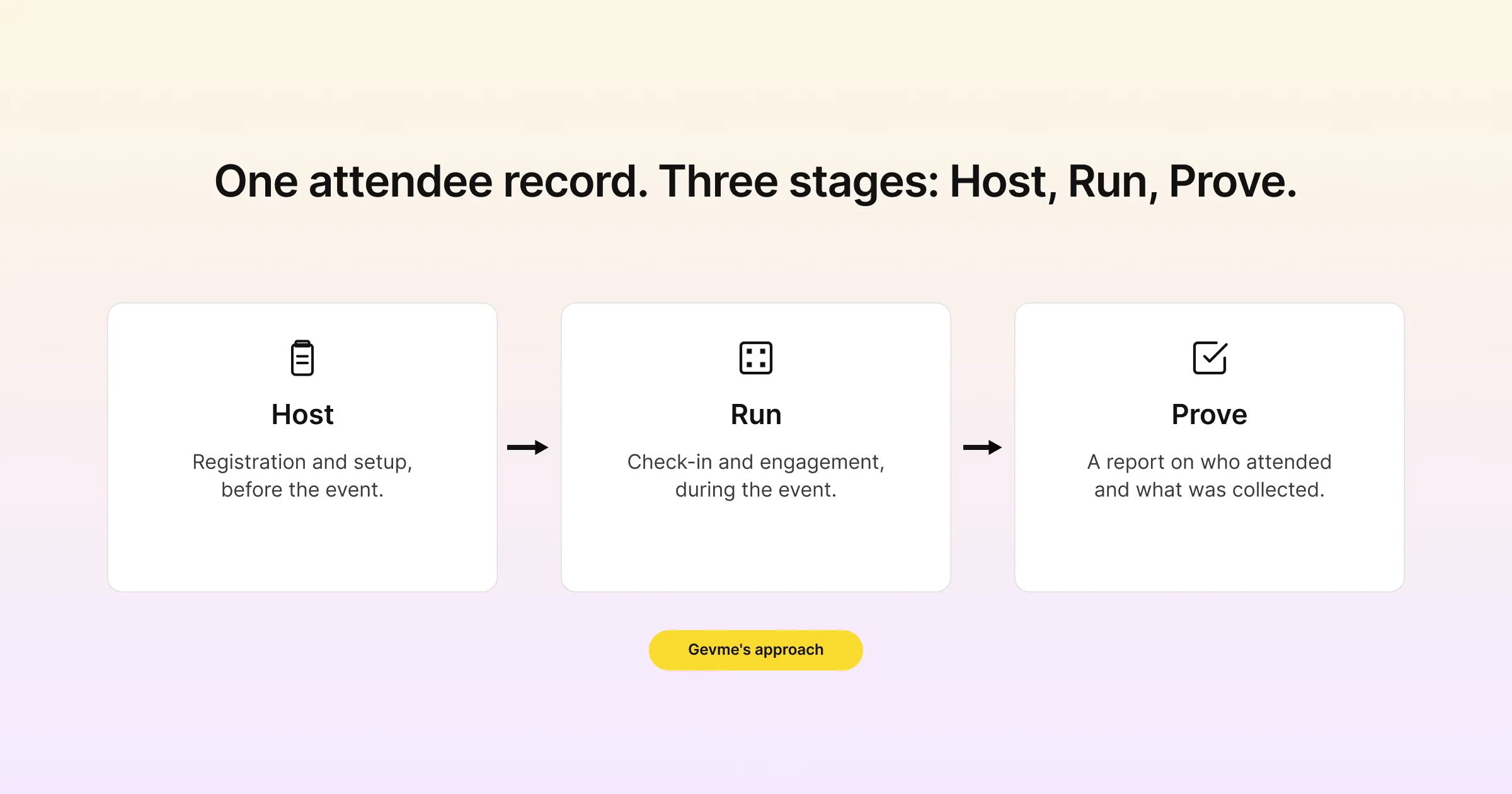
Gevme’s approach is to build all three of those pillars on one shared attendee record: registration, on-site check-in and a template-driven virtual venue. It’s organized around what Gevme calls a Host, Run, Prove lifecycle. You plan and register before the event, manage check-in and engagement during it, then report on the results afterward. Most of the platforms in this guide cover similar ground. However, they differ in how deep each piece goes, and in how each vendor structures the pricing around it.
What Gevme and Its Alternatives Actually Cost
Pricing is the fastest way to sort this category into two groups. There are platforms that publish real numbers, and platforms that route every buyer into a sales conversation before revealing anything.
Gevme sells its Registration Platform and Virtual Venue Platform as separate products. Per Gevme’s pricing page, checked in late August 2026, the Registration Platform starts at USD $960 a year on the Starter plan and USD $2,160 a year on the Pro plan. Gevme prices its Enterprise tier on request, adding multi-organization support, advanced security and compliance reporting, and a custom integrations engine. The Virtual Venue Platform has the same Starter and Pro starting prices. In addition, it includes a free plan for testing before paying, plus its own Enterprise tier with dedicated premium support, a white-label mobile app and enterprise-grade security controls.
Cvent doesn’t publish prices at all. Per Cvent’s pricing page, checked in late August 2026, buyers choose between a Professional tier and an Enterprise tier. Professional covers 15 user logins and core modules. Enterprise adds unlimited logins, SSO, API access, multi-factor authentication and budget management. Every figure requires a sales quote.
Bizzabo is one of the few vendors here that publishes a real number. Per Bizzabo’s pricing page, checked in late August 2026, its Event Experience OS costs $499 per user per month billed annually, with a three-user minimum. That works out to a starting price of $17,999 a year. However, Bizzabo prices add-ons separately and quotes them on request. That covers virtual experience tools, advanced onsite features and its Klik SmartBadge wearable hardware.
Swapcard, EventMobi and Accelevents
Swapcard splits its pricing in a similar way to Gevme. Per Swapcard’s pricing page, checked in late August 2026, its Event Engagement Platform starts at $610 a year as a self-service entry price that scales with attendee volume. Meanwhile, its separate Registration and Management Platform stays quote-based, and Swapcard prices it on registrant volume and complexity.
EventMobi publishes starting figures for two different pricing models. Per EventMobi’s pricing page, checked in late August 2026, its per-event plan starts at $3,000. Its per-year plan, which includes unlimited events and a dedicated Event Success Manager, starts at $8,900 annually. It also itemizes common add-ons: pre-printed badges from $3.99 each, onsite hardware rental around $1,000 for a week, and standard integrations from $1,000 each.
Accelevents is the most transparent vendor in this list on raw numbers. Per Accelevents’ pricing page, checked in late August 2026, its Professional tier starts at $7,500 for a single event and its Business tier at $13,500 for unlimited events. By contrast, Accelevents quotes both its Enterprise and White Label tiers, and the Enterprise tier adds a dedicated account manager and approval workflows.
EventsAIR, Whova and Two Niche Options
EventsAIR keeps its tier names public but not its prices. Per EventsAIR’s pricing page, checked in late August 2026, it offers Single, Multi and Enterprise tiers, covering one event, three or more events, and enterprise programs respectively. In practice, all three include unlimited registrations, and EventsAIR quotes all of them.
Whova doesn’t show pricing at all. Per Whova’s pricing page, checked in late August 2026, the page is a quote-request form asking for event size, format and frequency, with no tiers or figures shown before you submit it.
Two more names are worth a mention if your internal events lean toward a specific niche. Glue Up publishes ranges from $3,000 to $18,500 a year, per Glue Up’s pricing page, checked in late August 2026, though it is really built as an association and membership management platform with events as one module. iVvy is quote-based, per iVvy’s FAQ page, checked in late August 2026, and is oriented around venue sourcing and room booking rather than attendee-facing corporate event management.
Feature-by-Feature: Registration, On-Site, Virtual and Security
Registration is table stakes across every platform here. So the differences show up more in on-site execution, virtual and hybrid delivery, and how seriously each vendor takes enterprise security.
Security and IT Fit
On the security side, Cvent has the most detailed public documentation of the group. Per Cvent’s security page, checked in late August 2026, it holds ISO 27001 and 27701, SOC 1 and SOC 2 Type II, PCI DSS and Cloud Security Alliance certifications. It states that most of its products support SSO out of the box, and explicitly names its data hosting regions: AWS US-East and US-West for North American customers, AWS Frankfurt and Dublin for European customers.
Swapcard is close behind. Its security page, checked in late August 2026, confirms ISO 27001:2022, SOC 2 Type II, GDPR compliance backed by a dedicated data protection officer, and both SSO and multi-factor authentication. EventsAIR stands out for a different reason. Alongside GDPR, PCI DSS and SOC 2 Type II, it holds an ASD Essential 8 Level 3 certification, an Australian government cybersecurity standard. That matters if your internal events include government or heavily regulated audiences.
Virtual and Hybrid Delivery
On virtual and hybrid delivery, don’t assume any platform in this list is onsite-only or virtual-only based on reputation. Gevme runs a template-driven virtual venue with more than 50 themes, quick setup and RTMP streaming, plus business matchmaking on its higher tiers. That sits alongside its on-site check-in and badging tools, so it covers both formats rather than specializing in just one.
Swapcard leans hardest into AI-driven networking. Its Sherlock AI feature recommends sessions and connections based on attendee behavior, which Swapcard says drives significantly higher app adoption than the category average. EventsAIR is built for organizers running complex, high-volume, multi-track programs. It bundles broadcast-quality hybrid streaming and more than 150 report templates into its plans. EventMobi and Whova both position themselves around simplicity and mobile app engagement rather than deep AI features. In practice, that is exactly what a small internal events team needs when nobody on staff has time to configure an advanced networking engine.
On-Site Check-In and Badging
For on-site check-in and badging specifically, most of the platforms here offer some combination of self-service kiosks, badge printing and mobile check-in. That includes Gevme, Cvent, Bizzabo, Swapcard, EventMobi and EventsAIR. That said, EventMobi is unusually transparent about the real cost of this layer, because it publishes per-badge and hardware rental prices rather than folding them into an opaque quote.
A Few Terms Worth Knowing
- SSO (Single Sign-On): Lets employees log into the event platform using the same company credentials they already use for email or other internal tools, instead of creating a separate password.
- Data residency: Where your attendee data is physically stored and processed. Enterprise buyers in regulated industries often need this to sit in a specific region, such as the EU.
- SOC 2 Type II: An independent audit confirming a vendor’s security controls actually work as described over a period of time, not just on paper at a single point in time.
- Hybrid event: An event with both an in-person and a live virtual audience at the same time, as opposed to a purely in-person or purely virtual format.
How Gevme and Its Alternatives Compare
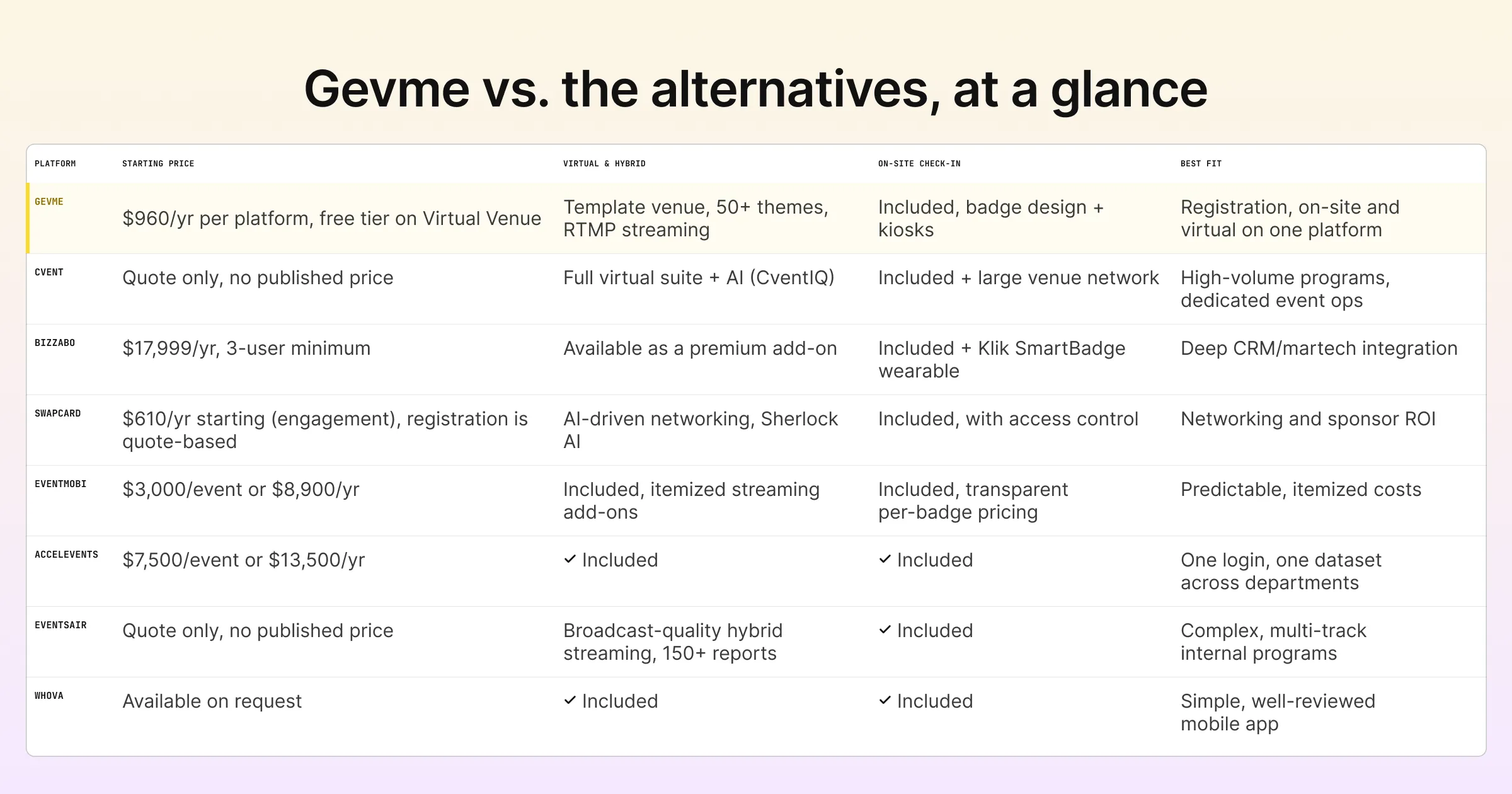
| Platform | Starting Price | Virtual & Hybrid Support | On-Site Check-In & Badging | Best Fit |
|---|---|---|---|---|
| Gevme | USD $960/year per platform (free tier on Virtual Venue) | Template-driven virtual venue, 50+ themes, RTMP streaming, business matchmaking on top tiers | Included, with badge design and on-site kiosk options | Internal teams that want registration, on-site and virtual on one connected platform |
| Cvent | Quote based, no published numbers | Full virtual/webinar suite plus AI features (CventIQ) | Included, plus a large venue-sourcing network | Large enterprises running high event volumes with dedicated event ops staff |
| Bizzabo | $17,999/year (3-user minimum) | Available as a premium add-on | Included, plus Klik SmartBadge wearable hardware | Companies running a portfolio of B2B-style events who want deep CRM/martech integration |
| Swapcard | $610/year starting (engagement platform); registration platform quote based | Strong AI-driven networking and matchmaking (Sherlock AI) | Included, with access control | Teams that prioritize attendee networking and exhibitor/sponsor ROI |
| EventMobi | $3,000/event or $8,900/year starting | Included, itemized add-ons for streaming | Included, with transparent per-badge and hardware pricing | Teams that want predictable, itemized costs and a dedicated Event Success Manager |
| Accelevents | $7,500/event or $13,500/year starting | Included | Included | Internal events teams that want one login and one dataset across departments |
| EventsAIR | Quote based, no published numbers | Broadcast-quality hybrid streaming, 150+ reports | Included | Organizations running complex, recurring, multi-track internal programs |
| Whova | Available on request | Included | Included | Smaller internal teams prioritizing a well-reviewed mobile app and fast support response |
Sources, checked in late August 2026, are each platform’s own pricing or product pages: Gevme, Cvent, Bizzabo, Swapcard, EventMobi, Accelevents, EventsAIR, Whova. Vendor pricing pages change often. Confirm directly before you budget against any figure here.
Which Platform Fits Which Kind of Internal Events Team
Are you a lean internal events team running a steady calendar of town halls, training sessions and smaller leadership meetings? Look closely at Gevme’s registration platform paired with its on-site check-in tools and virtual venue. The appeal here is running one attendee record across formats, instead of reconciling data from three separate tools after every event. You also start on a plan priced in the low thousands rather than a five-figure annual minimum.
Some internal events are truly massive. Think global sales kickoffs with tens of thousands of attendees across regions. Cvent’s scale and venue-sourcing network are hard to match there, though you should budget for a longer procurement cycle given the quote-based pricing. Similarly, EventsAIR fits organizations running many complex, recurring programs that want broadcast-grade hybrid production built in.
Where networking and attendee engagement data matter more to your leadership than raw cost, Swapcard’s AI matchmaking is a genuine differentiator. It fits particularly well for internal conferences designed to connect employees across departments or regions. Finally, if your team is small and mostly needs something reliable that won’t require a dedicated administrator, EventMobi and Whova are both built around ease of use rather than configuration depth.
Pro Tip
Before you sign anything, ask your IT or security team to review each finalist’s SSO setup and data residency documentation. Run that review in parallel with your own feature evaluation, not after you’ve already picked a favorite. Enterprise rollouts stall far more often over an unanswered security question discovered at the eleventh hour than over a missing feature. Running the review alongside your shortlist, rather than as a final gate, saves weeks.
Frequently Asked Questions
Ticketing tools mainly handle registration and payment. Event management software for corporate and internal events typically adds on-site check-in and badging, a virtual or hybrid delivery layer, reporting, and enterprise features like SSO and integrations with your existing corporate systems.
Yes. Gevme registration and on-site check-in tools are commonly used for internal programs like town halls and training days. Its virtual venue platform supports fully virtual or hybrid formats for distributed employee audiences, alongside its in-person capabilities.
It can be, depending on your event volume. Cvent scale and venue network are built for very high event volumes and large enterprise programs, and its quote-based pricing and Enterprise tier reflect that. Smaller internal teams sometimes find lighter platforms easier to manage day to day.
Among the platforms in this guide, Gevme, Bizzabo, EventMobi and Accelevents publish real starting prices on their sites. Cvent, EventsAIR and Whova require a sales quote before you see any figures. Swapcard publishes a starting price for its engagement platform but keeps its registration platform quote based.
At minimum, ask whether the platform supports your company SSO provider, and where attendee data is stored. Ask what compliance certifications it holds, because SOC 2, ISO 27001 and GDPR alignment are common baselines. Also ask how quickly it commits to notifying you in the event of a data breach.
Yes. Several platforms in this guide, including Gevme, Cvent, Bizzabo and EventMobi, are built to cover all three from one system rather than requiring separate tools stitched together with integrations.
It varies with your security review timeline more than the software itself. Teams that involve IT and procurement early, rather than after choosing a vendor, tend to move from decision to first live event in a matter of weeks rather than months.
Conclusion: Choosing the Right Fit for Your Internal Events Program
Every platform in this guide is capable software built by teams who understand events. Cvent and EventsAIR earn their reputations with enterprises running enormous, complex programs. Bizzabo and Swapcard bring real strength in engagement data and networking for teams that prioritize those outcomes. EventMobi and Whova make a credible case for teams that want reliability without a steep learning curve.
For an internal or enterprise events team that wants registration, on-site check-in and virtual or hybrid delivery working off the same attendee data, Gevme is worth putting on your shortlist. Gevme publishes its pricing, and it starts well below the five-figure minimums common elsewhere in this category. It also covers both in-person and virtual formats rather than asking you to choose one. If that matches how your team actually runs events, request a demo and see how it fits your next internal program.