If your team is planning 2027 campaigns right now, you’ve probably already noticed something. “Event marketing software” means something different depending on which vendor you’re talking to. For some platforms it’s a full email and automation suite built into the product. For others it’s a landing page builder bolted onto registration, with the real marketing work expected to happen in a separate tool your team already owns. Neither answer is wrong, but the difference changes what you’re actually buying.
To be fair to the vendors here, most of them are good at the piece they focus on. A platform built around deep CRM integrations genuinely helps large marketing teams keep event data in sync with the rest of their funnel. A platform with a lighter marketing layer isn’t failing at anything. It’s just betting your team already has an email and analytics stack it prefers.
This guide covers what event marketing software includes, and how the main platforms approach email, landing pages, segmentation, and attribution. It sets out what the category costs. Finally, it offers a framework for deciding how much of your marketing stack should live inside your event platform versus outside it.
Key Takeaways
- “Event marketing software” isn’t one feature, it’s a bundle. That bundle covers email campaigns, landing pages, segmentation, retargeting, CRM integrations, and attribution reporting. Platforms vary widely in how much of it they build in-house.
- Some platforms treat marketing as a core product line with its own pricing tier. Others fold basic marketing tools into registration and expect deeper needs to run through an external CRM or marketing automation tool.
- Attribution, meaning tracing which channel or campaign actually drove a registration, is the feature most likely to be underbuilt, even on otherwise strong platforms.
- Integration breadth varies enormously. Some platforms connect to dozens of CRM and marketing tools, while others support only a handful of the most common ones.
- Registration data and marketing data sharing one record matters more for personalization and retargeting than any single marketing feature on its own.
- Pricing for marketing capability is rarely broken out separately. It’s usually bundled into a higher tier rather than sold as its own line item.
- The right stack depends on whether your team runs a handful of high-touch events a year, or a high volume of similar campaigns that benefit from heavy automation.
Why Marketing Tools Matter for Your Event Stack
Registration software gets people who already know about your event to sign up. Marketing software is what gets them to know about it in the first place. It’s also what keeps talking to them after they register, through reminder sequences, personalized content based on their session picks, and post-event follow-up that turns attendees into repeat registrants.
The two functions used to live in separate tools almost by default: a registration page here, an email platform like Mailchimp or HubSpot there, a spreadsheet stitching the two together. That gap is exactly where campaigns break down. A registrant who clicked a specific email gets the same generic follow-up as someone who found the event through a random search. A no-show doesn’t get flagged for a different message than someone who actually attended. None of that is a disaster on its own. Across a full campaign calendar, though, it adds up to a lot of missed personalization.
Platforms that build marketing tools directly into the event system close that gap without extra manual work, because they don’t require a separate integration for every campaign. Whether that matters enough to prioritize depends heavily on two things: how many campaigns your team runs, and how much time you currently spend stitching tools together by hand.
What Event Marketing Software Includes
Under the single label “event marketing software” sits a handful of distinct capabilities, and few platforms build all of them to the same depth. Here’s what typically shows up.
- Email campaigns and automation. Branded email templates, automated sequences triggered by registration status or behavior, and the ability to send targeted follow-ups without exporting a list to a separate tool.
- Landing pages and branded event sites. A page, or a full microsite, that matches your event branding, separate from a generic registration form, often with its own URL and design controls.
- Segmentation and personalization. Grouping attendees by ticket type, session interest, company, or behavior, so messaging and content can differ by segment instead of going out as one blast to everyone.
- Referral tracking and retargeting. Tools for tracking which attendees referred others, and for re-engaging people who started registering but didn’t finish, or who attended a past event and haven’t registered for the next one.
- CRM and marketing-automation integrations. Two-way syncing with tools like Salesforce, HubSpot, or Marketo, so registration and engagement data flows into the systems a marketing team already uses for the rest of its pipeline.
- Campaign analytics and attribution. Reporting that goes beyond “how many people registered” to show which channel, campaign, or email actually drove those registrations, so budget can shift toward what’s working.
How Each Platform Approaches Marketing
Email Campaigns and Automation
Gevme’s registration platform includes automated email workflows built around registration status. Confirmations, reminders, and follow-ups are tied directly to attendee data, without a separate email tool in the loop. Cvent and Bizzabo both build deeper campaign automation into their platforms. Cvent in particular offers multi-touch email sequences aimed at large-scale demand generation programs. Swapcard and Whova keep their built-in email tools lighter, leaning more on integrations for teams that need heavier automation.
Landing Pages and Branded Sites
Most platforms in this comparison offer some form of branded registration page, but the depth varies. Cvent and Bizzabo both support fuller event microsites with more design flexibility, aimed at teams running larger campaigns with dedicated marketing budgets. Gevme’s registration pages are branded and customizable per event. However, they don’t extend into a standalone microsite builder the way Cvent’s does. So a team wanting a fully independent event website, separate from the registration flow, may need to build that piece elsewhere.
Segmentation and Personalization
Segmentation shows up across most of these platforms in some form, typically by ticket type or registration answers. Bizzabo and Cvent both offer more granular behavioral segmentation aimed at large-scale campaigns. That lets marketing teams target messaging based on session attendance or engagement history rather than just sign-up data. Gevme’s segmentation works off registration data and ticket types, which covers most mid-size event campaigns without the deeper behavioral layer larger enterprise programs sometimes need.
Referral Tracking and Retargeting
This is one of the thinner spots across the category as a whole. Few platforms build dedicated referral tracking directly in. Most retargeting still happens through an external ad platform fed by exported data, rather than a native in-platform feature. Where it does exist, it’s usually part of a higher tier. Bizzabo and Cvent both offer some retargeting support through their broader marketing suites, generally as part of enterprise-level plans rather than a feature available across every tier.
CRM and Marketing-Automation Integrations
Integration breadth is where the platforms diverge most sharply. Cvent and Bizzabo both maintain wide integration libraries covering Salesforce, HubSpot, Marketo, and a long list of other marketing and sales tools. That reflects their focus on large enterprise marketing teams. Gevme currently integrates with a narrower set, including ActiveCampaign and Gmail. That covers common mid-market workflows, but it is a smaller library than what the largest enterprise-focused platforms offer. If your team runs campaigns through a specific CRM not on a platform’s supported list, confirming that integration exists before you commit is worth the extra step.
Campaign Analytics and Attribution
Registration counts and basic traffic sources are close to universal at this point. Real attribution is far less consistent. By that we mean tracing a specific registration back to the email, ad, or referral link that drove it. Cvent and Bizzabo both offer deeper attribution reporting as part of their higher tiers, aimed at marketing teams that need to justify channel-level spend. Most other platforms in this comparison, Gevme included, report on registration sources and campaign performance at a more general level rather than full multi-touch attribution.
Pricing: What’s Public
Marketing capability is rarely priced as its own line item. It’s almost always bundled into a platform’s broader tier structure. So the pricing model for the whole platform is the best signal for how much marketing depth you’re likely getting.
| Platform | Pricing Model | Starting Point |
|---|---|---|
| Gevme | Published tiers, two product lines | Free (Virtual Venue) / $960 per year (Starter, either product line), per Gevme’s pricing page |
| Cvent | Quote based | No published numbers, per Cvent’s pricing page |
| Bizzabo | Published starting number | $499 per user per month ($17,999 per year minimum), per Bizzabo’s pricing page |
| vFairs | Quote based | No published numbers, per vFairs’ pricing page |
| Whova | Quote based | No published numbers, per Whova’s pricing page |
| Swapcard | “Starting at” plus volume-based quote | From $610 per year (Event Engagement plan), per Swapcard’s plans overview |
| Accelevents | Published starting numbers | From $7,500 per event, per Accelevents’ pricing page |
| EventMobi | “Starting at” floor | From $3,000 per event or $8,900 per year, per EventMobi’s pricing page |
Sources, checked in late August 2026, are each platform’s own pricing or product pages: Gevme, Cvent, Bizzabo, vFairs, Whova, Swapcard, Accelevents, EventMobi. Vendor pricing pages change, so confirm current numbers directly before you budget against any figure here.
Deeper marketing features tend to live behind enterprise-level quotes rather than an entry tier’s published number. That includes the behavioral segmentation and multi-touch attribution that Cvent and Bizzabo build out. Gevme’s published tiers cover email automation, branded registration pages, and segmentation by ticket type and registration data at the Starter and Pro levels. No separate quote conversation is required to see what those tiers include.
A Few Terms Worth Knowing
- UTM tracking: Short tags added to a link, like
utm_source=email, that let analytics tools trace which specific campaign or channel a visitor came from, instead of lumping all traffic together. - Marketing automation: Software that triggers actions automatically based on a rule, such as an email, a tag change, or a follow-up task. Think “send this message three days after registration” rather than someone sending it by hand.
- Attribution: The practice of tracing a result, like a registration, back to the specific marketing touchpoint that caused it, so you know which channels are actually worth the budget.
- Segmentation: Dividing your audience into groups based on shared traits, like ticket type or past attendance, so messaging can be tailored instead of sent identically to everyone.
Event Marketing Software Compared
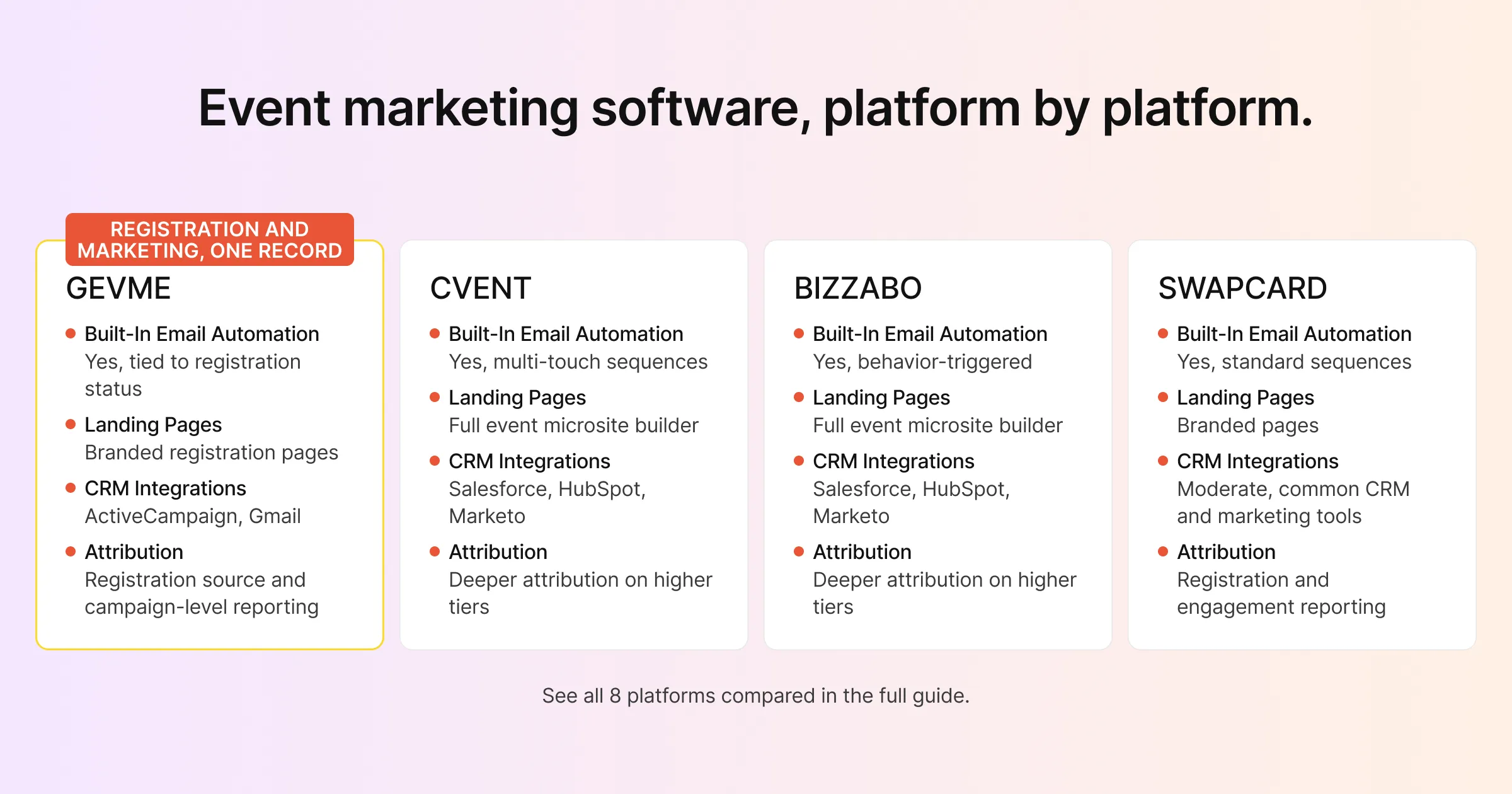
| Platform | Built-In Email Automation | Landing Page / Microsite Builder | CRM Integration Library | Attribution Depth |
|---|---|---|---|---|
| Gevme | Yes, tied to registration status | Branded registration pages, no standalone microsite builder | Narrower, includes ActiveCampaign and Gmail | Registration source and campaign-level reporting |
| Cvent | Yes, multi-touch sequences | Full event microsite builder | Wide, including Salesforce, HubSpot, Marketo | Deeper attribution on higher tiers |
| Bizzabo | Yes, behavior-triggered | Full event microsite builder | Wide, including Salesforce, HubSpot, Marketo | Deeper attribution on higher tiers |
| vFairs | Yes, standard sequences | Branded pages, limited microsite options | Moderate, common CRM and marketing tools | Registration-level reporting |
| Whova | Lighter, basic sequences | Branded registration pages | Moderate, common integrations | Registration-level reporting |
| Swapcard | Yes, standard sequences | Branded pages | Moderate, common CRM and marketing tools | Registration and engagement reporting |
| Accelevents | Yes, standard sequences | Branded pages | Moderate, common integrations | Registration-level reporting |
| EventMobi | Lighter, basic sequences | Branded registration pages | Moderate, common integrations | Registration-level reporting |
Sources for platform capabilities, checked in late August 2026, are each vendor’s own product and features pages: Gevme, Cvent, Bizzabo, vFairs, Whova, Swapcard, Accelevents, EventMobi. Feature sets change as vendors update their products, so verify current capability directly before you commit budget.
How to Choose Your Stack for 2027
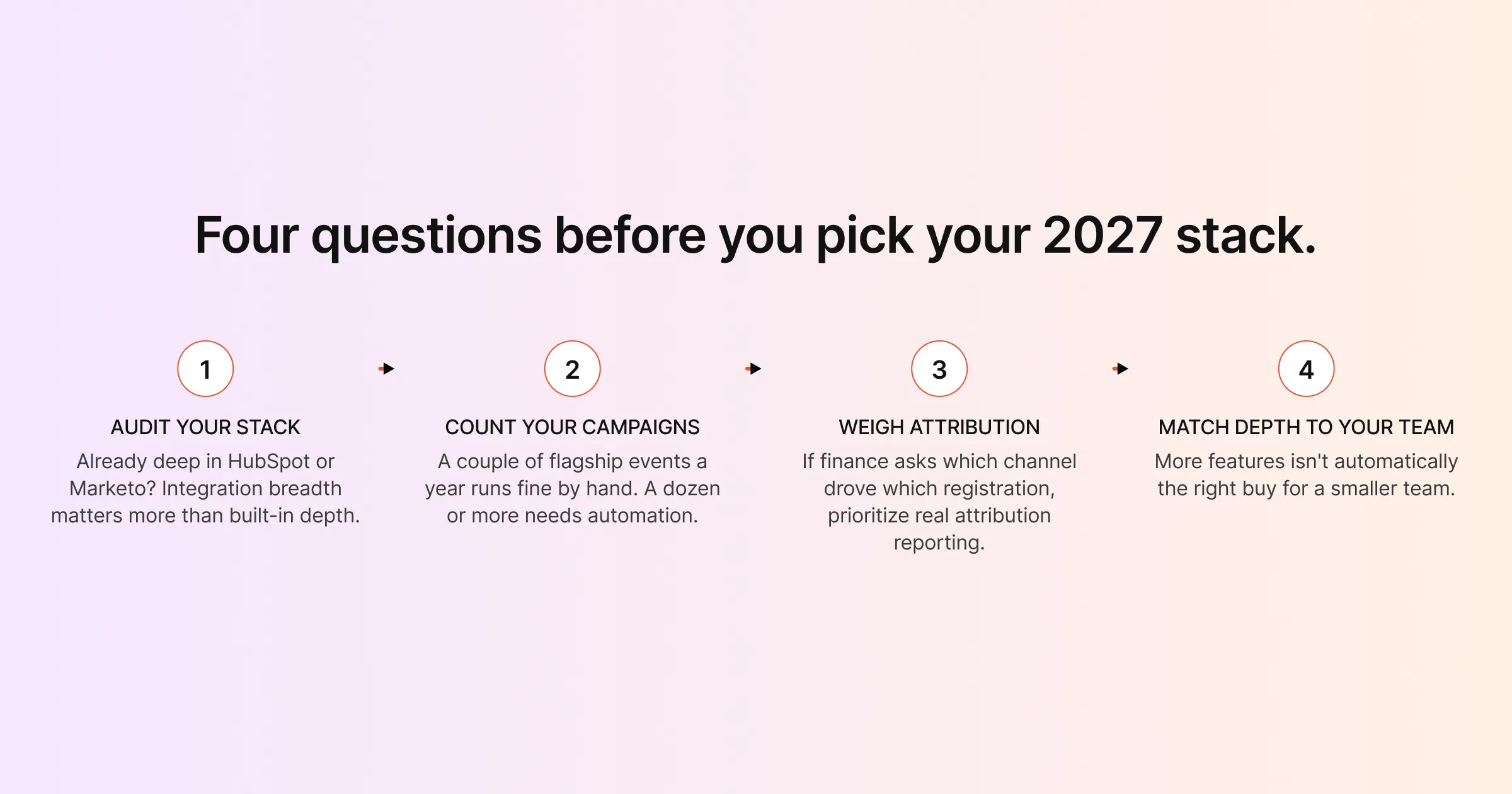
Start with what you’re already running. Say your team has a mature marketing automation setup in HubSpot or Marketo and just needs event data to flow into it cleanly. Then integration breadth matters more than how many marketing features live natively inside the event platform itself. A narrower built-in marketing layer is a non-issue if the real work happens in a tool you already trust.
Perhaps your team doesn’t have a dedicated marketing stack, or wants event campaigns to run without bouncing between three separate logins. In that case, built-in depth matters a lot more. Weigh how much of the bundle genuinely needs to live inside the event platform, versus what you’re fine handling manually or through a lighter tool.
For events where networking is the draw, marketing and matchmaking tend to work best as a pair. That is especially true at trade shows and B2B conferences. Campaigns that promise real connections need a matchmaking layer that can actually deliver them once people show up. Otherwise the marketing message overpromises against what the event floor delivers.
Campaign Volume, Attribution and Team Size
Think about campaign volume next. A team running one or two flagship events a year can usually get by without deep automation, because the personal touch of hand-built campaigns is manageable at that scale. A team running a dozen or more similar events a year benefits a lot more from automation and segmentation, because manually customizing each campaign stops scaling somewhere around event three or four.
Attribution deserves its own line of thinking. If your team has to justify marketing spend by channel to finance or leadership, a platform with genuine multi-touch attribution is worth prioritizing even if it costs more. The reporting gap on lighter platforms usually means falling back on spreadsheets and guesswork. If nobody’s asking which channel drove which registration, that gap matters a lot less.
Finally, don’t assume the platform with the most marketing features is the right buy. A large integration library and deep attribution reporting are built for teams running high-volume, multi-channel campaigns across a marketing org with several people touching the tool. A smaller team running fewer, higher-touch events often gets more value from a platform that keeps registration, check-in, and basic marketing tied together simply, without paying for enterprise capability that mostly sits unused.
Pro Tip
Before you commit to a platform for 2027, ask to see its integration with your specific CRM or marketing automation tool actually working live, rather than reading about it on a features page. A logo on an integrations page doesn’t guarantee the sync covers the fields or triggers your team actually relies on. Finding that out after signing a contract is a much more expensive way to learn it.
Frequently Asked Questions
It depends on how deep your campaigns need to go. Built-in email tools handle confirmations, reminders, and basic follow-ups well on most platforms. If your team runs multi-touch nurture campaigns across many channels, a dedicated marketing automation tool integrated with your event platform usually covers that better than relying on the platform native email alone.
Segmentation groups your audience so you can message them differently, by ticket type or interest, for example. Attribution traces results back to their cause, showing which specific campaign or channel drove a registration. They are related but answer different questions: segmentation shapes what you send, attribution tells you what worked.
Multi-touch attribution requires tracking a person across multiple touchpoints before they register, such as an ad click, an email open, and a landing page visit. That is a heavier technical build than basic registration-source reporting. Platforms built primarily for large enterprise marketing teams tend to invest in it more, because that is where the demand and budget for it concentrates.
Most platforms support at least the most common CRMs, but the depth of that support varies a lot. It ranges from a simple one-way data export to full two-way syncing. Check a platform specific integration list for your CRM before assuming it will work the way you need, rather than relying on a general “we integrate with CRMs” claim.
Not for every team. A wide integration library matters if you are actively using several of those tools already. If your stack is simpler, a platform with fewer but well-built integrations covering the tools you actually use often serves you better than one with a long list you will never touch.
It is rarely broken out as its own charge. Marketing depth is usually part of what separates a platform tiers. So moving to a higher tier for more marketing capability comes bundled with other upgrades too, like deeper analytics or higher attendee limits, rather than being sold as a standalone add-on.
No. Marketing capability matters, but it is one piece of a much bigger decision that includes registration, on-site check-in, virtual delivery, and pricing. A platform with excellent marketing tools but a clunky registration flow can still create more problems than it solves on event day.
Conclusion: Matching Marketing Depth to How You Run Campaigns
Cvent and Bizzabo both build genuinely deep marketing capability: wide CRM libraries, granular segmentation, and real attribution reporting. That is aimed squarely at large marketing teams running high-volume, multi-channel campaigns with dedicated budget behind them. For a team already living inside that kind of setup, that depth is worth paying for.
Gevme takes a different approach. It offers built-in email automation, branded registration pages, and segmentation tied directly to the same attendee data used across on-site check-in and the virtual venue. The integration list is narrower, covering ActiveCampaign and Gmail rather than a sprawling library. For a team that wants registration, on-site check-in, and everyday marketing tasks running off one shared record without piecing together several tools, that’s a fit worth a closer look. You can request a demo and see how it lines up against the campaigns you’re actually planning for 2027.