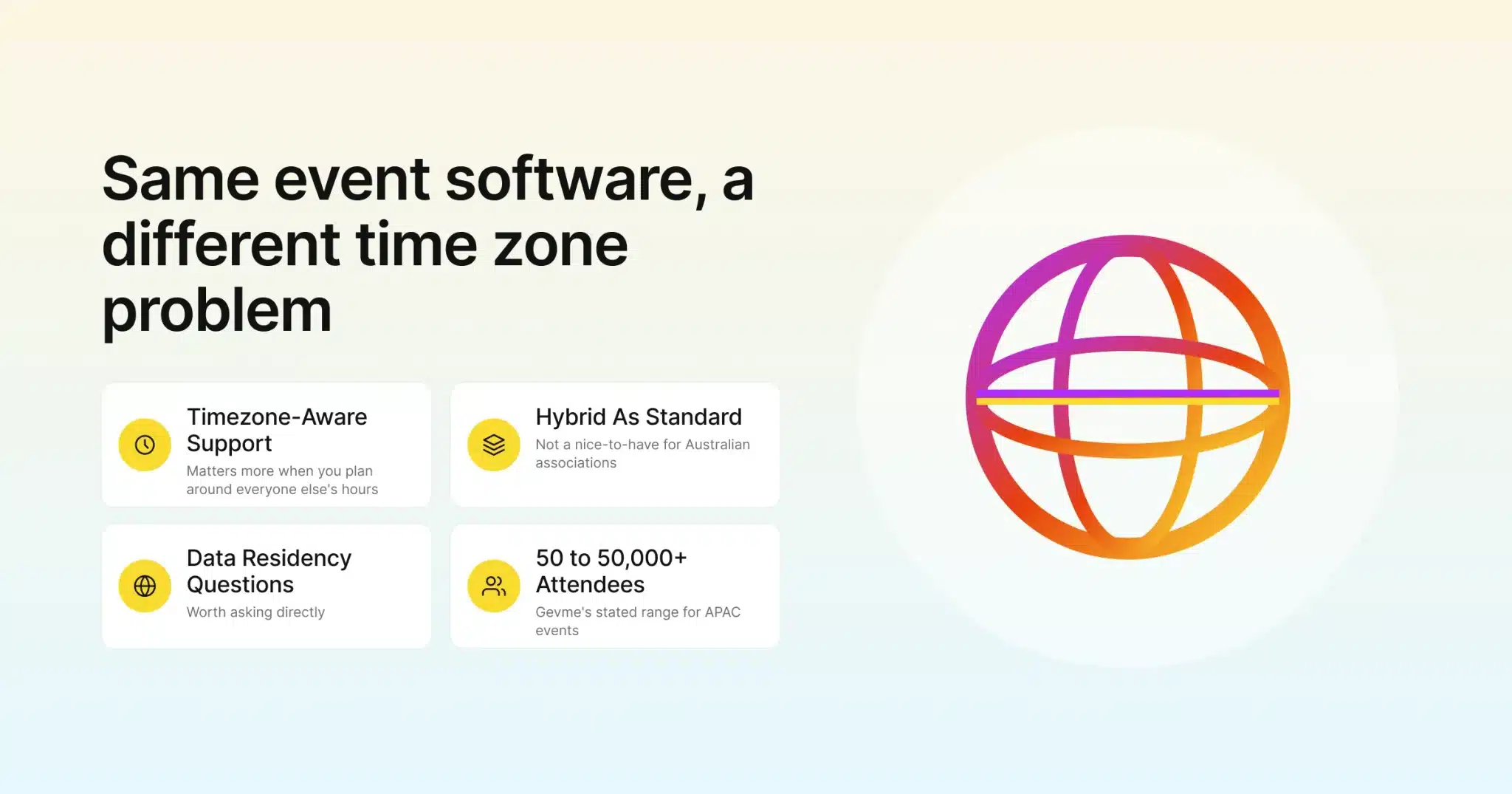
Australian event teams have a slightly different shopping list than most. Timezone overlap with attendees across APAC, North America, and Europe matters more here. You’re often the one planning around everyone else’s business hours. Hybrid formats are close to standard for associations trying to reach members outside the capital cities. And more buyers are asking, reasonably, where their attendee data gets stored and processed before they sign a contract.
Most of the platforms Australian planners end up comparing are global products without a dedicated Australian pricing page or local edition. That makes it harder to tell what’s genuinely built with the local market in mind versus what simply happens to be available in it. One notable exception is iVvy, which is Australian-founded. As you’ll see below, though, it’s solving a narrower problem than a full event management platform.
This guide covers what to actually look for as an Australian buyer. That includes an honest look at the platforms Australian teams most often compare, real pricing where it’s published, and a decision framework based on the kind of events you run.
Key Takeaways
- Most global event platforms don’t publish Australia-specific pricing or support terms. Confirming timezone coverage and data handling directly with any vendor before signing pays off.
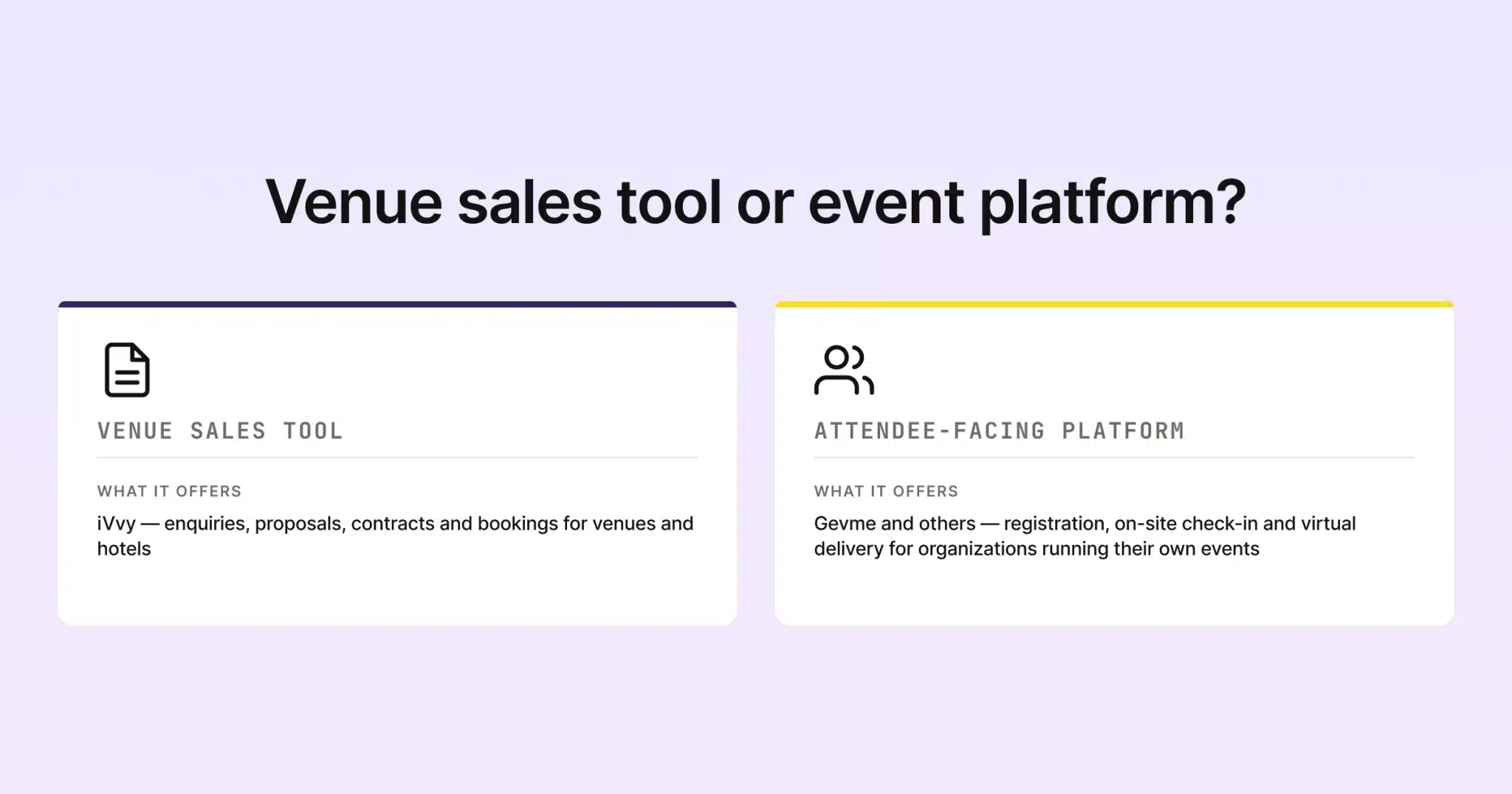
- iVvy is genuinely Australian-founded. It’s built primarily as venue and hospitality sales software though, managing enquiries, proposals, and bookings for venues, not a full attendee-facing event management platform like the others in this comparison.
- EventsAIR was founded in Australia in 1990. It has a strong reputation with associations and scientific or medical conferences, particularly for continuing-education tracking and abstract management.
- Gevme is built to work the same way regardless of region, with registration, on-site check-in, and virtual delivery sharing the same attendee data. That suits Australian teams running hybrid events for spread-out or international audiences.
- Pricing is mostly quote-based across this category. Cvent, Bizzabo’s add-ons, Swapcard, EventsAIR, and iVvy all require a sales conversation for a final number.
- The right platform depends heavily on event type. Association and medical conferences lean toward EventsAIR, and venue and hotel groups managing their own bookings lean toward iVvy. Teams running registration-heavy hybrid or virtual events across time zones lean toward a platform like Gevme.
What Australian Event Planners Should Actually Look For
A few considerations come up more often in Australian buying conversations than in a generic “best event software” search.
- Timezone-aware support and scheduling. Your attendees, sponsors, or internal team might span Australia, New Zealand, and other APAC markets, or you might regularly run sessions timed for European or North American audiences. Either way, check what hours a vendor’s support team actually covers rather than assuming round-the-clock coverage.
- Hybrid and virtual capability, not just onsite. Many Australian associations and membership bodies serve members well outside the major cities. That makes hybrid delivery closer to a baseline requirement than a nice-to-have.
- Where attendee data is actually processed. Data residency and handling practices vary by vendor, and few publish an Australia-specific answer on their marketing pages. If this matters for your organization, it’s a direct question worth asking any shortlisted vendor. Don’t just assume based on where the company is headquartered.
- Whether you need a venue tool or an event platform. This is where the Australian market gets a specific wrinkle. iVvy, one of the best-known Australian names in this space, is primarily built for venues and hospitality groups managing their own sales pipeline. It’s not for organizations planning and running their own attendee-facing events. Knowing which side of that line you’re on before you start demoing saves a lot of wasted sales calls.
- Whether pricing scales the way your event calendar does. Australian teams running a single annual conference have very different budget math than an association running a dozen chapter events across the country each year. Quote-based pricing covers most of the platforms in this comparison. The number you’re quoted often depends on how clearly you can describe your actual event volume upfront. It helps to walk into a sales call with that figure ready, rather than working it out mid-negotiation.
Why Timezone and Hybrid Support Matter More Here
Australia’s east coast sits roughly two to three hours ahead of most of Asia, and a full working day ahead of Europe and North America. That gap depends on the time of year. For an organizer scheduling sessions, coordinating with international speakers, or fielding support tickets, that gap shows up constantly. It’s not an occasional edge case. A platform whose support team is only reachable during US business hours can leave an Australian organizer without help. That gap often lands during the exact stretch of their own event day when something is most likely to go wrong.
This is also part of why hybrid delivery gets treated as closer to a baseline requirement than an add-on for many Australian associations and membership bodies. It’s also why buyers here tend to weigh it more heavily in a shortlist than teams in more geographically compact markets might. A conference held only in Sydney or Melbourne inherently excludes members based in Perth, regional Queensland, or across the Tasman in New Zealand. That’s true unless there’s a virtual option running alongside the in-person event, and it’s a gap plenty of member-driven organizations have had to reckon with in recent years. Platforms that treat virtual delivery as a genuinely equal format, rather than a stripped-down version of the in-person experience, tend to serve that reality better. The alternative is a platform where the virtual side feels like an afterthought.
The Platforms Australian Teams Actually Compare
Gevme
Gevme runs on the same registration, on-site check-in, and virtual venue foundation everywhere it’s used, without a region-specific product tier. Per Gevme’s Australia page, the platform is positioned for events from roughly 50 to 50,000-plus attendees. It highlights an APAC case study with AIME event director Silke Calder, who described running “a flawless event for over 5,000 participants across 3 days” on the platform. There’s no Australia-specific pricing shown separately from the global rates. Per Gevme’s pricing page, checked mid-August 2026, the Registration Platform and Virtual Venue Platform each start at $960/year for Starter and $2,160/year for Pro. A free tier is available on the virtual side, plus custom Enterprise quotes on both.
EventsAIR
EventsAIR was founded in Australia in 1990. Per the Austrade profile of the company, it has grown into a platform trusted by major events globally while keeping deep roots in the local market. Per EventsAIR’s own site, checked mid-August 2026, the company has processed more than 18 million registrations across 400,000-plus events. Named clients include the University of Sydney and the University of Queensland. It’s particularly well regarded for association and scientific or medical conferences, where abstract management and continuing-education tracking are common requirements. Per EventsAIR’s pricing page, checked mid-August 2026, its Single, Multi, and Enterprise tiers all bundle unlimited registrations and 24/7 support. None lists a public dollar figure; pricing requires a quote request.
iVvy
iVvy is an Australian company, iVvy Pty Ltd, and one of the more recognizable local names in event technology. Still, being precise about what it does matters here. Per iVvy’s own site, checked mid-August 2026, the platform is built for venues, hotels, hospitality groups, and function centres to manage the sales side of hosting events. That covers enquiries, proposals, contracts, banquet event orders, and payments. It’s a strong fit if you’re a venue or hotel group managing your own booking pipeline. But it isn’t built as an attendee-facing registration, check-in, or virtual delivery platform for organizations running their own events, which is the category the rest of this comparison covers. No pricing is published; per iVvy’s site, checked mid-August 2026, the vendor directs visitors to request a demo.
Cvent
Cvent is a global platform available to Australian teams without a local pricing tier. It spans registration, venue and vendor sourcing, budgeting and approvals, onsite check-in, and support for hybrid and virtual formats. Per Cvent’s own site, checked mid-August 2026, pricing isn’t published. Visitors are directed to request a demo or contact sales for a quote.
Bizzabo
Bizzabo’s Event Experience OS is priced at $499 per user/month billed annually with a 3-user minimum. That works out to roughly $17,999/year as a starting point, per Bizzabo’s pricing page, checked mid-August 2026. There’s no Australia-specific pricing shown; the published rate appears to apply globally. Its Klik SmartBadge hardware and premium add-ons are priced separately on a quote basis.
Swapcard
Swapcard prices annually based on attendee volume. Per Swapcard’s pricing page, checked mid-August 2026, its Event Features plans range from Starter (up to 200 attendees/year) to Professional (up to 1,000 attendees/year) to Enterprise (unlimited). Separate tiers cover exhibitor services and support levels. No flat figures are published globally or for Australia specifically; pricing requires a live demo.
A Few Terms Worth Knowing
BEO (Banquet Event Order) is a venue’s internal document covering room setup, catering, and timing. It’s typically the core document venue-sales tools like iVvy are built around.
Data residency means where a vendor physically stores and processes your data. It’s a common question for Australian buyers, even though most global vendors don’t publish region-specific answers on their marketing pages.
APAC: shorthand for Asia-Pacific, the broader region Australian events and attendees are usually grouped into for scheduling and market purposes.
Abstract management is the process of collecting, reviewing, and scheduling submitted research papers or presentations. It’s a common requirement for academic and medical conferences.
Event Management Software Compared for Australian Teams, 2026
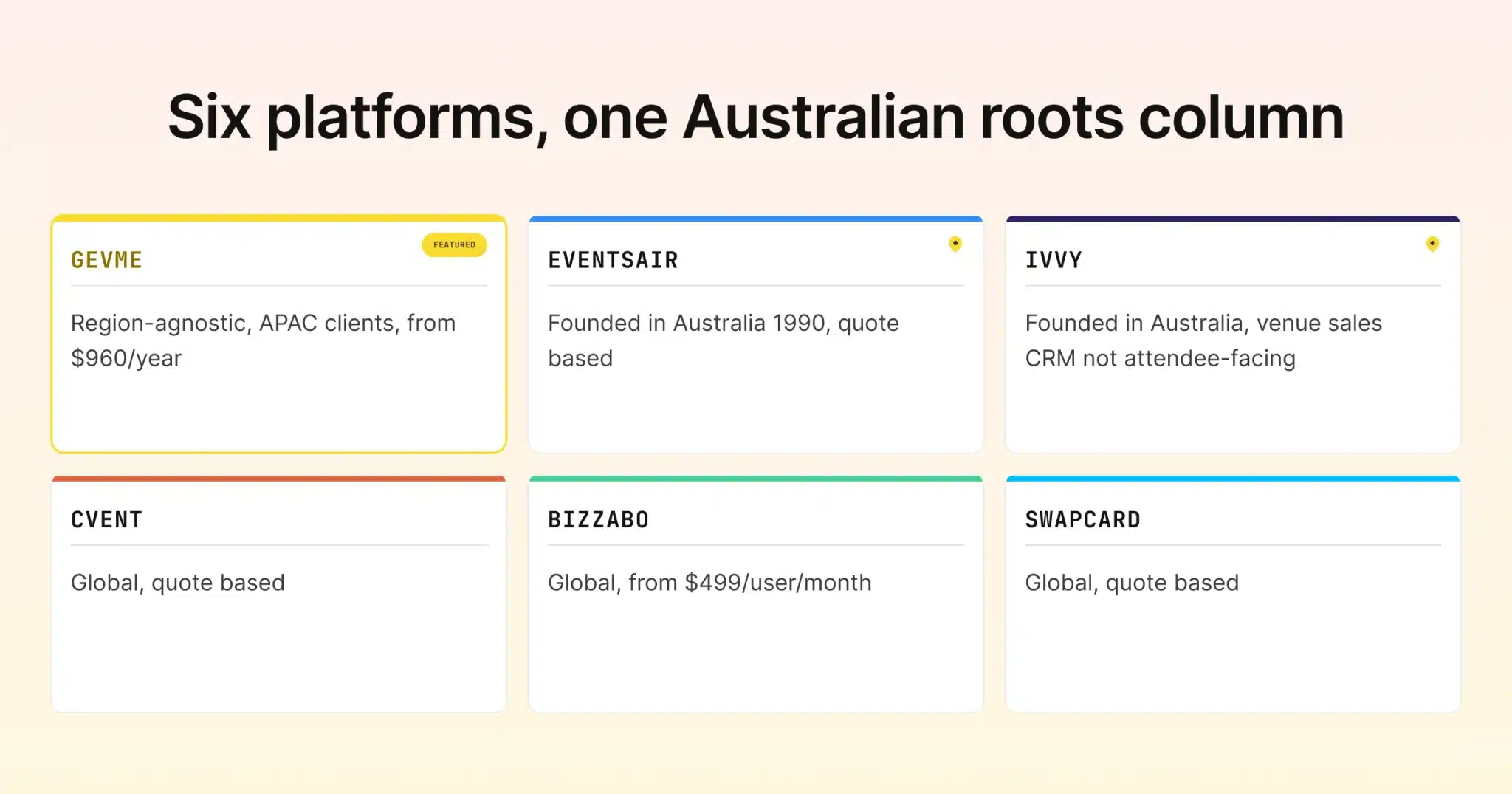
| Platform | Australian Roots | Best For | Attendee-Facing Platform? | Starting Price |
|---|---|---|---|---|
| Gevme | Region-agnostic, APAC clients | Hybrid/virtual events across time zones | Yes | $960/year per product line (Starter) |
| EventsAIR | Founded in Australia, 1990 | Association and medical/scientific conferences | Yes | Quote based, no published numbers |
| iVvy | Founded in Australia | Venues and hotels managing their own bookings | No, venue sales CRM | Available on request |
| Cvent | Global, no AU-specific tier | Large enterprise programs | Yes | Quote based, no published numbers |
| Bizzabo | Global, no AU-specific tier | Mid-to-large conferences | Yes | $499/user/month (3-user minimum) |
| Swapcard | Global, no AU-specific tier | Networking-heavy conferences and trade shows | Yes | Quote based, no published numbers |
Sources: figures above come from each platform’s own pricing or product pages, checked mid-August 2026: Gevme, EventsAIR, iVvy, Cvent, Bizzabo, Swapcard. Vendor pricing pages change, so it’s worth confirming directly before you budget against any figure here.
Who Should Choose Which
If you’re a venue, hotel, or function centre managing your own enquiries and bookings, iVvy is squarely built for that job. It’s worth a serious look given its local roots. If you’re running association meetings, scientific conferences, or anything involving abstract submissions and continuing-education credits, EventsAIR’s decades of focus in that space are hard to match. Programs that are large, multi-stakeholder, and need built-in budgeting and approval chains point toward Cvent, whose breadth covers that ground. If you want a strong networking and matchmaking layer for a trade show or expo-style event, Swapcard’s AI matchmaking is a differentiator. Your events might span onsite, virtual, and hybrid formats for audiences spread across Australia and beyond. If you want registration, check-in, and virtual data staying connected rather than living in separate systems, that’s where Gevme fits.
None of these are mutually exclusive, either. It’s common for a venue running on iVvy to host an association conference that’s registered and managed through a separate platform like Gevme or EventsAIR. It’s also common for a Cvent-run enterprise program to book its physical space through a venue using iVvy on the back end. Understanding where each platform actually sits in that chain, rather than expecting one tool to cover every layer, makes the comparison a lot less confusing.
What Happens If You Pick the Wrong Category
The most expensive mistake in this comparison isn’t picking the wrong vendor within a category. It’s picking the wrong category altogether. A venue might sign up for a full attendee-facing event platform when what it actually needed was a sales and booking tool. That venue ends up paying for registration and virtual features it’ll never touch. An association might sign up with a venue-sales tool like iVvy, expecting it to handle member registration for their own conference. That association will hit a wall fast, since that’s simply not what the product is built to do. Sorting out which category you’re in before you start taking sales calls saves real time on both sides. It’s a five-minute exercise that most teams skip in the rush to start comparing feature lists.
Pro Tip: Ask About Support Hours Before You Ask About Features
Most vendors in this comparison lead with feature lists. But for Australian teams, support coverage during your actual event hours matters just as much. Few vendors publish this clearly on their websites. So it’s worth asking directly during a demo: what timezone is support based in, and is there a live option during your event window. Also ask what the actual response time looks like if something breaks at 7am on event day. This single question tends to reveal more about day-to-day reliability than a feature comparison ever will.
Frequently Asked Questions
Not really, in the sense of a dedicated local product line from a global vendor. Most platforms Australian teams use are global products without an Australia-specific edition or pricing page. iVvy is a notable exception in that it’s Australian-founded. It’s built for venue sales rather than general event management, though, so it solves a different problem than most people searching this term are looking for.
EventsAIR has the strongest track record here, with decades of focus on association and scientific or medical conferences, including abstract management and continuing-education tracking. For associations also running hybrid or virtual formats with an emphasis on unified attendee data, Gevme is worth including in that comparison too.
Not necessarily, but some organizations, particularly government-adjacent or highly regulated ones, do require or prefer it. Most global vendors don’t publish a clear Australia-specific data residency answer on their marketing pages. This is worth confirming directly with any vendor you’re seriously considering, rather than assuming either way.
iVvy is built for venues and hospitality groups to manage their sales pipeline: enquiries, proposals, contracts, and payments for spaces they’re renting out. Gevme is built for organizations running their own events, covering registration, on-site check-in, and virtual delivery for attendees. They solve adjacent but different problems. Some events actually touch both: a venue using iVvy to manage the booking, and an organizer using a platform like Gevme to run the event itself.
Still Have Questions?
Pricing is mostly the same as global rates, since few vendors publish Australia-specific numbers. Gevme’s registration and virtual products start at $960/year per product line. Bizzabo starts around $17,999/year for its Event Experience OS. Cvent, EventsAIR, iVvy, and Swapcard are all quote-based, with final pricing depending on event size and features.
Yes, this is one of the more common use cases for Australian teams. Gevme, Cvent, Bizzabo, and Swapcard all support hybrid delivery, combining onsite and virtual attendees in the same event. The practical consideration is less about whether the platform supports it. It’s more about whether session scheduling and support coverage work across the time zones your attendees are actually in.
Not directly, since it’s solving a different problem. iVvy is built for venues and hospitality groups managing their booking pipeline. Gevme, Cvent, and Bizzabo, by contrast, are built for organizations running their own attendee-facing events. If you’re a venue, iVvy is worth comparing against similar venue-sales tools. If you’re an organizer planning an event, the more relevant comparison is between Gevme, Cvent, Bizzabo, EventsAIR, and Swapcard.
This isn’t clearly published by most vendors in this comparison. That’s exactly why asking directly during a demo beats guessing. Given iVvy and EventsAIR’s Australian roots, they’re reasonable starting points for that conversation. Confirm actual coverage, though, rather than assuming it based on where a company was founded.
Conclusion: Matching the Platform to the Event, Not Just the Postcode
Being Australian-founded doesn’t automatically make a platform the right fit. Being a global product doesn’t automatically make one the wrong fit either. iVvy earns real credit for solving a genuine problem for Australian venues and hotels. EventsAIR’s decades of work with associations and medical conferences reflect a track record that’s hard to argue with. Both deserve serious consideration if your event fits their strength.
For teams running attendee-facing events across onsite, virtual, and hybrid formats, especially with attendees spread across Australia and international time zones, Gevme’s approach tends to be the more direct fit. It keeps registration, check-in, and virtual data connected in one system. It’s a platform built the same way regardless of which market it’s used in. In practice, that means Australian teams get the same registration, check-in, and virtual capabilities as anyone else, without a stripped-down regional version to work around.
If that describes your next event, it’s worth a look at Gevme’s ecosystem or a demo to see how it holds up against your actual requirements.