Every event team has a risk register. Fire safety, speaker cancellations, catering logistics, the visible risks get documented, rehearsed, and planned for.
The risks that derail events are often the ones that were never on the list.
The hidden risks in event operations are not dramatic failures. They are quiet system breakdowns, the access control gap that let the wrong person into a restricted session, the check-in queue that turned what should have been a confident arrival into a frustrating 20-minute wait, the badge printing system that went offline when 400 people were waiting to get in.
These risks are invisible until they happen. And by the time they surface, the damage to the attendee experience and the event team’s credibility is already done.
Risk 1: Access Control That Relies on Trust, Not Systems
At most events, access control is managed by staff with a printed list and a highlighter. Or a scanner that checks whether a QR code is valid, without verifying what that person is actually entitled to access.
This is not access control. It is access hope.
Consider the scenarios that break it:
- A speaker’s guest arrives with a general delegate badge and requests access to the VIP dinner. Without a system that knows the difference, staff make a judgment call.
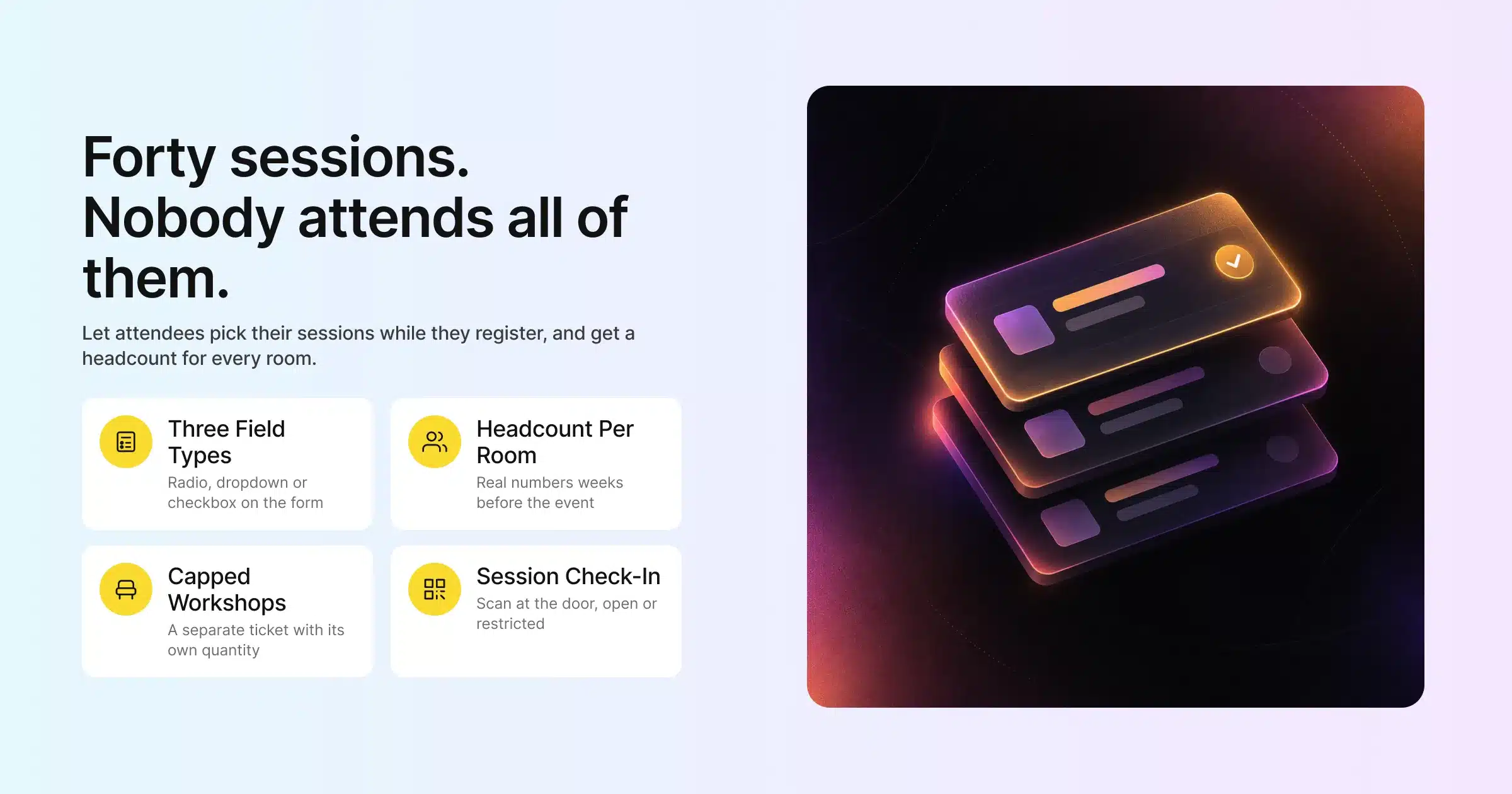
- A session reaches capacity, but there is no automated flag, so the next 30 people walk in until someone notices.
- A registrant transfers their QR code to a colleague who was not registered. Without validation logic, the transfer goes undetected.
Real access control means every attendee’s entitlements are defined in the system and enforced by it, not by a staff member’s memory.
Gevme’s onsite platform ties access rules directly to attendee registration data. Session caps, attendee tier restrictions, and zone-based access are all enforced at the scan point. If an attendee’s badge does not match the access rule, the system flags it, before they walk through the door.
Risk 2: Hardware Failure at the Worst Possible Moment
Event technology fails. This is not a design flaw. It is physics and probability.
The question is not whether a device will fail. It is whether your operation has been designed to handle failure without attendees noticing.
The high-risk moments are predictable:
- The first 30 minutes of check-in, when volume peaks sharply
- After a session break, when large numbers arrive at the same access point simultaneously
- During badge reprints, when staff are handling hardware manually under pressure
At each of these moments, a single device failure, a frozen kiosk, a disconnected printer, a scanner that stops reading can cascade into a queue that takes 40 minutes to clear.
Gevme’s onsite setup is designed around operational resilience. Check-in stations support multi-device configurations where workloads distribute automatically. The system continues to operate on each device even if connectivity drops data syncs when the connection is restored, without losing a single scan. Staff can switch to a manual mode with visual confirmations without needing to call a technician.
This is not a feature. It is a design philosophy: the event should not stop because a device did.
Risk 3: No-Shows, Last-Minute Changes, and the Data Gap
One of the most consistent hidden risks in event operations is the gap between who registered and who actually arrives.
No-show rates at business events commonly range from 20% to 40%. VIP lists change between confirmation and event day. Group bookings shift. Corporate registrants get reassigned internally.
If your onsite system is not connected to your registration system in real time, you are operating on stale data. And stale data means:
- VIP guests who are not flagged as such at check-in
- Catering and seating allocations that do not reflect actual attendance
- Session capacity management that is based on registrations, not arrivals
- Post-event reporting that cannot tell you who was actually in the room
Gevme connects registration and onsite data into a single live record. Every check-in is reflected immediately across the platform. Capacity counts update in real time. If a VIP’s status was updated two hours before the event, the check-in team sees the current record, not last week’s export.
This is the operational foundation that makes everything else, catering, seating, session management, accurate.
Risk 4: Badge Security and Identity Verification
Printed badges are easy to reproduce. A determined bad actor with a photo of someone else’s badge can walk into many events without challenge.
This is a higher-stakes problem for certain event types:
- Government and regulatory forums where access is restricted by clearance
- Healthcare and pharmaceutical conferences with HCP compliance requirements
- High-security corporate events with commercially sensitive content
- Events where ticket value is high enough to motivate fraudulent access
Gevme’s badge system supports QR codes that are uniquely tied to the attendee’s live registration record, not just a static printed identifier. Each scan validates against the live system. A badge that has already been scanned once flags on re-entry, preventing the same credential from being shared or reused.
For events with higher security requirements, Gevme’s onsite platform can be configured for biometric or photo verification at access points, adding a layer of identity confirmation that printed badges alone cannot provide.
Risk 5: The Fallback Plan That Does Not Exist
Ask most event teams what happens if their check-in system goes down ten minutes before doors open. The honest answer is: improvise.
Improvisation under pressure, in front of a growing queue of attendees, with a team that has not practised the contingency, almost always makes things worse.
The best risk management is a fallback plan that has been tested before you need it.
Gevme’s onsite platform is designed with offline capability as a baseline feature, not an add-on. Devices cache the attendee list locally. Check-in continues without internet. Data syncs when connectivity is restored.
For event teams, this means the contingency plan is already built in. You do not need to explain to your staff what to do if the system goes down, because functionally, it doesn’t.
Building an Operation That Can Absorb Risk
The hidden risks in event operations do not disappear when you use better technology. But their impact, the queue, the breach, the staff member making a judgment call they should not have to make shrinks dramatically.
The difference between an event that recovers from a problem and one that is defined by it is almost always the same thing: whether the system was designed to handle it, or whether someone had to improvise.
Gevme’s onsite event features, access control, offline-capable check-in, real-time registration sync, badge security, and hardware resilience are built around one operational principle: the event runs, no matter what.
Want to see how Gevme’s onsite platform handles the scenarios your current system leaves to chance? Request a demo and let us walk you through a real-world onsite operations review.
Gevme is an omnichannel event management platform trusted by event teams at the Singapore Fintech Festival, Monetary Authority of Singapore, GovTech, and global trade show operators. Gevme is ISO 27001, ISO 27017, ISO 27018, and SOC2 Type 2 certified.