Finding a venue used to mean phone calls and PDF floor plans flying back and forth by email. A spreadsheet somewhere tracked holds on each function room, for who, and until when. Venue management software replaced most of that. However, it did not make the category simple to shop for. The wrong choice here rarely looks dramatic. Instead, it shows up months later as a quiet mismatch. Your team needed one thing, and the vendor built the software for another.
Part of the confusion is the name itself. Vendors apply the label “venue management software” to several different things. Some tools help event organizers find and book a space. Others help venues run their own sales pipeline and contracts. A few do both at once under the same product. As a result, two platforms can share a category label and still solve almost entirely different problems.
Venue management software is a category of tools. These tools help venues and event organizers manage the venue side of an event. That work covers sourcing and booking a space, tracking availability, and generating proposals and contracts. It also covers the sales and logistics behind function rooms, hotels, and event venues. It sits next to the software that manages attendees once you book the venue. That said, it stays separate from it.
This guide covers what the category actually includes. It shows how to tell venue-sourcing tools apart from venue-operations tools. It then offers a practical framework for evaluating either kind. Finally, it covers the mistakes that trip up otherwise careful buyers. It also shows where a genuine Australian example, iVvy, fits in.
Key Takeaways
- Venue management software splits into two related but different jobs. One job helps organizers find and book a venue. The other helps venues run their own sales, contracts, and operations.
- iVvy, a Gold Coast-founded platform, is a genuine Australian example on the venue-operations side. It covers proposals, contracts, banquet event orders, and payments.
- Most venue management platforms, iVvy included, do not publish pricing publicly. Because of that, getting a real quote early matters more here than in categories with list prices.
- Venue management software is a different category from attendee registration and check-in software. Most event teams end up needing both, rather than one instead of the other.
- Independent reviews across the category consistently praise ease of use and time saved on proposals and contracts. Reporting flexibility, however, draws the most common complaint.
- One question matters most at the start of any evaluation. Does the platform serve a venue’s own operations, or an organizer’s venue search? That answer decides almost everything else.
What Venue Management Software Actually Covers
At its core, this category replaces the manual, back-and-forth process of finding, holding, and confirming an event space. In practice, that means enquiry tracking, availability calendars, and proposal and contract generation. It also means banquet event orders and payment processing. Vendors build these tools for the venue’s sales team, for the organizer doing the searching, or for both.
Venue Sourcing vs Venue Operations, and Why the Difference Matters
Venue sourcing tools work like a marketplace. An event organizer searches available spaces, compares options, and sends enquiries. It works much like comparing hotels before you book one. Venue operations tools work from the other side of that same enquiry. They live inside the venue itself. There, they turn an incoming request into a proposal, a signed contract, a banquet event order, and eventually an invoice.
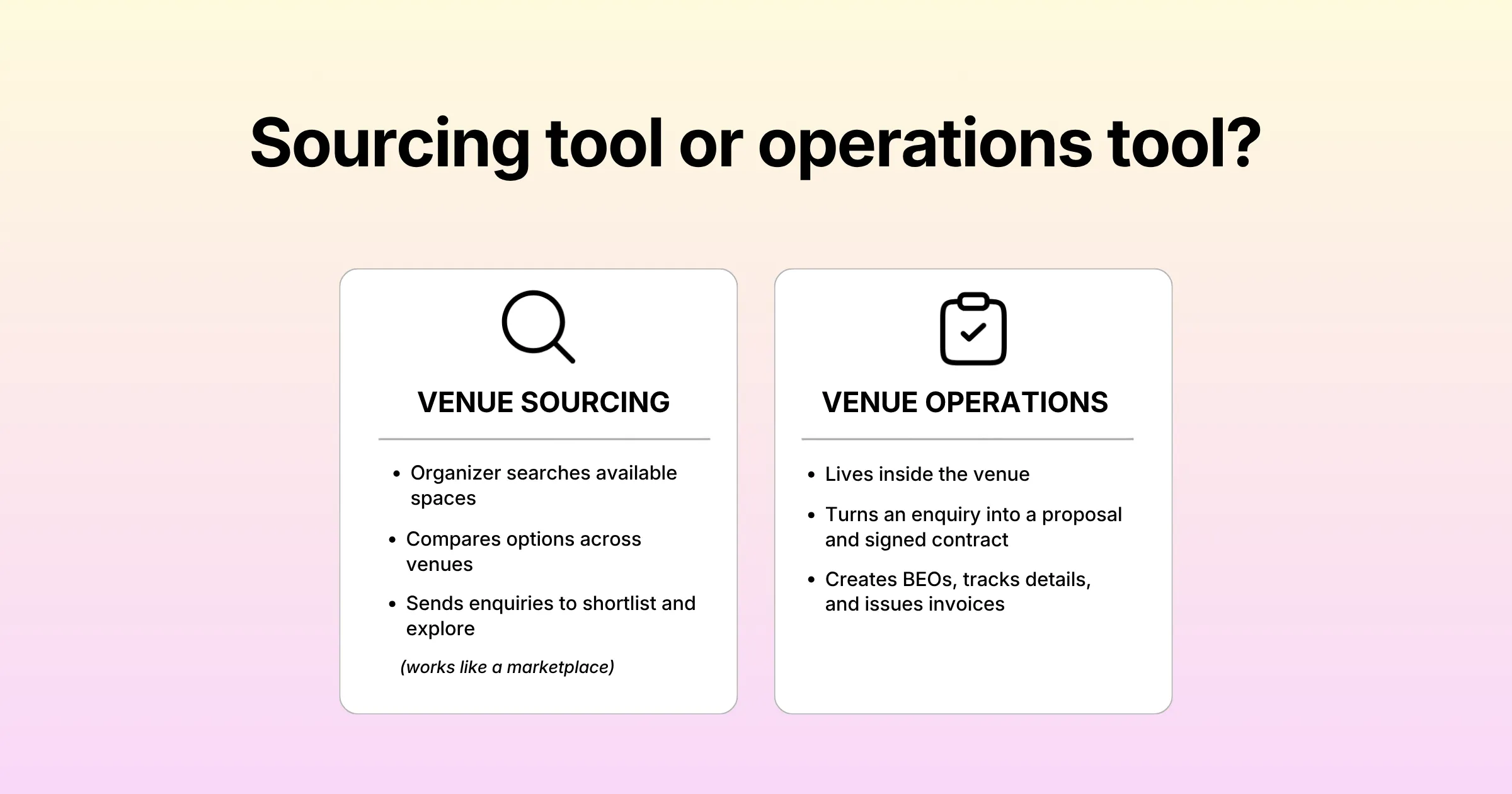
Some platforms genuinely do both, running a sourcing marketplace on one side and operations software for venues on the other. One question is the single most useful thing to establish early. Which side of that line does a vendor sit on, or does it straddle both? Settle that before you compare feature lists. A sourcing-focused tool and an operations-focused tool simply answer different questions.
Core Features to Look For
| Feature | What It Does | Why It Matters |
|---|---|---|
| Enquiry and CRM management | Tracks incoming venue enquiries and organizer relationships in one place | Prevents leads and follow-ups from getting lost in someone’s inbox |
| Proposals and contracts | Generates branded proposals and contracts, often with e-signature | Cuts the turnaround time between an enquiry and a confirmed booking |
| Banquet event orders | Version-controlled run sheets covering room setup, catering, and AV | Keeps everyone, from kitchen to AV crew, working from the same current plan |
| Reporting and analytics | Dashboards on bookings, revenue, and conversion | Shows which enquiries are turning into revenue and which are stalling |
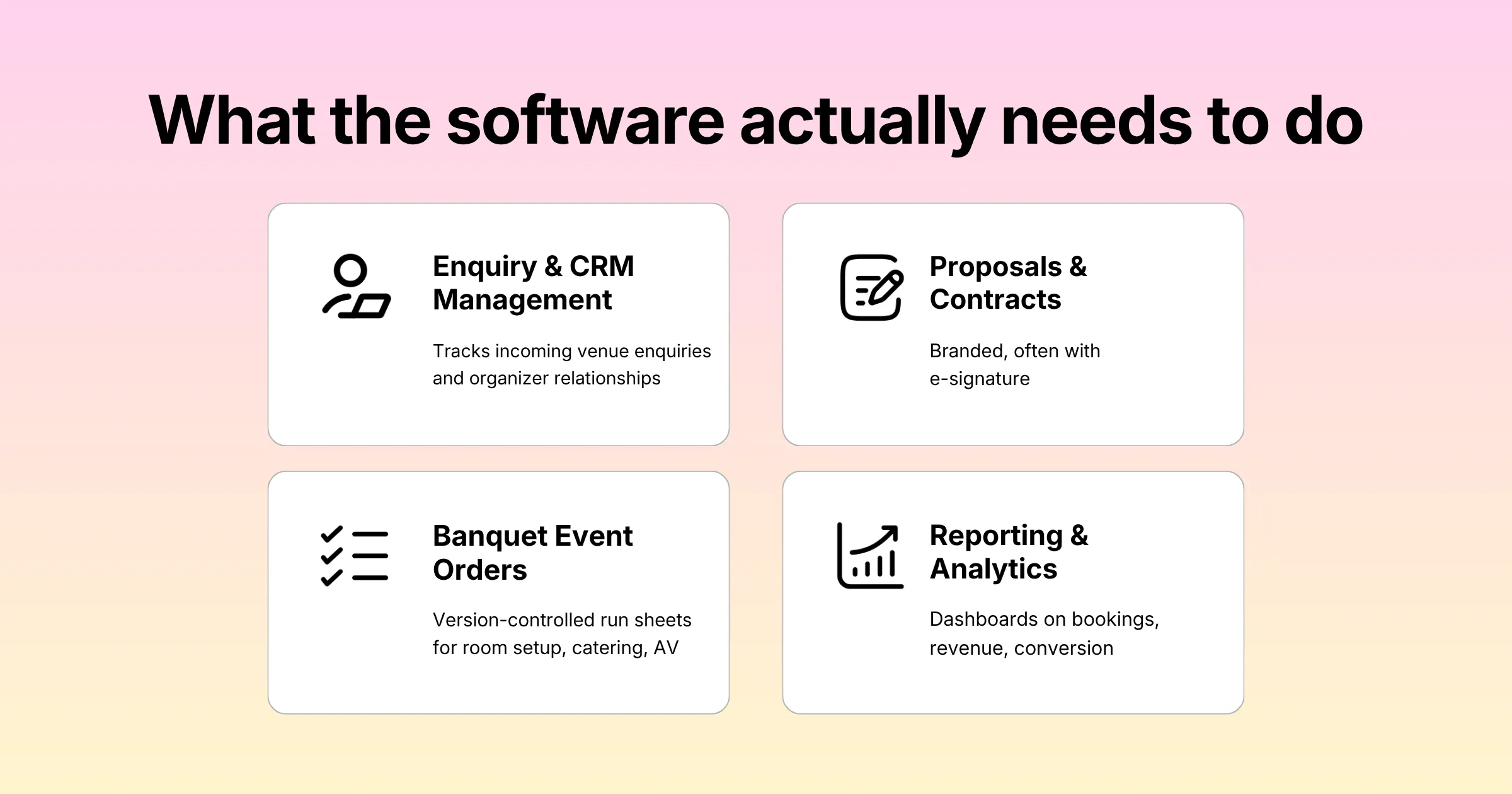
Not every feature matters equally, because it depends on who evaluates the platform. A venue’s sales team cares most about proposal turnaround and CRM tracking. Those two things determine how many enquiries turn into signed contracts. A venue’s operations team cares more about banquet event order flexibility. It also cares how well the platform communicates last-minute changes to catering and AV staff. If both teams have a say in the decision, let both test the platform properly. They should try the parts they will actually use daily, not just the polished, sales-facing side of a demo.
If pricing isn’t listed, that’s normal
Most vendors in this category, including well-established ones, price on venue size, user count, and feature needs. They rarely publish a flat rate. That is standard for the category, not a sign a vendor is hiding something. So ask for a quote directly. Do not assume the absence of a price list puts the product out of your range.
Who Venue Management Software Is, and Is Not, For
This category makes the most sense for two groups. Venues themselves come first: hotels, function centres, conference centres, and hospitality groups. They benefit from operations software that turns enquiries into contracts and banquet event orders. No spreadsheet then sits in the middle of the process. Organizers who source venues often come second. Think agencies, associations running an annual conference circuit, or corporate teams booking offsites across multiple cities. They benefit from sourcing tools that speed up comparison shopping across dozens of possible spaces.
It makes less sense as a default purchase for a small team. Think of a team running one or two events a year in venues they already know well. A phone call and a shared spreadsheet can genuinely be enough at that scale. Learning a new platform costs time, and that time is not always worth it. Wait until your event calendar grows, or until the number of venues you deal with does.
How to Tell Venue Management Software Apart From a Full Event Platform
Venue management software and an attendee-facing event platform solve genuinely different problems. However, the overlap in marketing language on search results pages causes real confusion. Venue management software is about the space: finding it, booking it, and running the contracts and logistics behind it. An event registration and engagement platform is about the people. It signs them up, checks them in on the day, and tracks them well enough afterward. Someone can then report on how the event actually went.
Most events need both. A conference organizer typically books a venue through a sourcing tool, or directly with the venue’s sales team. That organizer then runs registration, badge printing, and check-in through a separate platform. Vendors build that second platform specifically for that job. Making one category of tool do both usually means a weaker version of at least one function.
Already have the venue locked in? Perhaps you are thinking about how you will register and check in attendees once they arrive. See how Gevme’s registration platform handles that side of the event.
A Look at the Australian Market: iVvy
iVvy is one of the more established Australian names in this category. It is a useful real-world example of what venue-operations software looks like in practice. Lauren Hall and James Greig founded iVvy on the Gold Coast in 2009. The platform primarily serves venues themselves: hotels, function centres, hospitality groups, and stadiums. It covers enquiry and CRM management, plus branded proposals and contracts with e-signatures. It also handles version-controlled banquet event orders and payments.
iVvy also runs a venue-sourcing marketplace that connects event organizers directly to venues. The company says over 30,000 organizers use that marketplace each month. It has also recently added AI tools for venue sales teams. Those tools aim to help staff respond to enquiries and qualify leads faster.
Reviewers on G2 rate iVvy 4.6 out of 5 across 48 reviews. They cite an easy-to-use interface and time saved on contracts and invoicing most often as strengths. Reporting flexibility, meanwhile, is the area they most commonly say could improve. iVvy does not publish pricing on its site. Its FAQ states that cost depends on venue size, user count, and features. A quote is available on request.
| Detail | iVvy |
|---|---|
| Founded | 2009, Gold Coast, Australia |
| Core focus | Venue sales, contracts, and operations, plus a venue-sourcing marketplace |
| Typical customers | Hotels, function centres, hospitality groups, stadiums |
| Pricing | Not published, quote on request |
The details above come from iVvy’s own site, current as of early August 2026.
Where iVvy Fits, and Where It Does Not
It is worth being precise about what iVvy is and is not. Its strength and its published case studies sit squarely on the venue-operations side. Think hotels, stadiums, and hospitality groups running their own sales and contracts. That is a narrower, more venue-specific job than an attendee registration and engagement data platform. Comparing the two directly would not be fair. So imagine you are a venue evaluating how to run your own bookings and sales pipeline. In that case, iVvy belongs on your shortlist.
Common Mistakes When Choosing Venue Management Software
The first mistake is not distinguishing between venue-sourcing tools and venue-operations tools before comparing vendors. A platform that helps organizers find a venue solves one problem. A platform that helps a venue run its own sales pipeline solves another. Comparing the two feature-for-feature does not hold up.
Skipping the pricing conversation until late in the process is another common one. Most vendors in this category do not publish pricing. Because of that, it is easy to fall for a clean interface. You then find out it does not fit the budget. So ask for a quote in your first or second call, not your last.
The Mistakes That Surface Later
Buyers underweight reporting flexibility too, and independent reviews across this category show the same pattern. Reviewers generally like the interfaces. However, they most often want more from reporting and custom templates. So if detailed reporting matters to your team, ask to see it directly. Do not take a features page’s word for it.
Some buyers also assume venue management software will handle attendee registration and check-in just as well. Some platforms in this category do offer basic ticketing add-ons. However, that is rarely the core strength of a venue-focused product. So test that functionality specifically before you rely on it for a real event.
Last, it is easy to buy for the venue portfolio you have today. The one you will have in two years may look very different. A single-property function centre and a multi-venue hospitality group need different levels of reporting, user permissions, and integration depth. Switching platforms later also disrupts more than paying for slightly more headroom now.
A Few Terms Worth Knowing
- RFP (Request for Proposal): the enquiry a planner sends a venue asking for availability, pricing, and terms.
- BEO (Banquet Event Order): the detailed run sheet a venue produces. It covers room setup, catering, AV, and timing for a specific event.
- Function diary: a venue’s master calendar tracking booked, held, and available spaces across every date.
- Group room control: how a hotel or venue manages room block allocations for a group booking alongside its general inventory.
How to Evaluate Venue Management Software: A Framework
- Does this platform serve a venue’s own operations, an organizer’s venue search, or genuinely both?
- Can you see a real proposal, contract, and banquet event order from a similar-sized event? A generic demo template does not count.
- How does the vendor structure pricing, and can you get an actual quote before investing more time?
- How flexible is the reporting, and can your team build a custom report without vendor support?
- Does the platform integrate with the accounting, CRM, or payment systems you already run on?
- If your event also needs attendee registration and check-in, is that a genuine strength here? Or did the vendor bolt it onto a venue-focused product as an afterthought?
Pro Tip:
Ask any venue management vendor for a sample banquet event order and a sample proposal. It should come from an event similar in size to yours. A generic template from their marketing site will not tell you much. How a platform handles a real, slightly messy event tells you more. Any feature list comes a distant second.
Frequently Asked Questions
What is venue management software?
Venue management software is a category of tools for venues and event organizers. These tools handle the venue side of an event. That covers availability, proposals and contracts, banquet event orders, and payments. It is distinct from attendee registration or check-in software. That software handles the people attending rather than the space itself.
What is the difference between venue sourcing software and venue management software?
Venue sourcing software helps event organizers search for and enquire about available venues, similar to a marketplace. The venue itself typically uses venue management software instead. It handles incoming enquiries, proposals, contracts, and event logistics once a booking lands. Some platforms, iVvy included, offer both under one umbrella.
Is iVvy good for venue management?
iVvy is a well-regarded, Gold Coast-founded platform. It suits hotels, function centres, and hospitality groups managing proposals, contracts, and banquet event orders. The platform holds a 4.6 out of 5 rating on G2 from 48 reviews. It does not publish pricing publicly, so you will need to request a quote directly.
How much does venue management software cost?
Most venue management platforms, including iVvy, do not publish pricing publicly. Instead, they offer a custom quote based on venue size, user count, and features. Third-party software directories have listed indicative starting prices around $250 a month for some products. However, the vendors themselves do not confirm that figure directly. So treat it as a rough starting point rather than a quote.
Do I need venue management software and event registration software, or just one?
Most event teams need both, since they solve different problems. Venue management software handles finding, booking, and running the logistics of the space itself. Event registration software, meanwhile, handles attendee sign-up, on-site check-in, and post-event engagement data.
What should I look for when evaluating venue management software?
Start by checking whether the platform serves venue-side operations, organizer-side sourcing, or both. That answer shapes everything else about fit. From there, look at proposal and contract turnaround time and banquet event order flexibility. Then check reporting depth. Finally, find out whether you can get a real pricing quote early rather than late.
Conclusion: Choosing Venue Management Software That Actually Fits Your Team
The venue management category is wider than a single search result suggests. The biggest evaluation mistake is treating every platform in it as interchangeable. One tool helps a hotel run its banquet sales pipeline. Another helps an organizer search for a space. Those two answer different questions, even when they share a category label.
Separate venue sourcing from venue operations. Sort out pricing early. Test reporting with something more real than a demo template. Do those three things, and the right platform for your team usually becomes obvious. Once you settle the venue itself, the next decision follows. How will you actually register, check in, and understand the people who show up?
Are you ready to plan that side of the event? Book a walkthrough with Gevme’s team. See how registration and check-in work once you settle the venue question.