EventsAir has earned a strong reputation in Australia. Associations, medical societies, and professional conference organisers have relied on it for years. They run complex, multi-day programs on it: abstract submissions, member pricing tiers, CE credit tracking, all of it. If you’re reading this, you already know that part. What you’re actually trying to work out is whether EventsAir is still the right fit. Or whether it’s time to start evaluating EventsAir alternatives in earnest.
That question rarely starts because the platform broke. It starts because the events changed. More of your program happens online or across time zones now. Your team wants to see registration, on-site check-in, and engagement data in one dashboard. Instead, they stitch three exports together in a spreadsheet. Meanwhile, your budget owner wants a straight answer on EventsAir pricing, which isn’t always easy to get.
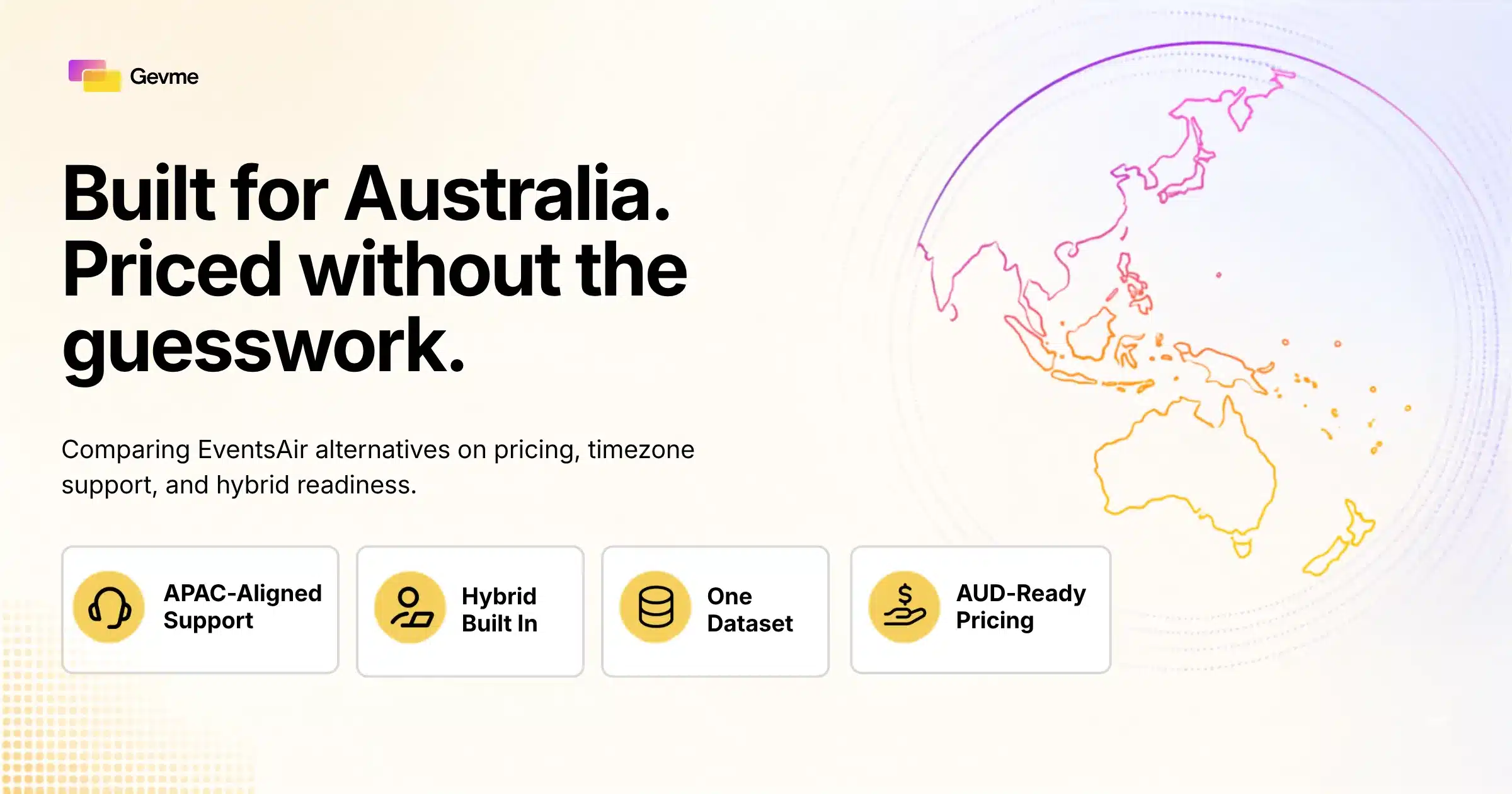
EventsAir alternatives are event management platforms that cover the same core ground: registration, abstract management, badging, and reporting. They add a more modern interface, clearer pricing, or stronger support for virtual and hybrid formats. Australian and broader APAC teams add a few local requirements on top of that. They want data hosted or supported in a reasonable time zone. They also want a support team that isn’t operating entirely out of the US or Europe. And they want event management software Australia teams can actually budget against in AUD without guesswork.
What This Guide Covers
This guide covers who EventsAir serves well and why Australian teams start looking elsewhere. It compares EventsAir pricing to other event management software Australia options. It then looks at which competitors are worth shortlisting. You also get the criteria that matter in conference management software Australia options. Finally, there’s a side-by-side table and a framework for deciding whether to switch or stay.
Key Takeaways
EventsAir is genuinely strong for associations and scientific conferences. Complex abstract workflows, CE credit tracking, and member pricing are where it earns its reputation. Few competitors match that depth.
Most teams don’t leave because EventsAir is bad. They start comparing other options because their event mix has shifted toward hybrid and virtual formats. Or because the cost stopped matching the value for a smaller event calendar.
EventsAir pricing is quote based, not published. Per EventsAir’s own pricing page, there are three tiers. One is a Single Event plan. Another is a Multi Event plan for organisations running three or more events a year. The third is a custom Enterprise plan. All three bundle in unlimited registrations. However, the actual number depends on your negotiation.
Support hours and data handling deserve as much weight as feature lists. A platform can look excellent on paper but only staff support during US or UK hours. As a result, it creates real friction during a live event in Sydney or Melbourne.
Data unification matters more than any single feature. The teams happiest with their event management software Australia setup share one thing. They can see registration, check-in, and session data in one place without exporting anything.
Switching platforms is a real project, not a toggle. Budget for data migration and a parallel run on at least one event before you commit fully. Also expect the migration to take longer than your first estimate.
Who EventsAir Serves Well
EventsAir isn’t a legacy tool coasting on inertia. For a specific type of event, it’s genuinely one of the strongest platforms available. That holds whether you’re comparing event management software Australia wide or looking globally. So it’s worth understanding that strength before you weigh it against anything else.
Associations and Membership Bodies
EventsAir grew up around associations, and it shows. Member based registration pathways, tiered pricing by membership status, sponsor self-service portals, and detailed sponsorship ROI reporting all ship natively. None of it feels bolted on. Your calendar might centre on an annual conference plus a handful of chapter meetings. Your attendees might be mostly existing members renewing an expectation. In that case, EventsAir’s workflows map closely to how your organisation operates. As a result, plenty of associations never bother looking elsewhere at all.
Medical and Scientific Conferences
This is arguably EventsAir’s strongest vertical. It handles abstract submission and peer review, automated reviewer assignment, and session scheduling built around accepted papers. It also includes a dedicated continuing education module with automatic credit tracking. Most general-purpose event software doesn’t attempt to build those features well. A medical congress can involve hundreds of submissions and strict CE compliance requirements. For those events, that depth is hard to replicate with a lighter tool. Therefore it’s a fair reason to think twice before switching to any alternative on the market.
Complex, Multi-Day Programs
EventsAir also handles the operational weight of large, multi-track programs. That means concurrent sessions, accommodation blocks, travel logistics, and the reporting that comes with reconciling all of it afterward. It covers most areas of a scientific or association event in one system, which is exactly the pitch. Think of a professional conference organiser (PCO) running someone else’s complex event on contract. For them, that breadth reduces the number of vendors to manage. It’s also the kind of depth conference management software Australia buyers weigh against price when they build a shortlist.
Why Australian Event Teams Look for EventsAir Alternatives
Teams rarely switch because EventsAir failed them. In reviews and in conversations with event teams, the same reasons come up consistently. They fall into three buckets.
The Interface and Learning Curve
EventsAir is a comprehensive platform, and comprehensive tools take time to learn. New team members typically need real training before they’re comfortable building an event from scratch. Some features also sit behind paid custom development rather than self-serve. The interface and mobile app can feel dated next to newer entrants. Reporting exports don’t always give you the reusable view you want without extra manual work. None of this makes EventsAir a bad platform. However, a lean team running a handful of events a year can spend disproportionate time operating the tool. That’s often the first thing that pushes them to look elsewhere.
EventsAir Pricing for Smaller Teams
EventsAir pricing uses tiers. Per EventsAir’s own pricing page, a Single Event plan covers one event, three users, and standard 24/7 support. A Multi Event plan serves organisations running three or more events a year, with unlimited users and premium 24/7 support. A custom Enterprise plan covers large-scale operations. All three tiers bundle unlimited registrations into the license fee rather than charging per attendee. That’s a genuine advantage for high-volume events. However, EventsAir doesn’t publish an exact number. So you need a sales conversation to know what it actually costs your organisation. Your calendar might centre on one flagship event and a couple of smaller meetings. In that case, the license fee can outweigh what you actually use. That’s worth weighing against something priced closer to your real event volume.
Virtual, Hybrid, and Data Unification Gaps
The clearest pattern behind the search for alternatives is format, not price. EventsAir arrived in an era when the conference was the event. Today, more Australian associations and corporates run hybrid programs, or an entirely virtual arm alongside the in-person one. As a result, teams want event management software Australia organisers can trust. They want virtual attendance, on-site check-in, and engagement data in the same system by default, not bolted on later. This is where a lot of the switching conversation actually starts. The complaint is rarely “EventsAir does registration badly.” Instead, it’s “our next event isn’t purely in-person anymore, and we want one dataset, not three.”
EventsAir Competitors Worth Knowing About
EventsAir alternatives go well beyond one or two names. Depending on your event mix, the shortlist usually includes enterprise platforms and specialist tools.
- Cvent comes up most often at the enterprise end, and it suits large corporate portfolios. That said, its pricing typically targets bigger budgets than a single association conference needs.
- Zoho Backstage and Attendease are lighter-weight options for simpler conferences. However, they generally lack EventsAir’s depth in abstract management and CE tracking.
- Gevme sits differently again. It targets teams that need registration, on-site check-in, and virtual or hybrid attendee data in one unified platform. Its support also aligns with Australian and APAC time zones.
Not every option on this list solves the same problem. That’s exactly why the next section compares them directly. It doesn’t treat “EventsAir competitors” as one interchangeable category.
What to Look for in EventsAir Alternatives in Australia
Once you’ve shortlisted a few names, the criteria matter more than the brand. Say you’re an Australian or broader APAC organisation comparing conference management software Australia wide. In that case, a few things deserve more weight than they’d get in a generic vendor comparison.
Data Residency and Local Support Considerations
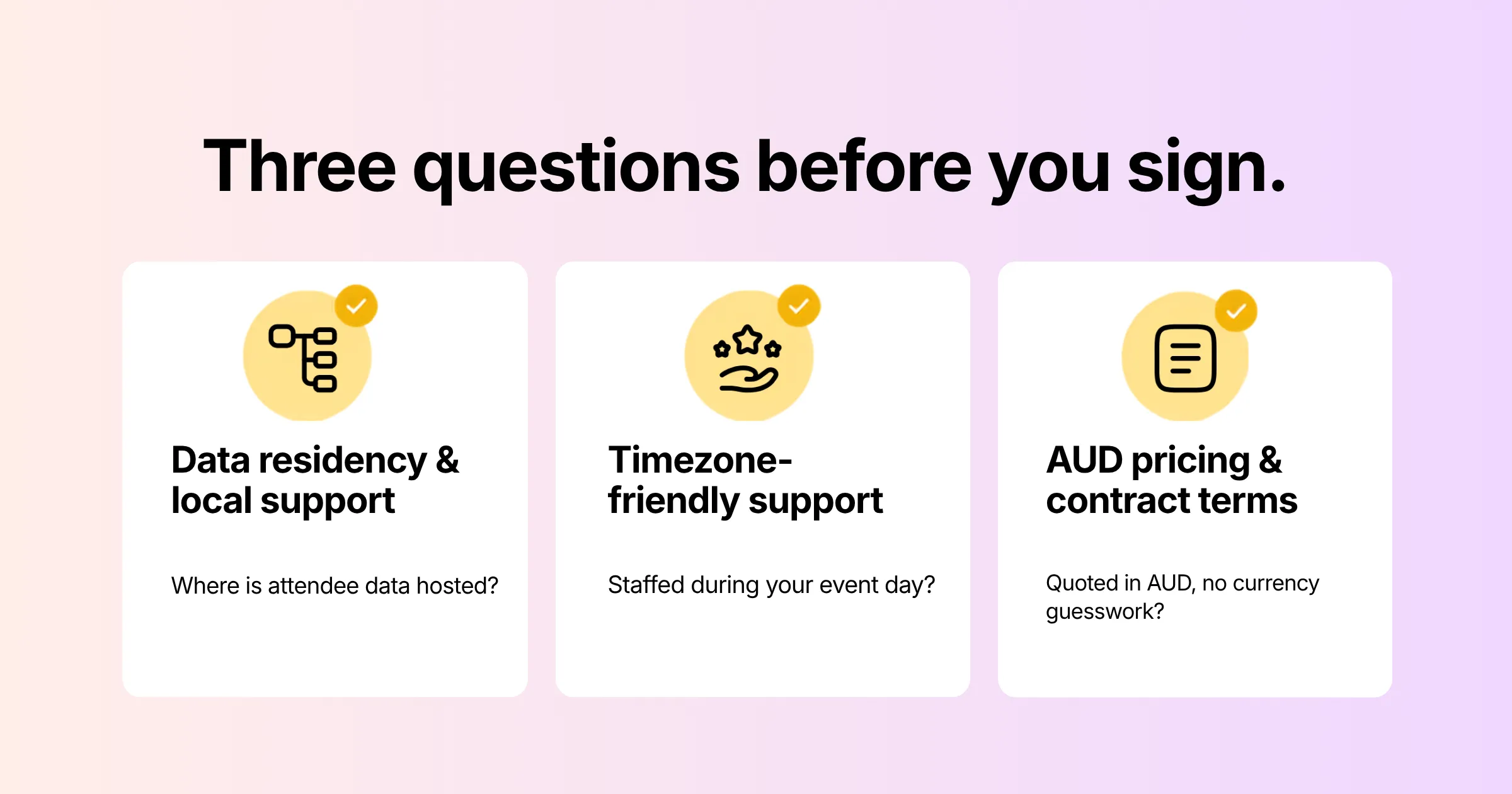
Ask directly where the vendor hosts and processes attendee data. Also ask whether it can meet your organisation’s privacy requirements under Australian expectations. This matters most for government, higher education, and healthcare-adjacent associations evaluating event management software Australia wide. That said, it’s worth confirming with any vendor you’re considering rather than assuming.
Timezone-Friendly Support
A platform’s support quality on paper doesn’t tell you much if the support desk sleeps through your event day. When you’re evaluating conference management software Australia teams can rely on, ask what hours the vendor actually staffs support. Also find out whether there’s a local or APAC contact, and how escalation works during a live event. That’s often the single biggest quality-of-life difference between vendors. Two options can look similar across event management software Australia comparisons and still differ here.
AUD Pricing and Contract Terms
Confirm whether the vendor quotes pricing in AUD or USD. Ask how it handles currency fluctuation over a multi-year contract. Check whether the model charges per event, per registration, or a flat annual license. Event management software Australia pricing varies widely on this point. One model charges per registration. Another bundles unlimited registrations into a license, like the one EventsAir uses. That difference can swing your total cost significantly. So put that question to every vendor on your list. A quote-based model can hide real costs behind a friendly sales call.
EventsAir vs. Gevme vs. Cvent: A Straight Comparison
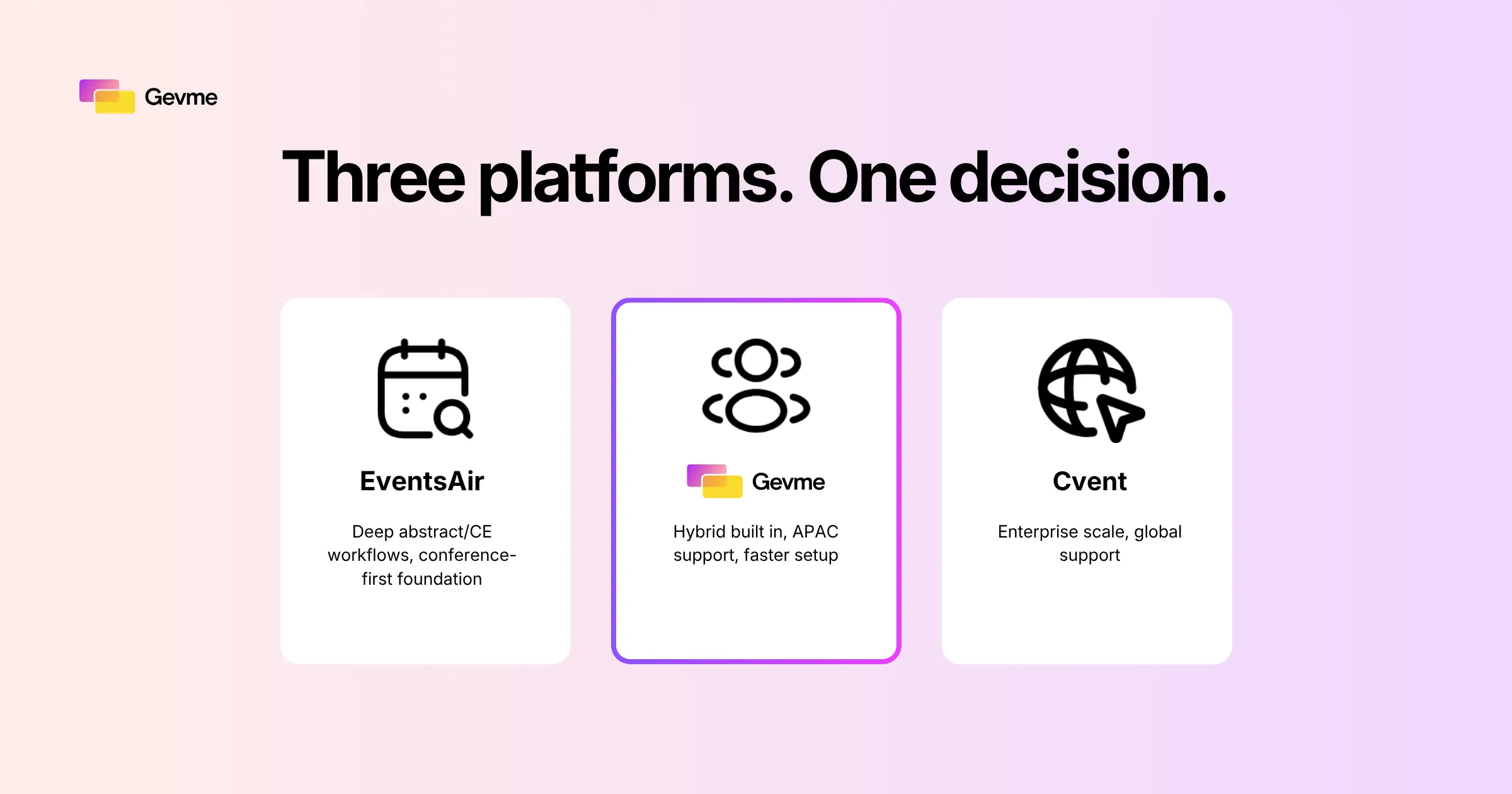
There’s no shortage of EventsAir alternatives, from Cvent at the enterprise end to smaller specialist tools. Rather than covering every one, here’s a direct comparison of EventsAir, Gevme, and Cvent. Cvent is another enterprise player that buyers frequently shortlist alongside EventsAir. The table covers the dimensions that matter most when choosing conference management software Australia wide.
| Dimension | EventsAir | Gevme | Cvent |
|---|---|---|---|
| Hybrid and virtual support | Available, added onto a conference-first foundation | Built in from the ground up, not an add-on | Available, strong at enterprise scale |
| Data unification | Strong within its own modules, less unified across virtual add-ons | Registration, check-in, and engagement data live in one dashboard by default | Strong, but often requires enterprise-tier packages |
| Support model | Standard 24/7 support on the Single plan, premium 24/7 support on Multi and Enterprise | APAC-based support with timezone-aligned coverage | Global support, enterprise-tier response times |
| Best fit | Associations, medical and scientific conferences with heavy abstract and CE workflows | Hybrid and virtual programs run by APAC teams that want one dataset | Large corporate events and multi-brand portfolios at enterprise scale |
Where These Comparison Points Come From
EventsAir’s plan structure, unlimited registrations, and support tiers above come from EventsAir’s pricing page. Those details are current as of August 3, 2026. We don’t have a reliable source for setup or onboarding timeframes across EventsAir, Gevme, or Cvent. So that comparison doesn’t appear above. In practice, setup time depends more on your team’s internal resourcing and event complexity than on any platform benchmark. That’s exactly why the pro tip further down recommends running a real event in parallel before you commit.
Fit Matters More Than Feature Count
None of this claims that EventsAir or Cvent are weaker products. It doesn’t claim that paying for EventsAir lacks justification for the right team either. Both are well-established platforms with real strengths, especially for the audiences they serve. This comparison is about fit, not about one platform being universally better. Your events might be shifting toward hybrid formats. You might want registration and on-site data in one place without extra configuration. That’s the specific gap Gevme aims to close. It targets event management software Australia teams running events across the wider APAC region.
Your events might increasingly involve complex on-site check-in alongside virtual attendance. In that case, look at how on-site event management works when it shares data with your registration and virtual tools. The alternative is a separate system running on its own. That’s usually where the gap becomes most obvious in practice. On-site data is exactly the piece that tends to get stranded in its own silo.
A Decision Framework: Who Should Switch to EventsAir Alternatives
Not everyone evaluating other options should actually switch. Here’s a practical way to think about it.
Stay with EventsAir if…
Your events are association or medical conferences with heavy abstract review and CE tracking needs. This is EventsAir’s strongest ground, and few alternatives match its depth here.
Your team already knows the platform well. The learning curve is a one-time cost. If you’ve already paid it, switching resets that investment.
Your event volume justifies the price. You might run enough events per year that unlimited registrations and bundled features deliver clear value. In that case, the cost equation likely still works.
Look at EventsAir alternatives if…
Hybrid and virtual formats are a permanent part of your program, not a one-off pandemic-era experiment. Therefore you want that capability built in rather than bolted on.
You’re paying for capability you don’t use. A smaller event calendar with simpler needs may suit something priced closer to your actual usage.
You want one dataset instead of three exports. Your team might spend more time reconciling spreadsheets than analysing results. In that case, data unification alone can justify the move.
Timezone-aligned support matters to your operation. Slow response times from another region can consistently frustrate your event days. That’s a legitimate reason to look at other conference management software Australia teams are adopting.
Pro Tip:
Before you sign anything, run one real event on the alternative platform in parallel with your existing EventsAir setup. Skip the cold-turkey switch. A single side-by-side event tells you more about setup time, support responsiveness, and data unification. No demo or feature comparison ever will. That matters even more if you’re weighing several vendors at once. Demos rarely reveal real support response times during a live event.
Frequently Asked Questions
What are the best EventsAir alternatives for Australian event teams?
The right EventsAir alternatives depend on what you run. For associations and medical or scientific conferences with heavy abstract workflows, EventsAir itself often remains the strongest fit. Other teams need hybrid and virtual formats unified with on-site registration and check-in data, plus timezone-aligned APAC support. Gevme is one of the platforms built specifically for that combination.
How does EventsAir pricing actually work?
EventsAir pricing is tiered, per EventsAir’s own pricing page. There’s a Single Event plan and a Multi Event plan for organisations running three or more events annually. A custom Enterprise plan sits above both. The license fee includes unlimited registrations. However, EventsAir doesn’t publish exact figures. So you’ll need a quote based on your event volume before comparing EventsAir pricing against other options.
Is EventsAir good for associations and medical conferences?
Yes. This is where EventsAir has its strongest reputation. It offers dedicated abstract management, automated reviewer assignment, CE credit tracking, and member based registration pathways. Many alternatives don’t replicate those at the same depth. In fact, few competitors even attempt to match this level of depth for associations and medical conferences.
What should I look for in event management software Australia wide?
Beyond core registration and reporting features, prioritise data residency and support hours that align with Australian and APAC time zones. Also look for pricing quoted in AUD, with contract terms you can budget against. This applies whether you’re comparing EventsAir competitors or conference management software Australia vendors you haven’t heard of yet.
Why do teams switch from EventsAir to alternatives?
Three reasons come up most often. Hybrid and virtual formats can feel bolted onto EventsAir’s conference-first foundation. Pricing can stop matching the value for a smaller event calendar. And teams want registration, check-in, and engagement data in one dashboard instead of separate exports. Once those signals stack up, most teams start comparing options seriously. They stop treating it as a one-off frustration.
How long does it take to switch to a new platform?
As a general planning guideline, budget six to twelve weeks to move from EventsAir to a new platform. Adjust that for your data volume and how many past events need to migrate. Testing an alternative against a real, live event is the safest way to confirm the switch is worth it. Do that before you fully commit, rather than relying on a demo alone.
Is Gevme a direct competitor to EventsAir?
Gevme comes up most often as an EventsAir competitor for teams running hybrid and virtual programs alongside in-person events. That’s particularly true in Australia and the wider APAC region. For deep association and medical conference workflows specifically, EventsAir’s specialised depth remains a fair comparison point. It’s worth evaluating on its own merits.
Conclusion: Choosing Based on Where Your Events Are Headed, Not Where They’ve Been
EventsAir earned its reputation the hard way. It built genuinely deep tools for associations and scientific conferences that most general platforms don’t attempt. If that’s still what your event calendar looks like, it remains a credible, well-supported choice, EventsAir pricing included. Switching for the sake of switching rarely pays off.
But your events may have changed shape. There’s more hybrid now, and more virtual reach. There’s also more pressure to see registration and on-site data as one connected story. Three separate exports no longer feel enough. That’s a legitimate signal to evaluate EventsAir alternatives properly, instead of defaulting to what you’ve always used. The decision isn’t about which platform is objectively better. It also isn’t about whose pricing looks best on paper, or which vendor has the longest feature list. It’s about which one matches the events you’re running now, not the ones you ran five years ago.
Want to see how registration, check-in, and virtual attendance data can live in one system instead of scattered exports? If so, request a demo and walk through it with your own event scenario.