If you’re reading this, you’re probably an event planner, marketer, or ops lead. Maybe you’ve used Cvent, requested a quote from it, or spent a frustrating afternoon hunting for a Cvent price online and come up empty. You’re not imagining things. Cvent is one of the biggest names in event management software, and for good reason. It’s been around since 1999, and it counts a large share of the Fortune 100 as customers. Its venue-sourcing network alone touches hundreds of thousands of hotels and spaces worldwide. For a certain kind of enterprise program, that scale is hard to match. So why do so many teams still end up shopping for Cvent alternatives?
Because scale comes with trade-offs. Cvent doesn’t post pricing anywhere on its site. Every plan goes through a sales conversation, from a single-event registration page to a full enterprise rollout. For teams that just want to compare a few numbers before picking up the phone, that is a lot of friction for a fairly simple question.
This guide covers why teams end up shopping for Cvent alternatives in the first place, and what Cvent itself includes. It then compares pricing across seven other platforms, where pricing is available at all. After that, it looks feature by feature at registration, on-site check-in, and virtual and hybrid delivery. Finally, it offers a practical decision framework for picking the right fit for your team.
Key Takeaways
- Cvent does not list pricing publicly. Both its Professional and Enterprise tiers require a sales conversation, and its own site frames pricing as fully custom.
- Most Cvent alternatives follow the same pattern. Of the seven platforms compared here, only Bizzabo and Accelevents show a real starting number.
- Gevme is the exception. It shows full tiered pricing for both product lines, Virtual Venue and Registration. You get named tiers and dollar amounts rather than a single “contact us” button.
- Cvent’s biggest structural advantage is its Supplier Network. That venue-sourcing marketplace covers roughly 340,000 hotels and venues, and no other platform here offers anything comparable.
- Teams running one or two events a year usually want a fast, transparent quote. As a result, they gravitate toward platforms with published starting prices. Larger, multi-market enterprise programs may still find Cvent’s depth worth the sales process.
- Every platform here supports some form of on-site check-in and badge printing. However, the technology behind it varies a lot, from wireless no-technician setups to full kiosk hardware fleets.
- AI-branded matchmaking now shows up across most of these platforms in some form. How it works, and how much proof each vendor shares about it, differs quite a bit.
Why Teams Go Looking for Cvent Alternatives
The most common trigger is pricing opacity. Cvent’s own pricing page states plainly that pricing is custom to “your events, your team, and your goals.” No numbers are attached to either the Professional or the Enterprise tier. For a large enterprise team with a dedicated events budget, that is a normal way to buy software, because procurement is already built for vendor negotiations. For a smaller team, an association, or someone doing early-stage research on a Friday afternoon, it means every comparison starts with a phone call rather than a webpage.
The second trigger is complexity. Cvent’s product catalog is extensive: registration, OnArrival check-in, Attendee Hub, the Supplier Network, Cvent Appointments, Event Diagramming, abstract management, lead capture, webinars, and more. Each one has its own page and its own learning curve. That breadth is a genuine strength for large, multi-event enterprise programs. However, it can also mean a longer implementation timeline for a team that mainly needs registration, check-in, and a virtual component sharing the same attendee data.
Where Mid-Sized Teams Get Stuck
A third, more specific trigger shows up around mid-sized associations and corporate teams. These are groups running a handful of events a year rather than hundreds, and they often want three things at once. First, a platform that handles registration, on-site check-in, and virtual or hybrid delivery without stitching together separate tools. Second, pricing they can see before a sales call. Third, a support experience that doesn’t require a dedicated account team to navigate. That combination is exactly where most of the alternatives in this guide, Gevme included, try to compete.
What Cvent Actually Is
Cvent is a broad event management platform built primarily for enterprise programs. Its core pieces include a registration builder with AI-assisted site creation, branded as CventIQ. OnArrival handles on-site check-in and on-demand badge printing, while Attendee Hub acts as the engagement layer for both web and mobile. Cvent Appointments covers AI-driven attendee matchmaking and meeting scheduling. Layered on top of all that is the Cvent Supplier Network, a venue-sourcing marketplace. Planners can send one RFP to multiple hotels and venues, then compare bids side by side. Cvent states that planners have sourced more than $20 billion in business through the network, with over 3 million RFPs sent.
Cvent by the Numbers
Cvent’s own numbers paint a picture of serious scale: 34,000-plus customers, 445,000 active users, and more than 8 million events run on the platform since 1999. Its marketing leans heavily on Fortune 100 usage and named enterprise customers like Walmart. There’s also a lower-friction Professional tier and a product called Cvent Essentials, aimed at higher-volume, lower-complexity events. In other words, it isn’t strictly an enterprise-only tool. Still, the center of gravity is clearly large organizations with dedicated events teams and the bandwidth for a sales-led buying process.
Pricing: What’s Public and What Isn’t
Here’s what each platform shows, or doesn’t show, on its own site, checked in late August 2026.
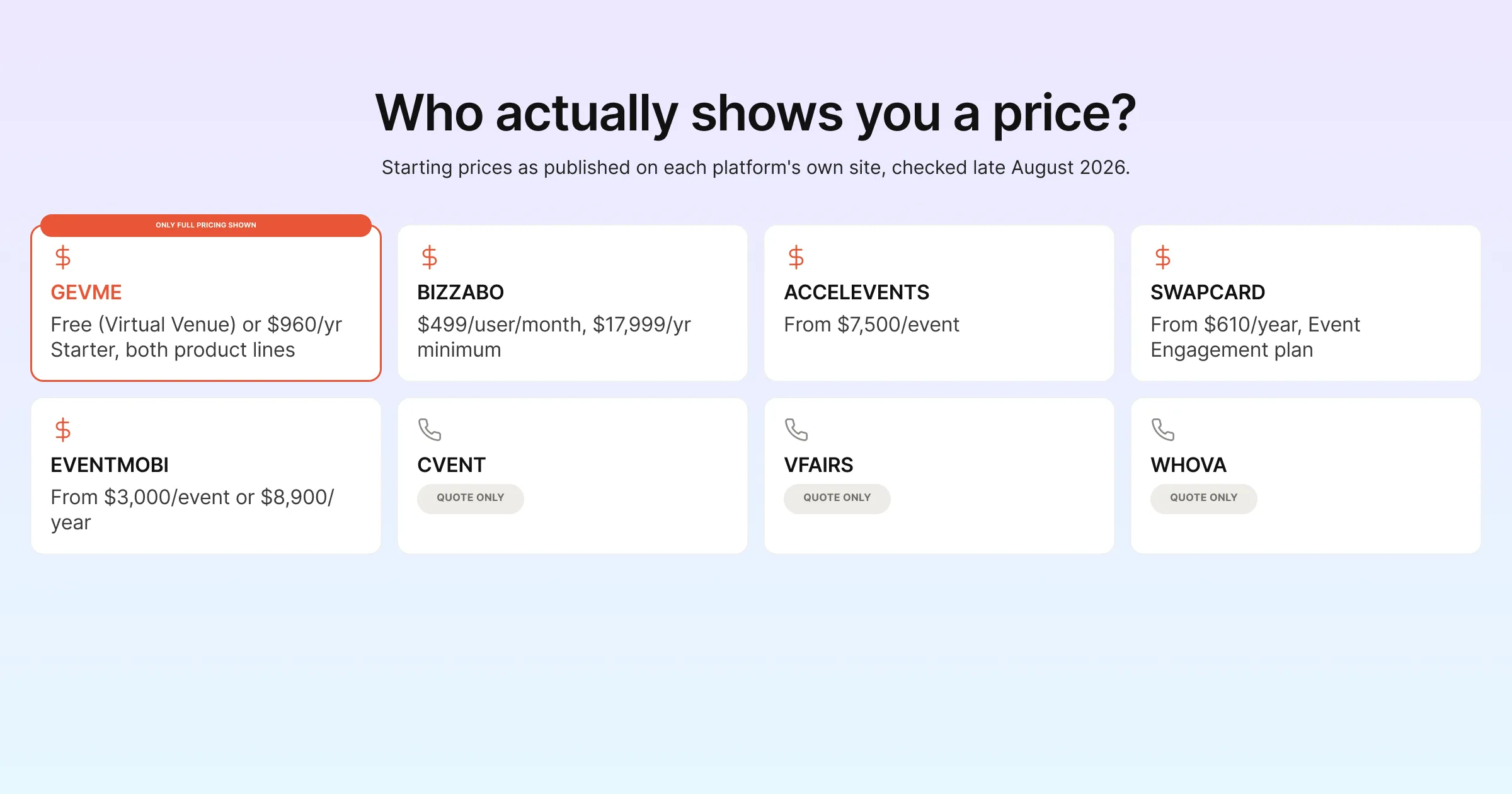
Cvent doesn’t list any pricing at all. Its pricing page offers two named tiers, Professional and Enterprise. They are distinguished mainly by user-login limits, 15 for Professional and unlimited for Enterprise. Every plan requires a quote request.
Gevme is the one platform here with full tiered pricing visible on its pricing page. It’s split cleanly into two separate product lines rather than one blended number. The Virtual Venue Platform runs Free, then Starter at $960 a year, then Pro at $2,160 a year, then a custom Enterprise tier. The Registration Platform has no free tier. It runs Starter at $960 a year, Pro at $2,160 a year, and a custom Enterprise tier. Buying both product lines means two separate purchases rather than one combined plan.
Bizzabo shows a real number too. Its Event Experience OS starts at $499 per user per month, or $17,999 a year with a three-user minimum, per its pricing page. Add-ons like the Klik SmartBadge hardware, virtual event tools, and premium integrations are quote-based on top of that.
vFairs, Whova and Swapcard: Mostly Behind a Quote
vFairs keeps pricing fully behind a quote request. Its pricing page states that organizers “pay only for what your events actually need,” with no dollar figures shown anywhere.
Whova also has no numbers on its site. The Whova pricing page is essentially a quote-request form. It asks about event format, size, and frequency, then offers a demo in place of a price list.
Swapcard sits in between. Its main pricing page names Starter, Professional, and Enterprise tiers based on attendee volume, without dollar amounts. A second page, Swapcard’s plans overview, lists its self-service Event Engagement plan starting at $610 a year, before volume and feature upgrades apply. Its Registration and Management Platform stays fully quote-based.
Accelevents and EventMobi: Floor Prices Published
Accelevents shows starting prices for its two lower tiers on its pricing page. Professional starts from $7,500 for a single event, and Business from $13,500 for unlimited events. Enterprise and White Label stay custom.
EventMobi publishes floor prices on its pricing page. Plans start at $3,000 per event or $8,900 a year for unlimited events. Add-ons like virtual streaming, pre-printed badges, and integrations are priced separately, so final cost stays quote-based beyond that starting point.
None of this is locked in stone. Vendors update these pages often enough that a number from last quarter can already be wrong.
Feature-by-Feature: What Each Platform Offers
Event Registration
Every platform here covers the basics: branded registration pages, custom fields, ticket types, and payment processing. The differences show up in the details. Cvent’s registration sites lean on CventIQ to speed up build time. They also connect natively to Salesforce, HubSpot, and Marketo, among 40-plus integrations. Gevme’s registration platform offers multi-step forms, prepopulation for returning attendees, multilingual forms, and waitlists with automated notifications. It also includes its own in-platform payment tool, Gevme Wallet.
Bizzabo adds a referral tool called Ticket Boost and a re-engagement feature called Hot Leads. vFairs and Whova both support conditional-logic forms and multi-language registration. vFairs also cites GDPR and PCI DSS compliance directly on its registration page. Swapcard and Accelevents both support conditional forms tied to attendee type. Accelevents goes further with niche fundraising features like auctions and text-to-give that the others don’t touch. EventMobi’s registration supports 19 languages with automatic timezone detection, a nice detail for globally distributed audiences.
On-Site Check-In and Badging
This is where the hardware story diverges the most. Cvent’s OnArrival supports wireless, on-demand badge printing. It also offers both self-service and Cvent-staffed check-in options. Gevme’s on-site check-in covers QR-code, facial-recognition, and ID-scanning check-in. It comes with its own kiosk hardware line, Model S, Model T, and Counter Set, built for mass device deployment. Bizzabo pairs its Onsite Command App with the Klik SmartBadge, a wearable badge built for tap-to-connect networking as much as check-in. For smaller events, Bizzabo rents out a kit called the Bizzabox.
vFairs and Whova both offer QR-based check-in and on-demand badge printing, and vFairs supports facial recognition too. EventMobi goes the opposite direction from kiosk hardware. Its BadgeON station uses wireless printers that, per EventMobi, event staff can set up themselves without a technician. Swapcard’s SwapAccess and Swapcard Go bundle offer a similar turnkey setup, claiming a sub-hour install even at large trade-show scale. Accelevents rounds this out with a drag-and-drop badge designer and standard QR check-in.
Virtual and Hybrid Capabilities
Cvent frames its offering as “one event platform, two experiences.” It combines in-person and digital delivery from a single build, with AI-powered networking and a broadcast-quality video layer inside Attendee Hub. Gevme’s virtual venue platform takes a no-code, template-driven approach instead. There are more than 50 themes and experiences to start from, plus a modular content-block editor. RTMP channel streaming is available on its Enterprise tier, alongside live chat, direct messages, Q&A, and polls.
It’s worth being direct here. Gevme is not an onsite-only tool that happens to have a virtual add-on. Virtual delivery is one of its two core product lines, built with the same visual-editor depth that vFairs is known for. Because the two lines share the same attendee data as Gevme’s registration and on-site products, nothing has to be reconciled afterward.
vFairs remains one of the more visually elaborate options in this group. It offers 3D and page-based virtual booths, animated avatars, and an animated lobby as the main navigation hub. That makes it a genuinely strong fit for organizers who want a highly produced virtual environment. Whova and EventMobi both support livestream integration with Zoom or Microsoft Teams alongside on-demand content libraries. EventMobi goes further with three distinct hybrid formats, depending on whether virtual sessions run alongside, after, or on separate days from the in-person program.
Bizzabo’s virtual and hybrid layer is called The Venue. It centers on a visual-forward destination with pre-session lounges and a centralized Command Center for organizers. Accelevents runs its own production layer, Accelevents Studio, for livestreaming and on-demand replay. Swapcard’s virtual and hybrid support is thinner on documentation. It is mentioned mainly as an included feature on the Event Engagement plan rather than broken out into its own product page.
Support and Security
Cvent, Gevme, vFairs, Swapcard, and EventMobi all cite standard compliance frameworks like GDPR. Several of them, namely Cvent, Swapcard, and EventMobi, name SOC 2 or ISO 27001 certifications directly on their sites. Accelevents advertises 24/7 support across every tier with an average 21-second response time. Whova promises sub-30-minute response during business hours. On both Gevme product lines, the Enterprise tier adds dedicated premium support and enterprise-level security on top of what Starter and Pro include.
A Few Terms Worth Knowing
- RFP (Request for Proposal): A formal document event planners send to venues or vendors asking for pricing and availability. Cvent’s Supplier Network is built around sending one RFP to many venues at once.
- Hybrid event: An event that runs in-person and virtual sessions at the same time, or in some combination, so both in-room and remote attendees can take part.
- On-demand badge printing: Printing name badges one at a time as each attendee checks in, instead of pre-printing the full list in advance. It cuts down on wasted badges, and it lets you handle late registrations without a reprint run.
- AI matchmaking: Software that suggests which attendees, sessions, or exhibitors a given person should connect with. It works from their profile, stated interests, and behavior at the event, rather than making attendees search a directory manually.
Cvent Alternatives Compared
| Platform | Starting Price | Registration | On-Site Check-In | Virtual/Hybrid |
|---|---|---|---|---|
| Gevme | Free (Virtual Venue) / $960 per year (Starter, either product line) | Multi-step, multilingual forms, waitlists, automation | QR, facial recognition, ID scan, kiosk hardware | No-code builder, 50+ themes, RTMP on Enterprise |
| Cvent | Quote based, no published numbers | AI-assisted site builder, 40+ integrations | OnArrival wireless badge printing | Attendee Hub, AI networking, broadcast video |
| Bizzabo | $499 per user per month ($17,999 per year minimum) | Ticket Boost, Hot Leads, CRM enrichment | Klik SmartBadge wearable, Onsite Command App | The Venue, pre-session lounges |
| vFairs | Quote based, no published numbers | Conditional logic, multilingual, GDPR/PCI DSS noted | QR, facial recognition, kiosks | 3D/animated booths, AI matchmaking |
| Whova | Quote based, no published numbers | Group bundles, abandoned-registration recovery | QR scanning, 17 badge templates | Zoom/Teams livestream integration |
| Swapcard | From $610 per year (Event Engagement plan) | Conditional forms by attendee type | SwapAccess, Swapcard Go hardware | Included in Event Engagement plan |
| Accelevents | From $7,500 per event | Fundraising add-ons (auctions, text-to-give) | Drag-and-drop badge designer, QR check-in | Accelevents Studio production |
| EventMobi | From $3,000 per event or $8,900 per year | 19-language support, timezone detection | BadgeON wireless, no technician needed | Three hybrid formats, native VOD |
Sources, checked in late August 2026, are each platform’s own pricing or product pages: Gevme, Cvent, Bizzabo, vFairs, Whova, Swapcard, Accelevents, EventMobi. Vendor pricing pages change often. Confirm directly before you budget against any figure here.
Who Should Choose Which
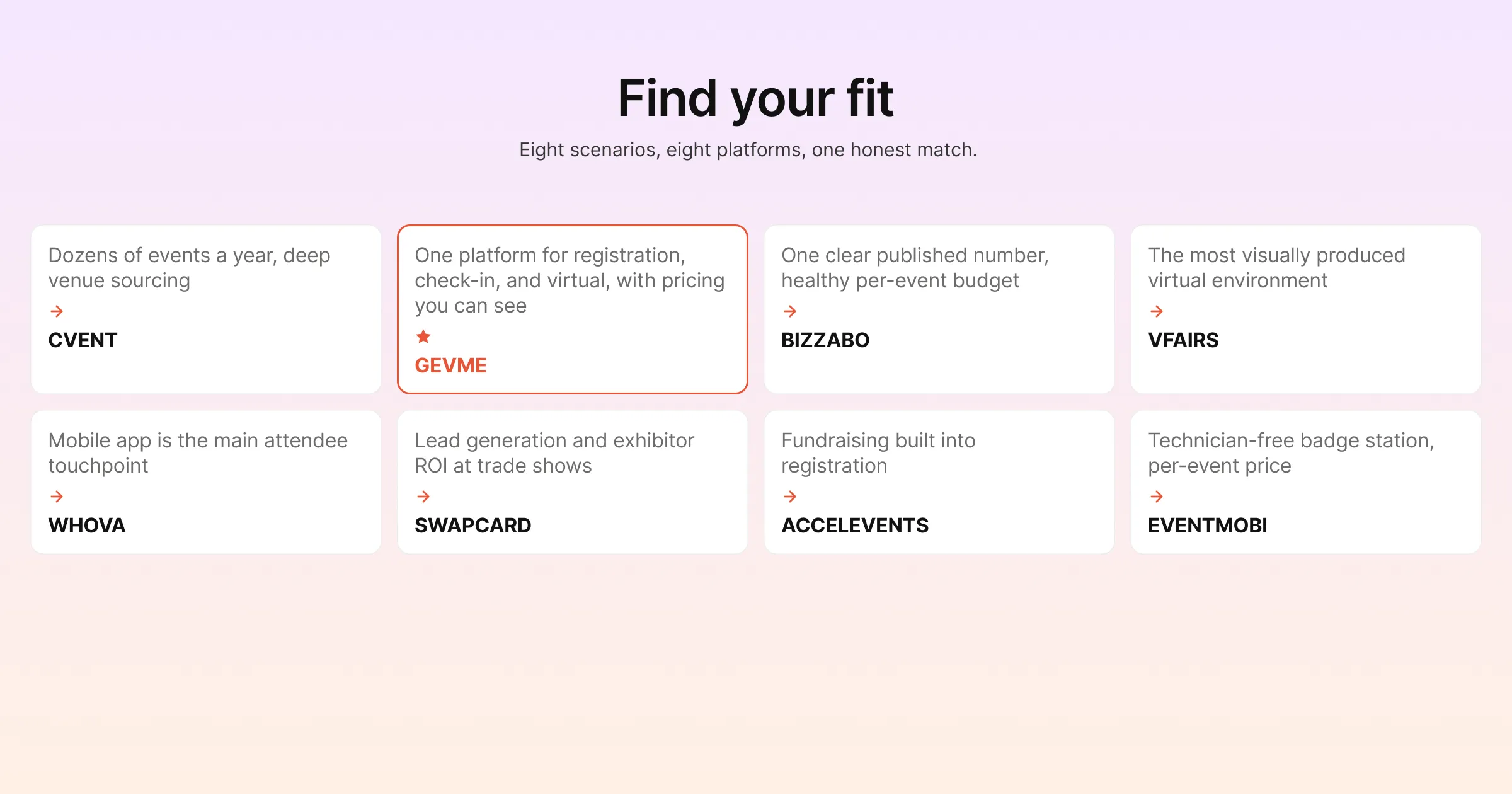
Does your program span dozens of events a year across multiple regions? If it also needs deep venue sourcing, and you have a procurement team built for a sales-led buying process, Cvent is hard to replace with anything in this list. Its depth and the Supplier Network simply don’t exist anywhere else here.
Perhaps you want registration, on-site check-in, and virtual delivery on one platform, sharing the same attendee data, with pricing you can see before you talk to anyone. Gevme covers all three without forcing a call just to compare starting numbers. Its business matchmaking is available from the Pro tier up on the Virtual Venue side.
Teams with a healthy per-event budget often want one clear published number instead. In that case, Bizzabo’s $499-per-user pricing is about as transparent as it gets among enterprise-grade options. That said, the three-user minimum and add-on costs mean the final bill grows quickly.
Where an event leans heavily virtual and you want the most visually produced environment on this list, vFairs is worth a serious look. It fits particularly well for trade shows, career fairs, or conferences where the “walk the show floor” feeling matters.
Apps, Lead Generation and Fundraising
Some teams run conferences or association events where the mobile app is the main attendee touchpoint. For them, Whova’s app-first approach makes sense. Its broad customer base across universities, government, and associations backs that up.
When lead generation and exhibitor ROI are the main goals, and you’re running trade shows or B2B conferences, Swapcard is built specifically for that use case. Its AI matchmaking stack and revenue-first positioning are the reason.
Should your events include a fundraising component alongside standard registration, Accelevents stands alone. It is the only platform here with auctions, raffles, and text-to-give built in natively.
Finally, you may want a wireless, technician-free badge station and a straightforward per-event price. EventMobi’s BadgeON system is a genuinely practical option for teams without dedicated on-site AV staff.
Pro Tip
Before you commit to any platform based on its stated starting price, ask each vendor for a sample quote. Base it on your actual attendee count and feature list rather than the starting number alone. Several platforms in this comparison, including Swapcard, Accelevents, and EventMobi, use volume-based or per-event pricing. As a result, the total can climb well past the homepage number once you add virtual streaming, integrations, or hardware rental. A real number for your specific event will tell you more than any pricing page can.
Frequently Asked Questions
The most common reasons are pricing that isn’t shown anywhere on the site, requiring a sales call just to get a number, and a large product catalog that can take longer to learn than a smaller team needs for registration, check-in, and virtual delivery.
Cvent does offer a lower-friction Professional tier and a product called Cvent Essentials for higher-volume, simpler events, so it isn’t off-limits for smaller teams. That said, its marketing and scale are built around large enterprise programs, so smaller teams sometimes find the buying process heavier than they need.
Cvent doesn’t list a number anywhere on its site. Both the Professional and Enterprise tiers require a quote, and pricing depends on which products you need and how many user logins your team requires.
Gevme is the only platform in this comparison with full tiered pricing, including exact dollar amounts, visible on its site for both its Virtual Venue and Registration product lines. Bizzabo and Accelevents also show real starting numbers, though their final pricing depends on add-ons and quotes beyond that starting point.
Yes, every platform in this comparison offers some form of hybrid delivery. The depth varies: EventMobi explicitly supports three different hybrid formats, Gevme and vFairs both offer template-driven virtual environments alongside on-site tools, and Cvent, Bizzabo, and Accelevents each run in-person and virtual sessions from a single build.
It depends on how much hardware you want to manage. Gevme and Cvent both offer kiosk-style hardware for larger events, while EventMobi and Swapcard both emphasize wireless, low-setup badge stations aimed at teams without dedicated onsite technicians.
On most of these platforms, yes, to a degree. Gevme, for instance, sells its Registration Platform as a separate product line from its Virtual Venue Platform, so you can start with one and add the other later without switching vendors.
Conclusion: Weighing Scale Against Transparency
Cvent earned its reputation the hard way. Over more than two decades it built one of the largest venue-sourcing networks in the industry, plus a product suite deep enough to run global, multi-market enterprise programs. If that’s the scale you’re operating at, its breadth is a legitimate reason to stay, sales process and all.
For teams that don’t need that much surface area, the calculus looks different. Gevme brings registration, on-site check-in, and a template-rich virtual venue together on one platform, sharing the same attendee data. You can see pricing for yourself before you ever pick up the phone. Its Pro-tier business matchmaking and Enterprise-level RTMP streaming show it’s built for serious virtual and hybrid programs as much as in-person ones. If a platform you can price out on your own sounds like the right next step, request a demo and see how it fits your next event.