If you’re reading this, you’re probably not casually browsing. Maybe you just got off a call with Bizzabo’s sales team. Maybe you stared at a $17,999 minimum on the pricing page. Or maybe you spent an afternoon working out what your actual bill looks like. Add-ons and Klik SmartBadge wearables tend to enter the quote later. Searching for Bizzabo alternatives usually isn’t about disliking the product. It’s about wanting a straight answer to a question that shouldn’t be this hard to get.
Bizzabo built a genuinely capable platform for large-scale conferences and branded experiences. That’s not in dispute. What trips up event and marketing teams is usually the friction around the edges. Pricing needs a sales call before you see a real number. A three-user seat minimum doesn’t fit smaller teams. The platform covers enough surface area that new admins face a real learning curve. Reporting, meanwhile, draws complaints on sites like G2 and Capterra. Reviewers there often describe it as harder to get clean answers out of than it should be. None of that makes Bizzabo a bad tool. However, it does make the platform worth comparing against a few other options before you sign a year-long contract. That’s exactly why so many teams run their own evaluation before renewal season.
What Counts as a Bizzabo Alternative
Bizzabo alternatives are event management platforms that offer comparable registration, virtual, and hybrid event tooling. What differs is the mix of pricing transparency, setup approach, and contract flexibility. Gevme, for instance, focuses on transparent pricing and a more focused setup workflow for teams running frequent or varied events. Whova and Cvent compete on different strengths entirely: community-style networking in Whova’s case, deep enterprise scale in Cvent’s. So weigh the options against Bizzabo’s pricing, onboarding approach, and support model. That comparison is usually the fastest way to see which one actually fits your team.
This guide covers why teams start looking elsewhere in the first place and what Bizzabo does well. It also covers what’s publicly known about its pricing in 2026. Then comes a side-by-side comparison against Gevme and Whova, plus a closer look at other competitors worth knowing about. Finally, it gives you a straightforward framework for deciding whether switching makes sense for your team.
Key Takeaways
- Pricing opacity is the top driver. Bizzabo’s published rate starts at $17,999 per year with a three-user minimum. However, most real quotes involve a sales conversation once add-ons enter the picture.
- Bizzabo is a strong fit for large, brand-heavy conferences. Those teams also need the budget and internal resources to run a platform that has a genuine learning curve.
- Onboarding effort and contract length matter as much as feature lists. How fast you get a first event live depends more on your team’s bandwidth than on the platform alone. Besides, neither Bizzabo nor Whova commits to a fixed timeframe for it.
- No single alternative replaces Bizzabo feature for feature. Instead, Gevme, Whova, and Cvent each solve a different version of the same problem.
- Data unification is where platforms diverge most. How well registration, on-site, and engagement data connect determines how useful your post-event reporting actually is.
- The right decision depends on event volume and team size, not just on which platform has the longest feature list.
- Comparing Bizzabo’s published pricing against the alternatives is worth doing before renewal. In practice, a side-by-side comparison takes less than an afternoon once you have real numbers in front of you.
Why Event Teams Search for Bizzabo Alternatives in the First Place
Nobody starts evaluating alternatives to Bizzabo on a whim. It’s usually one of a handful of recurring frustrations. These show up consistently in reviews on G2, Capterra, and TrustRadius. Understanding what drives the search helps you weigh Bizzabo’s competitors against the right criteria. Otherwise you end up just collecting a longer feature list. Here are the four reasons that come up most.
Bizzabo Pricing Opacity and the $17,999 Floor
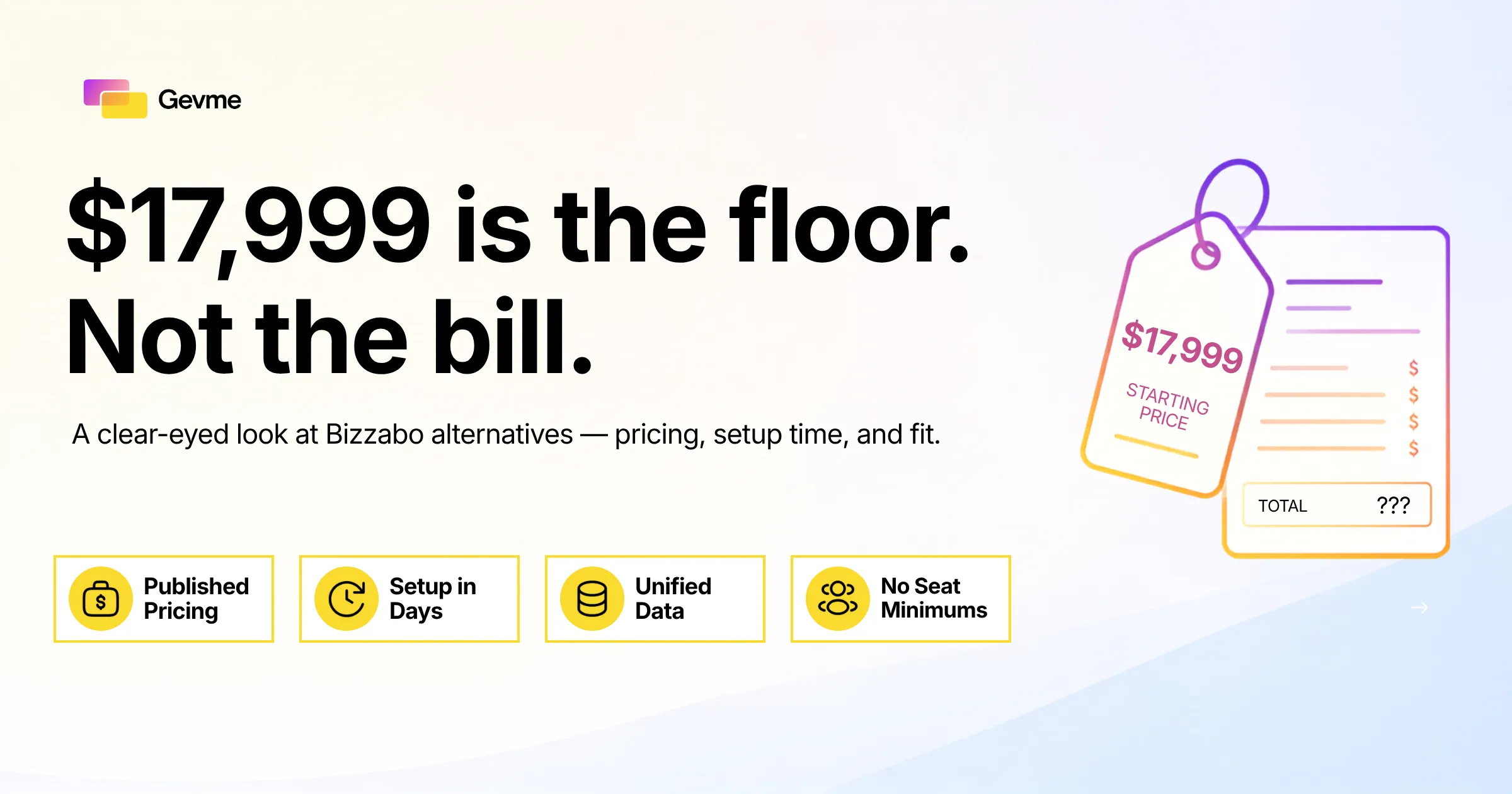
Bizzabo’s own pricing page confirms a starting rate of $499 per user per month, billed annually, with a three-user minimum. That works out to a floor of $17,999 per year, per Bizzabo’s pricing page. Publishing that number at all puts Bizzabo ahead of some competitors. In practice, it’s the first data point teams cite once they start comparing options side by side. But it’s a floor, not a ceiling. Bizzabo prices premium add-ons, the Klik SmartBadge wearable line, and professional services separately. Its own page also describes that pricing as variable and customized per event. For a team trying to budget a full year of events in advance, that’s a problem. The number on the page is rarely the number on the final invoice. That gap is the single biggest reason evaluations of Bizzabo alternatives start in the first place.
Seat Minimums and Contract Terms
A three-user minimum plus annual billing works fine for a dedicated events team running a heavy calendar. But it fits less well for smaller teams and agencies managing client events. The same goes for organizations that only run two or three events a year. Those teams rarely want to commit to an annual contract just to get started. Bizzabo’s own pricing page confirms that structure, and it leaves less room for self-serve or month-to-month flexibility. As a result, seat count and contract length keep coming up when people compare their options.
Onboarding Effort and Platform Complexity
Bizzabo’s Event Experience OS covers a lot of ground. Registration, ticketing, website building, mobile apps, email campaigns, and analytics all live under one roof. Bizzabo itself describes the onboarding as “curated” rather than self-serve, without committing to a specific number of days or weeks. We couldn’t find an independent review that pins down a reliable figure either. What’s fair to say is that breadth is a genuine selling point. It also means new admins face a real learning curve. Teams without a dedicated event operations person often say the platform takes more hands-on effort than a narrower tool would. Because of that, they start scoping alternatives before the contract renews.
Reporting and Customization Gaps
Two complaints surface more than others across public review platforms. First, analytics and reporting are functional but not always easy to turn into a quick, specific answer. Second, the website builder and registration logic, while capable, can feel restrictive for a highly custom flow. Neither issue is disqualifying on its own. Together, though, they explain a meaningful share of the searches for event management alternatives that mention Bizzabo by name. As a result, plenty of teams go looking for something that makes reporting simpler out of the box.
What Bizzabo Actually Does Well
Bizzabo earns its market position, and any honest comparison should say so plainly. Public reviews on sites like G2 and Capterra rate Bizzabo highly. In fact, it consistently lands among the higher-rated platforms in the enterprise event software category. That puts it ahead of plenty of competitors on raw feature depth.
Built for Large, Brand-Heavy Conferences
Bizzabo’s strongest use case is the large annual flagship conference where brand experience matters as much as logistics. The website builder produces polished, on-brand event sites, and the mobile app is full-featured. The Klik SmartBadge line also adds a physical layer of networking and lead capture. Few alternatives match it at the same depth.
Support Quality Reviewers Actually Praise
Support quality is a theme that comes up again and again in reviews, and Bizzabo backs it up. Every tier of the Event Experience OS includes a dedicated Customer Success Manager and tiered, 24/7 support. Customers describe that team as responsive and hands-on, which matters a lot when something breaks during a live event. So it’s a genuine strength, and one reason larger organizations with the budget for it stick with Bizzabo. It’s also a benchmark worth keeping in mind as you weigh Bizzabo against other platforms. After all, not every one of them matches that level of hands-on support.
Bizzabo Pricing in 2026: What’s Actually Public
Bizzabo’s pricing is more visible than a lot of enterprise event software, but it’s still not fully transparent. Here’s precisely what the company publishes, and what it doesn’t, before you weigh it against other options.
Bizzabo’s own pricing page confirms the core numbers directly. The Event Experience OS starts at $499 per user per month, billed annually, with a minimum of three users. That works out to a published floor of $17,999 per year. The tier includes unlimited events, registration, ticketing, contact management, and email campaigns. It also covers the website builder, the mobile app, analytics, curated onboarding, and support with a dedicated Customer Success Manager. Klik SmartBadge pricing stays off the page and requires a custom quote based on event size and scope. The same goes for anything Bizzabo categorizes as a premium add-on or professional service.
What isn’t public is anything beyond that entry point. There’s no published breakdown for mid-market versus enterprise tiers. There’s also no visible per-attendee or per-event pricing beyond the base seat cost, and no free trial. Most organizations end up paying more than the published floor. That’s because an actual quote reflects their real event volume and add-on needs. It happens simply because so much of the platform sits behind “contact sales.” Maybe your evaluation depends on knowing the total annual cost before you get on a call. If so, that’s a legitimate reason to widen your search. Look for platforms with published, all-in pricing rather than a starting number built around the smallest possible team.
Bizzabo Alternatives Compared: Bizzabo vs. Gevme vs. Other Options
No two event platforms serve the same team. The table below compares Bizzabo against Gevme and Whova, two of the more commonly searched alternatives. It covers the dimensions that affect day-to-day operations, not just the feature checklist most comparison pages lean on.
| Dimension | Bizzabo | Gevme | Whova |
|---|---|---|---|
| Setup time | No fixed timeline; Bizzabo frames onboarding as a “curated,” guided process | Built around a more focused core workflow, aimed at getting a first event live quickly | No fixed timeline; depends on how much app customization you need |
| Pricing transparency | Entry price published, add-ons and higher tiers require a quote | Published pricing tiers available upfront | Some starting prices published, enterprise tiers quote based |
| Virtual and hybrid support | Strong, built for large hybrid conferences | Strong, built around registration, on-site, and virtual data flowing together | Solid for community and conference style hybrid events |
| Data unification | Registration, on-site, and engagement data live across connected modules | Registration, on-site check-in, and engagement data unified in one system by design | Attendee engagement and networking data strong, less built around post-event data unification |
| Support model | Dedicated Customer Success Manager included at every tier | Direct support team, hands-on through setup and live events | Standard support tiers, community-oriented |
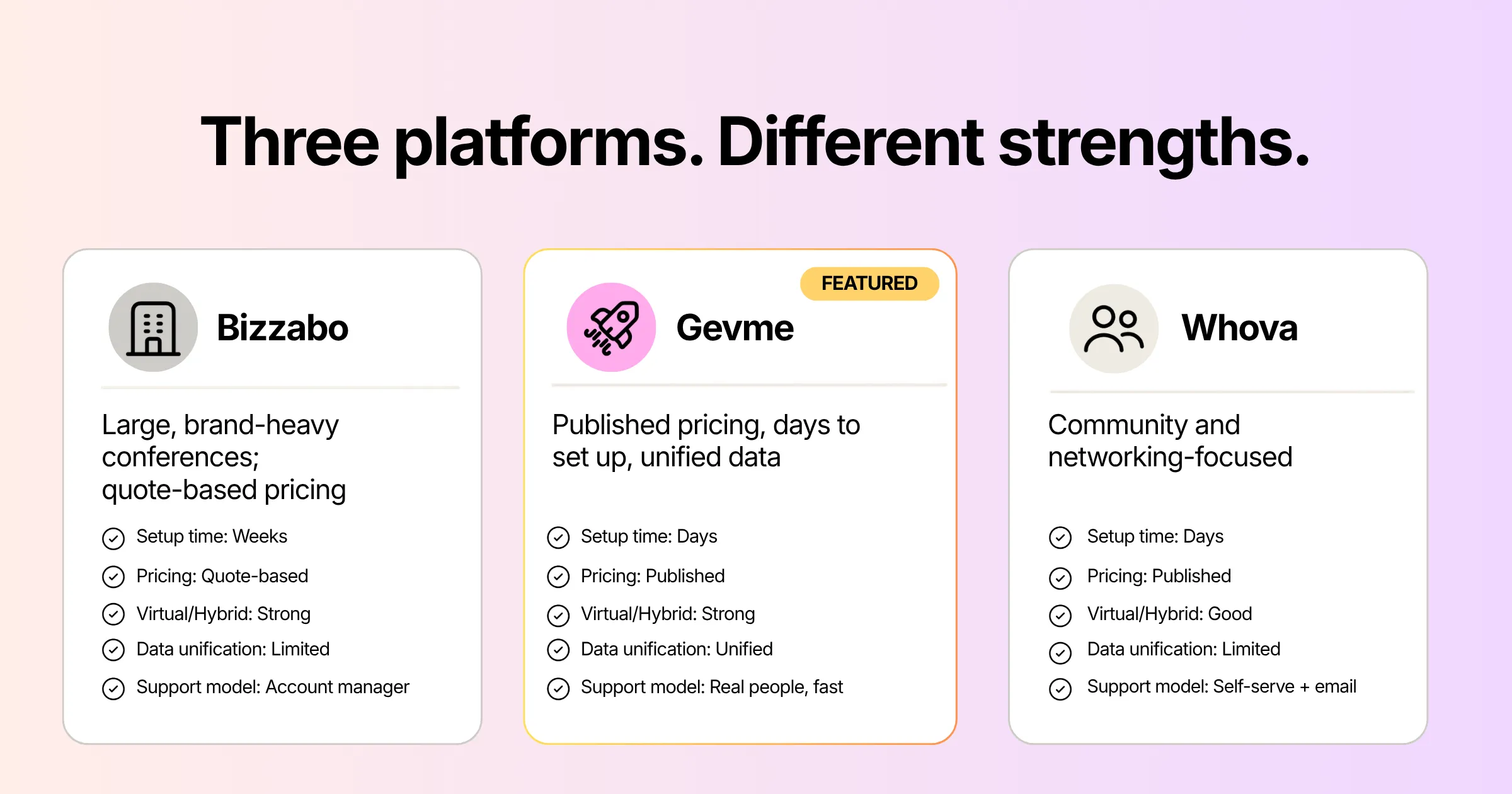
How to Read the Comparison Table
Sources: the Bizzabo figures above come from Bizzabo’s own pricing page, current as of August 3, 2026. Neither Bizzabo nor Whova publishes a specific onboarding or setup-time figure. Therefore the setup row above reflects what each vendor actually states rather than an assumed day or week count.
That side-by-side view is the fastest way to compare these platforms. It covers onboarding approach, support, and data handling. So pair it with the pricing figures above before you rule anything out.
Where Gevme Fits Among Bizzabo Alternatives
Gevme starts from a different assumption than Bizzabo’s Event Experience OS. Registration data, on-site check-in data, and post-event engagement data should live in one connected system from the start. The alternative is stitching it together after the fact. That shows up in two practical ways. First, Gevme publishes its pricing in tiers you can review before talking to anyone. Second, the core workflow stays more focused. As a result, a first event goes live faster than a broader, more modular platform typically allows. Many teams run a varied calendar, from small internal sessions to larger hybrid conferences. Yet they don’t want a different vendor for each format. For them, that combination tends to matter more than a longer feature list. That’s why Gevme comes up so often in these comparisons.
A Word on Whova, Cvent, and Other Bizzabo Competitors
Bizzabo isn’t the only enterprise-leaning platform worth comparing against Gevme. Whova is a strong option for community-driven and mid-size conferences. Networking and attendee engagement inside a mobile app are the priority there. Cvent, by contrast, sits at the other end of the spectrum. It’s an enterprise platform with deep venue sourcing and logistics tools. It serves organizations running large event portfolios with dedicated operations teams. Neither is a one-to-one substitute for Bizzabo. A full breakdown of how they and other registration platforms stack up deserves its own dedicated comparison. That goes beyond what fits here.
Who Should Actually Switch Away From Bizzabo
Not every Bizzabo customer should leave, and not everyone evaluating alternatives should assume switching is the right move. The honest answer depends on event volume, team size, and how much you value pricing transparency over brand polish. So a short decision framework helps more than another feature comparison at this stage.
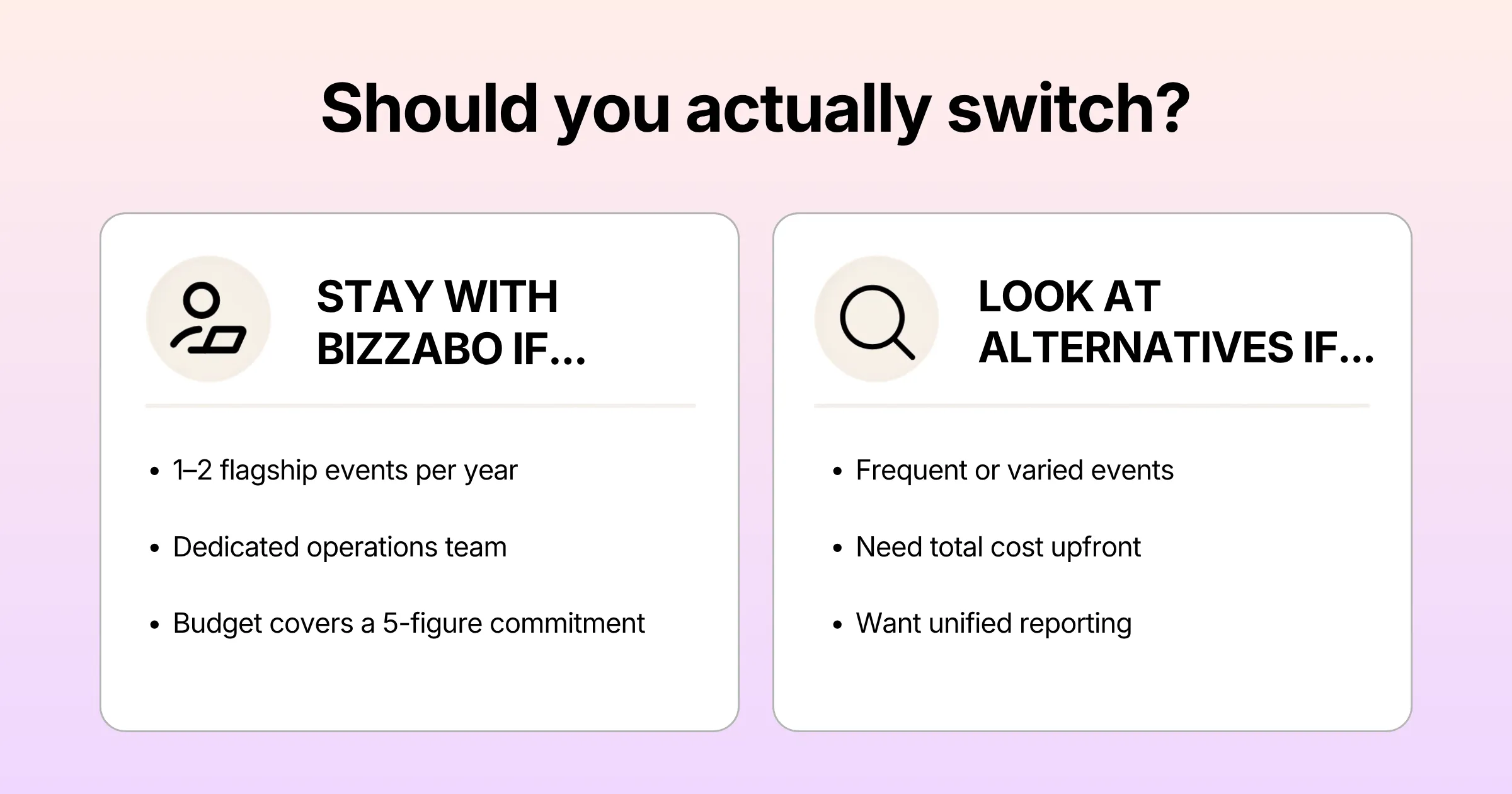
When It’s Time to Look at Bizzabo Alternatives
Some teams run a frequent or varied mix of events, from webinars to hybrid conferences to small in-person sessions. If that’s you, and you don’t want to pay flagship-conference pricing for the simpler ones, compare your options. The same goes if you need to know your total cost before committing to a contract. It applies too if a three-user minimum doesn’t match your team size. Finally, it applies if clean post-event reporting takes longer to produce than it should. Comparing a real published number against a sales-call quote is often enough on its own. In practice, that one exercise tells you which direction to take your search next.
Pricing transparency matters as much as features do. So see how Gevme’s transparent, simple event platform pricing works before you sign anything.
When Bizzabo Still Fits
Bizzabo remains a legitimate choice for some teams. Maybe you run one or two large, brand-critical flagship conferences a year. Perhaps you have a dedicated event operations team that can absorb the learning curve. And maybe your budget comfortably covers a five-figure annual commitment plus add-ons. In that case, the support quality and the depth of the platform pay off. On top of that, the Klik SmartBadge networking layer is genuinely hard to replicate elsewhere. Few alternatives try to compete directly at that scale; most aim at smaller, faster-moving teams instead.
Pro Tip:
Before you request a demo from any Bizzabo alternative, pull your actual event calendar for the next twelve months. Total the events by format (in person, virtual, hybrid). Then ask each vendor for one number that covers all of them, not just the flagship event. That number tells you whether their pricing model fits how you actually run events. It matters far more than how their sales page reads. Next, run that same math against Bizzabo’s published $17,999 floor. You’ll see fast whether it holds up once you factor in your real calendar. Do this for two or three vendors side by side and the right choice tends to become obvious. In practice that usually takes less than a day once you have the numbers in front of you.
Frequently Asked Questions
What are the best Bizzabo alternatives in 2026?
The strongest Bizzabo alternatives depend on what kind of events you run. Gevme fits teams that want transparent pricing and unified registration, on-site, and engagement data across a varied event calendar. Whova suits community and mid-size conferences focused on networking. Cvent, meanwhile, fits large enterprise portfolios with dedicated event operations teams. Running your own comparison across two or three of these before you commit is worth the afternoon it takes.
What is Bizzabo pricing like in 2026?
Bizzabo pricing starts at $499 per user per month, billed annually, with a three-user minimum. That works out to a published floor of $17,999 per year. Bizzabo’s own pricing page confirms it directly as of August 2026. Add-ons like Klik SmartBadge wearables and professional services carry separate pricing and require a custom quote. As a result, most real invoices end up higher than the published starting number.
Is Bizzabo good for small event teams?
It can work. That said, the three-user seat minimum and annual contract structure suit teams running a heavy calendar of larger events. Smaller teams, or organizations running only a couple of events a year, often find better cost and contract fit elsewhere. Several competitors built for lighter calendars publish flexible, tiered pricing upfront.
What is Bizzabo missing that alternatives offer?
Public reviews most often point to three gaps. First, reporting and analytics take extra work to turn into a clean answer. Second, registration and website customization can feel restrictive for complex flows. Third, pricing isn’t fully visible until you’re deep into a sales conversation. None of these are dealbreakers for every team. However, they’re the recurring reasons people start comparing Bizzabo against event management alternatives in the first place.
Is Gevme cheaper than Bizzabo?
Gevme publishes its pricing tiers upfront, so you can compare actual cost without a sales call. Bizzabo’s model works differently: the published $499-per-user starting price is a floor rather than a full quote. Whether Gevme is actually cheaper for your specific calendar depends on your event volume and format mix. A side-by-side quote from a few vendors will tell you that faster than any pricing page on its own.
How long does it take to switch event platforms?
Migrating away from Bizzabo mid-contract usually isn’t practical, so most teams plan the switch around a contract renewal date. Once you’ve chosen a new platform, setup for a first event varies. It typically ranges from a few days to a few weeks. The exact timeline depends on how much custom branding, registration logic, and integration work the event needs. That holds roughly true across most event platforms, not just Bizzabo alternatives.
Conclusion: Choosing the Right Platform, Not Just the Popular One
Bizzabo earns its reputation for a reason. It’s a capable, well-supported platform for large, brand-heavy conferences, and its published pricing and support model back that up. But capability at the high end doesn’t automatically mean it’s the right fit for every team. Consider pricing opacity beyond the floor, seat minimums, and the real effort of onboarding a broad platform. Those are all legitimate reasons to look elsewhere. That’s the gap Bizzabo alternatives aim to close.
The point of running this kind of comparison isn’t finding a platform with more features on paper. Instead, it’s finding one whose pricing model, setup approach, and data handling match how your team runs events. That could mean a single flagship conference a year. Or it could mean a steady calendar of webinars, hybrid sessions, and in-person meetups. So weigh the alternatives against your actual calendar, not against Bizzabo’s flagship use case. The right platform tends to stand out quickly once you’ve done the comparison yourself.
Your team may be ready to see what a transparent, unified alternative looks like in practice. If so, request a demo with Gevme and bring your real event calendar to the call.