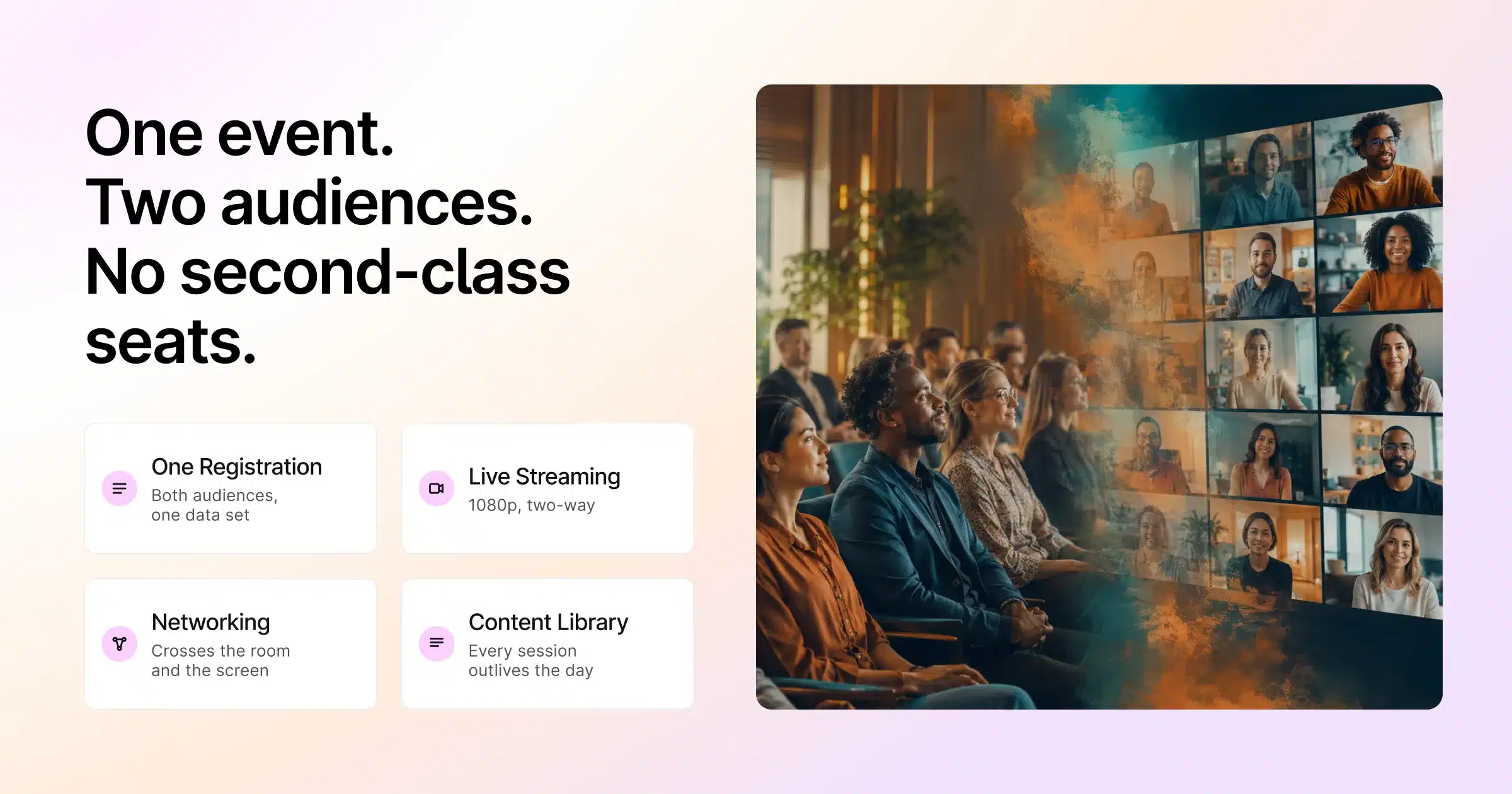
Here is the mistake almost every hybrid event makes: it runs a great in-person event and streams it to people who feel like they are watching through a window.
The room is buzzing. The stage looks good. And somewhere online, a few hundred people are staring at a static wide shot, unable to ask a question, invisible to everyone in the venue. They log off early, and next time they do not register at all. The event was technically hybrid. It just was not designed to be.
A real hybrid event is not an in-person event with a camera pointed at it. It is a single experience built for two audiences at once, where the person at home has as much of a seat at the table as the person in the third row. Getting there depends less on the venue and more on the hybrid event platform underneath it.
This guide covers what a hybrid event platform actually is, the features that decide whether your virtual audience stays or leaves, the mistakes that quietly kill hybrid events, and how to choose a platform that treats both rooms as one.
Key Takeaways
- A hybrid event is one experience built for two audiences, not an in-person event with a camera on it.
- A hybrid event platform unifies in-person and virtual: one system for streaming, engagement, registration, and data.
- The format’s strength is reach plus presence and a new revenue stream, plus content that lasts after the event.
- Virtual attendees judge everything by the screen, so streaming quality, two-way engagement, and cross-audience networking decide whether they stay.
- The biggest failure is treating virtual attendees as second-class. Rehearsals, dedicated bandwidth, and time-zone planning prevent the rest.
- The foundation is one integrated platform where data flows between both audiences.
What a Hybrid Event Platform Actually Is
A hybrid event platform is the software that connects your in-person and virtual audiences into one event, run from one place. It broadcasts live content to remote attendees, lets both audiences interact, and manages registration, engagement, and data for everyone through a single system rather than two disconnected ones.
The key word is single. Plenty of teams run a hybrid event by bolting a streaming tool onto an in-person setup and a separate app onto the virtual side. That technically works, but it splits the audience in two: two registration flows, two sets of data, two experiences that never meet. A true hybrid event platform keeps them unified, so a question from an online attendee can reach the stage and a poll on stage can include the people at home.
Hybrid vs. In-Person vs. Virtual: A Quick Comparison
| Format | Audience | Main Strength | Main Risk |
|---|---|---|---|
| In-person | On-site only | Energy, networking, presence | Limited by travel and capacity |
| Virtual | Remote only | Reach, low cost, easy scale | Weaker connection and attention |
| Hybrid | On-site and remote together | Reach plus presence, wider revenue | Neglecting the virtual audience |
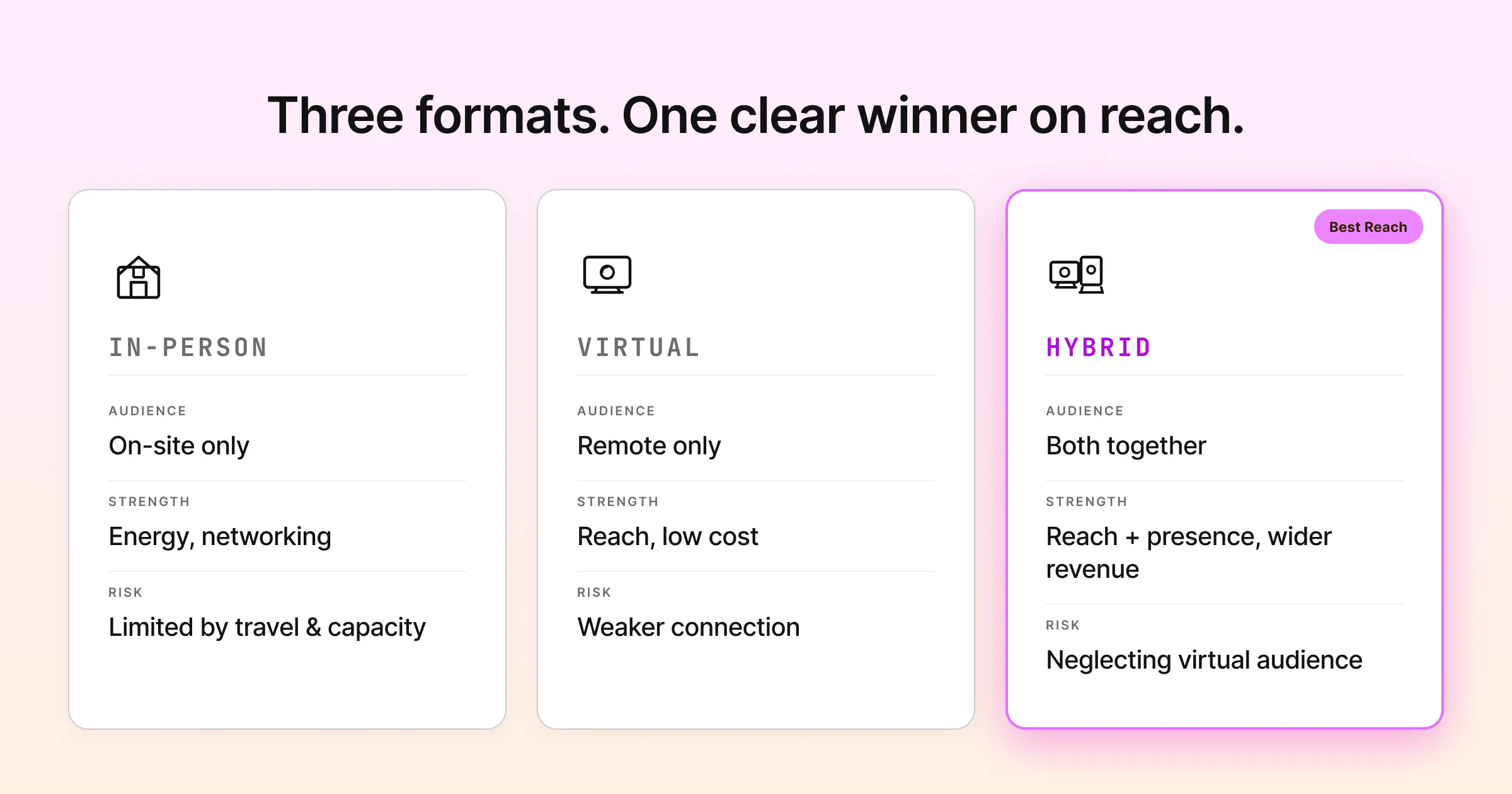
Hybrid offers the widest reach and the most flexible revenue, but it carries a specific risk that the other two do not: it is easy to run a hybrid event that quietly treats half the audience as an afterthought.
Why Run a Hybrid Event at All
When done properly, the hybrid format is not a compromise between in-person and virtual. It combines the strongest parts of both.
Wider Reach Without a Bigger Venue
A hybrid event removes the geographic ceiling. People who cannot travel, cannot afford the trip, or simply cannot spare the days can still attend. Your audience is no longer capped by the size of the room or the cost of getting there.
A New Revenue Stream
A lower-cost virtual ticket opens the event to people who would never have bought an in-person pass. That is not revenue you cannibalised. It is a new segment attending a version of the event that suits them, which makes the whole event more profitable.
Content That Keeps Working After the Event
A hybrid event is built to be recorded. Every session becomes an on-demand asset you can use for marketing, training, or member value long after the day itself. The event stops being a single moment and becomes a library.
Thinking about going hybrid? See how Gevme’s virtual event platform and on-site tools run in-person and remote audiences from one system.
The Features That Decide Whether Your Virtual Audience Stays
Virtual attendees judge your entire hybrid event by what happens on their screen. A handful of platform features decide whether they lean in or log off.
High-Quality, Reliable Streaming
This is non-negotiable. Remote attendees form their opinion of the whole event from the video quality. Look for a hybrid event platform that streams at 1080p or better and holds up under load. A blurry or buffering stream tells your online audience they are watching a second-rate version of the real thing.
Two-Way Engagement, Not Just Broadcast
The difference between watching and attending is interaction. Live polls, Q&A, and chat let remote attendees do more than consume, and crucially, those interactions should reach the room. When an online question is read out on stage, the virtual audience stops feeling invisible. Strong engagement tools are what turn a broadcast into a shared event.
Networking That Crosses the Divide
The hardest part of hybrid is connection between the two audiences. A good platform lets remote and on-site attendees find each other, book meetings, and exchange details, so networking is not a privilege reserved for people in the building. Business matching and digital profiles help bridge that gap.
One Registration and One Data Set
If your in-person and virtual audiences register through different systems, you end up with two data sets that never reconcile. A unified hybrid event platform captures both audiences in one registration flow, so you can see the full picture of who attended, how, and what they did. Gevme’s event registration software is built to handle both audiences in a single flow.
The Feature Behind All the Others
Every feature above depends on one foundation: an integrated platform where data flows freely between registration, content, and networking. When both audiences live in the same system, a poll, a question, or a connection can cross between them. When they live in separate tools, the divide is baked in from the start, and no amount of production polish closes it.
The Mistakes That Quietly Kill Hybrid Events
Most hybrid events do not fail loudly. They fail by neglect, in ways the in-person audience never notices.
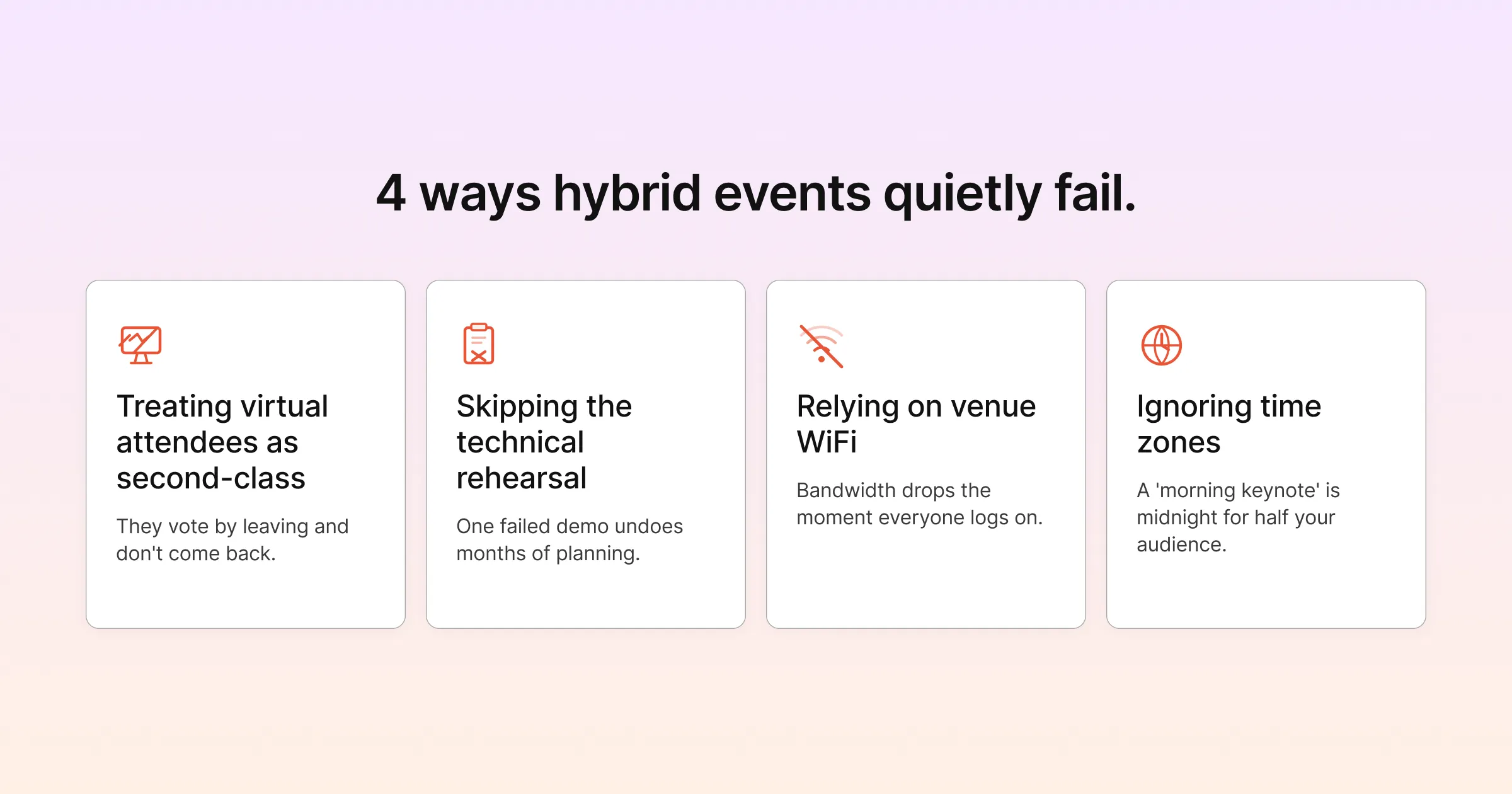
Treating Virtual Attendees as Second-Class
This is the big one. When the whole team focuses on the room and forgets the screen, remote attendees feel it immediately, and they vote by leaving. They will not attend the next one. Treating virtual attendees as first-class participants is the single most important habit in running a hybrid event.
Skipping the Technical Rehearsal
Speakers need practice with the platform, and every transition, slide, and video should be tested before the day. A hybrid event has more moving parts than an in-person one, and the seams show fastest on the virtual side. A rehearsal is not optional insurance. It is the difference between a smooth stream and a scramble.
Relying on Venue WiFi
Professional streaming demands serious, dedicated bandwidth. Hotel and venue WiFi rarely holds up when it matters. Always plan for a wired connection with a backup, because your entire virtual experience depends on that pipe staying open.
Ignoring Time Zones
A virtual audience is global. A 9 AM session in one city is the middle of the night in another. Building in on-demand access and considering session timing keeps your remote audience from being locked out by geography.
Pro Tip:
Put one person on your team in charge of the virtual audience only, with no on-site duties. Their whole job is to make sure remote questions reach the stage, polls include people at home, and the stream stays healthy. The single biggest reason hybrid events fail is that everyone gets pulled into the room and the screen becomes nobody’s responsibility. Give it an owner and half the problem disappears.
Frequently Asked Questions
What is a hybrid event platform?
A hybrid event platform is software that connects in-person and virtual attendees into a single event, run from one place. It streams live content to remote attendees, enables interaction for both audiences, and manages registration, engagement, and data through one unified system. The point is to keep the two audiences connected, so an online question can reach the stage and an on-site poll can include the people at home, rather than splitting the event into two disconnected experiences.
What is the difference between a hybrid event and a virtual event?
A virtual event has only remote attendees. A hybrid event has both a physical audience in a venue and a remote audience joining online, at the same time. The challenge unique to hybrid is connecting the two: making sure the virtual audience is not treated as a second-class version of the in-person one. That connection depends on a platform designed to run both audiences together rather than two separate tools stitched loosely at the edges.
What features should a hybrid event platform have?
Prioritise reliable high-quality streaming at 1080p or better, two-way engagement such as live polls, Q&A, and chat that reaches both audiences, and networking that lets remote and on-site attendees connect. Just as important is a single registration flow and one shared data set, so both audiences live in the same system. That integration is what lets interaction cross between the room and the screen, which is the whole point of running a hybrid event.
How do you keep virtual attendees engaged at a hybrid event?
Treat them as first-class participants, not viewers. Give them high-quality video, and use two-way tools so they can ask questions, vote in polls, and chat, with those interactions visible to the in-person room. Enable networking that crosses both audiences, and plan for time zones with on-demand access. The core principle is simple: whenever the on-site audience gets to interact, the virtual audience should get to interact too.
Is a hybrid event more expensive than an in-person event?
A hybrid event adds streaming and platform costs, but it also lowers some costs and opens new revenue. You reach people who would never travel, you can sell a lower-cost virtual ticket to a new segment, and you turn every session into on-demand content that keeps working after the day. For many organisers the wider reach and new revenue stream outweigh the added production cost, especially when both audiences run on one platform instead of two.
What is the biggest mistake in running a hybrid event?
Treating virtual attendees as an afterthought. When the team focuses entirely on the room and forgets the screen, remote attendees notice at once and leave, and they do not come back for the next event. The fix is to design for both audiences from the start, rehearse the technical flow, secure dedicated bandwidth, and use a platform that keeps both audiences in one connected experience.
Conclusion: Hybrid Works When It Is One Event, Not Two
The promise of a hybrid event is real. More reach, more revenue, and content that outlives the day. But that promise only holds when the event is designed as one experience for two audiences, not as an in-person event with the virtual side taped on.
That design choice lives in the platform. Choose one that keeps both audiences in a single system, where engagement and data flow between the room and the screen, and the person at home gets a real seat at the table. Do that, and hybrid stops being a compromise and becomes the most flexible, far-reaching format you run.
Ready to run in-person and virtual as one event? Explore Gevme’s approach to hybrid events, or request a demo to see both audiences managed from one platform.